Silence.
That is the first thing you notice when you stop thinking about Hollywood movies and start looking at what actually happened off the coast of China on a gray, salt-stung morning. For over a century, the defining soundtrack of naval power has been the ear-splitting, chest-rattling roar of human ambition strapped into a metal tube—the afterburners of a fighter jet screaming off a carrier deck while a twenty-two-year-old pilot fights three Gs of pressure just to keep their vision from graying out.
Then came the Sichuan. And with it, a flying wing without a cockpit, a canopy, or a heartbeat.
When Chinese state media confirmed that the People’s Liberation Army Navy had successfully executed take-off and landing trials for the GJ-21 stealth drone aboard its first Type 076 amphibious assault ship, the defense community did what it always does. Analysts pulled out their rulers. They measured wingspans, debated electromagnetic catapult frequencies, and published dry, clinical briefs that read like refrigerator manuals.
They missed the point entirely.
To understand what really occurred on that deck, you have to step away from the spreadsheets and stand on the steel. You have to smell the sharp, metallic tang of ozone and marine diesel, feel the vibration of a forty-thousand-ton hull cutting through choppy swells, and look at the empty space where a human being used to sit.
The Weight of an Empty Cockpit
Let us build a hypothetical scene to make the mechanics of this moment visceral, because military jargon is designed to numb us to reality.
Imagine a young naval aviator—let’s call him Lieutenant Chen, though he doesn’t exist in this cockpit, and that is the entire point. In a traditional carrier strike group, Chen is the most expensive, fragile, and irreplaceable component in the entire multi-billion-dollar ecosystem. Years of training, millions of dollars in flight hours, and the biological limits of the human body dictate everything the ship can do. A human pilot needs oxygen. A human pilot needs sleep. A human pilot bleeds, panics, and has a mother waiting for a phone call back in a coastal town.
Because of Chen, the aircraft has to be heavy enough to carry life-support systems, ejection seats, and armor. Because of Chen, the ship’s commanders have to hesitate before sending an aircraft into a wall of surface-to-air missiles.
Now, erase Chen.
When the GJ-21—known colloquially as the Gongji-21, or "Sharp Sword"—sat on the deck of the Sichuan, it wasn't just an airplane waiting for a green light. It was the physical manifestation of a terrifying mathematical equation. By removing the human from the loop, engineers stripped away the biological speed limit of modern warfare.
The GJ-21 is a tailless, bat-winged silhouette designed with one obsessive goal in mind—evading radar. Without vertical stabilizers to bounce radio waves back to an enemy destroyer, it slips through electronic surveillance like a shadow through tall grass. For years, defense watchers knew this drone existed, having seen it paraded through Beijing in 2019. They assumed it was a land-based asset, tethered to concrete runways on the mainland, limited by the fuel it could carry from shore.
Putting it on the Type 076 changes the geometry of the entire Pacific Ocean.
A Ship That Refuses to Be Categorized
To appreciate why the Sichuan is causing sleepless nights in defense ministries from Tokyo to Washington, you have to understand what an amphibious assault ship used to be.
Historically, these vessels were the workhorses of the fleet—floating garages designed to carry Marines, helicopters, and hovercraft toward a hostile beach. They were big, boxy, and distinctly secondary to the crown jewels of any navy, the supercarriers. Think of them as the heavy pickup trucks of the ocean, while nuclear-powered aircraft carriers were the Formula One race cars.
China looked at that decades-old distinction and threw it overboard.
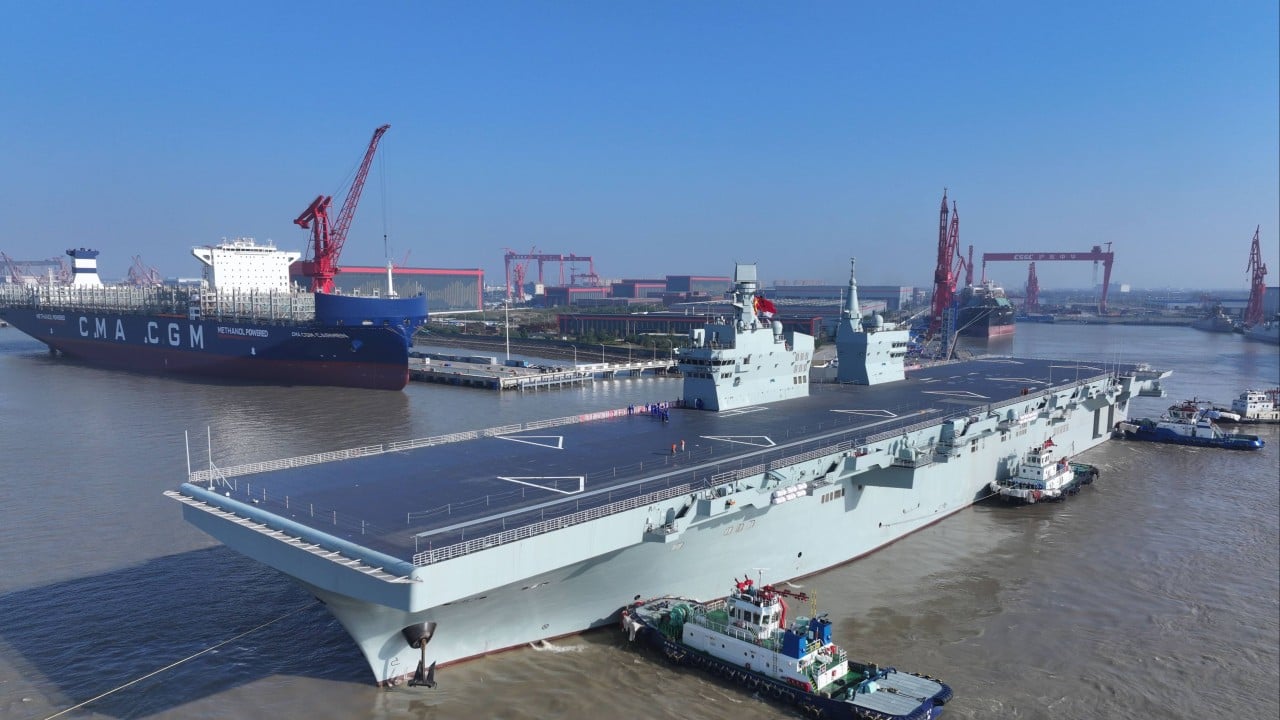
The Type 076, led by the Sichuan, is roughly forty thousand tons of steel that refuses to stay in its lane. If you stand on the pier and look up at its twin islands—two separate control towers rising from the starboard side, one for steering the ship and the other for managing the chaotic ballet of flight operations—you realize you are looking at a hybrid creature.
The secret weapon isn't just the size of the deck. It is what is buried beneath the steel plates.
Traditional amphibious ships rely on "ski-jump" ramps or vertical-takeoff jets like the F-35B, which burn massive amounts of fuel just to hover into the air, severely limiting how many bombs or how much fuel they can carry. The Type 076 bypasses that compromise entirely by incorporating an electromagnetic aircraft launch system, or EMALS.
Think of EMALS like a magnetic levitation bullet train turned on its side and compressed into a hundred-meter track. Instead of using violent, high-maintenance steam pistons that jerk an airframe apart, electromagnetic coils accelerate the aircraft smoothly, precisely, and relentlessly down the deck. You can dial the power up for a heavy strike fighter, or dial it down for a lighter reconnaissance drone without tearing the wings off.
Until now, only two ships on the planet possessed this capability—the United States Navy’s USS Gerald R. Ford and China’s own massive Fujian supercarrier. By bolting an electromagnetic catapult onto an amphibious assault ship, Beijing effectively figured out how to mass-produce miniature aircraft carriers at a fraction of the cost and time of a traditional supercarrier.
The Invisible Stakes of the Autonomous Horizon
I spent years covering maritime security and watching how bureaucratic inertia shapes military strategy, and if there is one thing I have learned, it is that institutions almost always prepare to fight the last war. We fall in love with the tools that brought us victory in the past. We romanticize the carrier battle groups of the twentieth century, forgetting that in an era of hypersonic anti-ship missiles and satellite constellations, a hundred-thousand-ton supercarrier can sometimes look less like an invincible fortress and more like a very expensive target.
This is where the human element returns, though not in the way we expect.
If you are a sailor standing watch on the bridge of a destroyer in the South China Sea or the Western Pacific, the arrival of the GJ-21 aboard the Type 076 alters your psychological reality. Previously, your radar operators were looking for massive, loud, predictable formations launched from a handful of known supercarriers. You knew where the threat was coming from because there were only so many decks capable of launching high-end stealth aircraft.
Now, every Type 076 hull that slides out of a Chinese shipyard—and China’s shipbuilding capacity dwarfs that of the rest of the world combined—becomes a potential launchpad for deep-strike stealth drones.
Consider what happens next in a crisis scenario.
Let’s use another explicit hypothetical to trace the ripple effects. Imagine a tense standoff in the waters east of Taiwan. Three Type 076 ships are operating hundreds of miles away, dispersed across the open ocean to avoid being targeted all at once. Under the cover of night, without a single afterburner lighting up the infrared sensors of overhead satellites, electromagnetic catapults hum to life.
One by one, GJ-21 drones are slung silently into the dark.
Because they carry no pilots, they do not need to fly back to the ship immediately. They can loiter at high altitudes for hours, invisible to standard radar, acting as forward eyes for long-range missiles fired from hundreds of miles away. Or, carrying internal bays packed with precision-guided munitions, they can slip past air defenses to strike radar sites, fuel depots, and command centers before a single manned fighter jet ever crosses the horizon.
And if one gets shot down? There is no search-and-rescue mission. There is no pilot paraded on television. There is no political fallout from a grieving family. The ship simply rolls another airframe onto the catapult track and presses a button.
The Illusion of Control
It is easy to get swept up in the cold brilliance of the engineering here, to marvel at the software algorithms that allow a tailless flying wing to land autonomously on a pitching, rolling deck in the middle of the ocean. Landing a conventional jet on an aircraft carrier is widely considered one of the hardest things a human being can do—often described by naval aviators as a controlled crash onto a postage stamp moving at thirty knots.
Doing it with an unmanned flying wing requires a level of sensor fusion and micro-second flight control adjustments that would have seemed like pure science fiction twenty years ago. The drone has to talk to the ship continuously, compensating for gusts of wind burbling off the stern, salt spray degrading optical sensors, and the unpredictable heave of the waves.
When Chinese state media released footage of the GJ-21 taking off and landing on the Sichuan, they weren't just showing off a successful test flight. They were broadcasting a message that they had solved one of the hardest aerodynamic and computational puzzles in modern naval aviation.
Yet, as someone who has watched technology promise clean, bloodless efficiency over and over again, I find myself deeply unsettled by what this milestone actually represents.
There is a dangerous seduction in unmanned warfare. When you remove the immediate risk to your own pilots, the threshold for using force drops. Political leaders and military commanders become bolder when the machines taking the hits are made of carbon fiber and titanium rather than flesh and blood. You start treating lethal strikes like moves on a chessboard rather than irreversible human tragedies.
We saw the early, crude version of this dynamic over the deserts of the Middle East over the past two decades, where propeller-driven drones turned warfare into a remote-control commute for operators sitting in air-conditioned trailers half a world away.
What the Type 076 and the GJ-21 represent is the industrialization and maritime expansion of that exact philosophy—scaled up for high-intensity conflict between nuclear-armed superpowers.
The Quiet Race Beneath the Waves and Clouds
Critics and skeptics will rightly point out that a successful test flight is a long way from full operational capability. They are right. History is littered with wunderwaffen—wonder weapons—that looked terrifying in controlled trials and fell apart under the chaotic, jammed, muddy reality of actual combat.
Flying a drone off a ship in calm, scripted conditions is one thing. Doing it when an adversary is blasting the electromagnetic spectrum with high-powered jamming, severing the data links between the ship and the aircraft, is another matter entirely. If the Sichuan loses communication with its GJ-21s, how much autonomy is Beijing willing to give an armed stealth aircraft to make its own targeting decisions?
Nobody outside a handful of classified briefing rooms knows the answer to that question, and frankly, that uncertainty is the most terrifying part of the entire equation. We are building systems that operate faster than human thought, deploying them into the most volatile geopolitical flashpoints on Earth, and hoping that the code holds when the weather turns bad and the radios go dead.
Meanwhile, the United States Navy is scrambling to answer the same questions with its own Collaborative Combat Aircraft programs and the MQ-25 Stingray aerial refueling drone, trying to figure out how manned jets and autonomous wingmen will share the crowded skies above future carriers.
For decades, the Pacific was effectively an American lake, patrolled by supercarriers whose dominance was unquestioned. That era did not end with a dramatic naval battle or a formal treaty. It eroded slowly, weld by weld, inside massive dry docks along the Yangtze River, until a flying wing with no pilot quietly rolled onto a catapult track, accelerated into the salt air, and touched back down on a deck that shouldn't have been able to launch it in the first place.
If you listen closely to the footage of that test flight, past the sterile voiceover of the state broadcaster and the low hum of the wind, you can hear the sound of a century-old military doctrine cracking down the middle. There is no roar of engines, no cheering crowd on the flight deck, and no pilot climbing down a ladder to salute the captain—just the steady, rhythmic slap of gray water against a hull that has already moved on to the next launch.