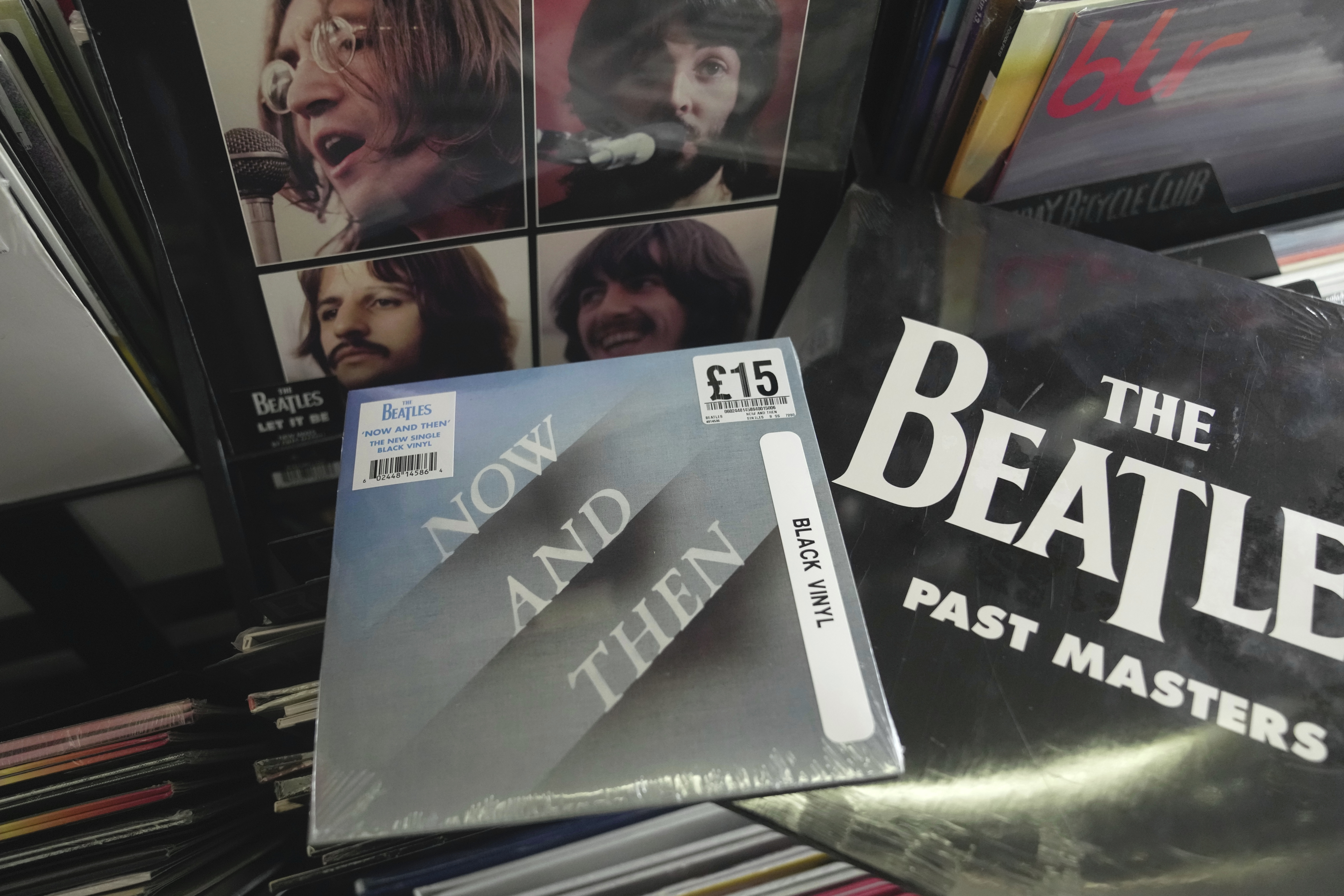
Drop a needle onto a spinning piece of vinyl from 1963. Or, more likely, tap a glass screen to stream a track recorded more than six decades ago. Within two seconds, a specific sensation hits the back of your throat. It is the sound of absolute, unvarnished joy.
It makes no logical sense. The teenagers who screamed until their lungs bled in 1964 are grandmothers now. The tape machines used to capture those harmonies are museum pieces, held together by a prayer and obsolete engineering. Two of the men who made that music have been dead for decades. Yet, walk into a coffee shop in Tokyo, a dive bar in Chicago, or a teenager’s bedroom in London today, and you will hear the exact same frequencies shaking the air.
We are told that pop culture is disposable. It is designed to be consumed, digested, and forgotten to make room for the next quarter's profit margins. Why, then, do The Beatles refuse to fade into the background noise of history?
The answer is not found in marketing budgets or nostalgia. It lives in the messy, human alchemy of four specific people who accidentally stumbled upon the blueprint for modern human emotion.
The Myth of the Overnight Sensation
Think about a grueling shift at work. The kind where your feet ache, the lighting is fluorescent, and you wonder if anyone would notice if you just walked out the back door.
Now imagine doing that for eight hours a night, seven nights a week, in a sweaty, underground club in a foreign country where you barely speak the language.
Before the matching suits, the stadium crowds, and the global hysteria, John Lennon, Paul McCartney, George Harrison, and Pete Best (later replaced by Ringo Starr) were essentially musical factory workers. In the early 1960s, they took a series of residencies in Hamburg, Germany. They did not play ninety-minute arena sets. They played for hours on end, fueled by cheap beer and stimulants, trying to keep drunk sailors from throwing bottles at their heads.
This was not a glamorous apprenticeship. It was an endurance test.
"We had to learn how to play for hours and hours," Lennon later recalled. "We got better and we got confidence. We couldn't help it, playing all night."
When they returned to Liverpool, they were no longer just a band. They were a single, eight-legged organism. They had logged an estimated 1,200 hours of live performance before most people outside their hometown had ever heard their names. For context, most modern bands do not play that many hours live in their entire careers.
When you listen to "I Want to Hold Your Hand," you are not just hearing a catchy pop song. You are hearing the raw, kinetic energy of thousands of hours of collective muscle memory exploding through a microphone. It felt alive because it was alive.
The Chemistry of Contrast
Most groups have a leader. A singular vision. One person who writes the songs and commands the spotlight while the rest of the band functions as a highly competent backing track.
The Beatles were a freak accident of human chemistry.
You had John: cynical, sharp-tongued, deeply wounded, and constantly pushing the boundaries of what pop music was allowed to say. Then you had Paul: a melodic genius, an optimist, a perfectionist who could hear an entire orchestra in his head before a single note was played.
They were opposites. Metaphorically speaking, John was the sandpaper and Paul was the wood. Without Paul, John’s songs could become overly abrasive or detached from melody. Without John, Paul’s songs risked sliding into sweet, sugary sentimentality. They rubbed against each other, creating a friction that sparked fire.
Behind them stood George, the quiet observer who would eventually develop into a songwriting titan in his own right, providing a spiritual, introspective counterbalance to the main duo. And locking it all together was Ringo, the human heartbeat of the band, whose unconventional drumming style—driven by the fact that he was a left-handed player using a right-handed kit—gave the songs their unique, swinging pocket.
This internal dynamic meant the band was constantly competing with itself. If Paul wrote a masterpiece like "Yesterday," John would counter with "Nowhere Man." This healthy, terrifying rivalry forced them to evolve at a breakneck pace.
The Great Sonic Leap Forward
Consider the year 1965. The band was exhausted. They were trapped in luxury hotel rooms, unable to go outside without being mobbed. The screaming at their concerts was so loud that they could not hear their own instruments. They were playing into a void.
So, they made a choice that should have ruined their careers. They quit touring.
They locked themselves inside EMI Studios on Abbey Road and decided to treat the recording studio not as a place to capture a live performance, but as an instrument in itself.
Imagine trying to paint a masterpiece using only primary colors, and then suddenly someone hands you a palette with a million shades you have never seen before. That is what happened when the band teamed up with producer George Martin. Together, they began to rip up the rulebook of popular music.
They wanted a guitar to sound like a crying seagull? They ran the tape backward.
John wanted his voice to sound like the Dalai Lama chanting from the top of a mountain? They ran his vocals through a rotating Leslie speaker cabinet normally reserved for organs.
They wanted a classical trumpet solo on a pop track? They hired a symphonic player to execute a frantically difficult line on a piccolo trumpet for "Penny Lane."
Between 1966 and 1969, they released a string of albums—Revolver, Sgt. Pepper's Lonely Hearts Club Band, The良好White Album, and Abbey Road—that fundamentally redefined what recorded sound could be. They invented techniques that are still used in every bedroom pop studio and hip-hop production suite today. Artificial double-tracking, tape loops, multitrack sampling—they did it all with razor blades, splicing tape, and physical imagination.
The Universal Emotional Blueprint
But technical innovation is sterile without soul. The true secret to their permanence is that they grew up in public, and their music mapped the entire trajectory of human experience.
They started with the frantic, desperate longing of youth. She loves you, yeah, yeah, yeah. It was simple. It was direct. It was the sound of adrenaline.
But as they aged, the music deepened. They started asking the questions we all ask when the initial rush of youth begins to cool. They wrote about loneliness ("Eleanor Rigby"), alienation ("Strawberry Fields Forever"), the quiet dignity of aging ("When I'm Sixty-Four"), and the devastating grief of a broken home ("Julia").
They became vulnerable. They admitted to feeling small.
When you listen to "Help!", you are not listening to a manufactured pop product. You are listening to a twenty-four-year-old millionaire genuinely crying out because the walls of fame are closing in on him. That vulnerability creates an instant, unbreakable bridge across time. A teenager experiencing heartbreak in 2026 hears the exact same truth in those chords as a teenager did in 1967.
The Unending Resonance
There is a temptation to look at ancient history through a sepia-toned lens, to assume that something is respected merely because it is old.
But respect is different from relevance.
Relevance is when a movie director uses "Something" to anchor a pivotal emotional scene in a modern blockbuster. Relevance is when a new mix of an old album shoots to the top of the streaming charts because a new generation discovered the bassline to "Come Together" on an algorithmic playlist.
We live in a deeply fragmented world. Our culture is split into a billion tiny micro-niches. It is entirely possible to be a massive star to five million people while the rest of the world has no idea you exist.
The Beatles represent the last time the world looked at the same thing at the same time. They are the baseline of our collective musical language. Every indie rock band, every pop diva, every bedroom producer is, consciously or unconsciously, working in a house that John, Paul, George, and Ringo built.
The instruments change. The delivery systems change. The world spins faster and faster, blurring the past into a generic haze.
But some things are anchored too deeply to be swept away. As long as people feel lonely in crowded cities, as long as people fall in love on warm summer nights, and as long as anyone needs to remind themselves that a dark time will eventually pass, those four voices will keep calling out from the speaker.
The song changes. The tape spins. And the music plays on.