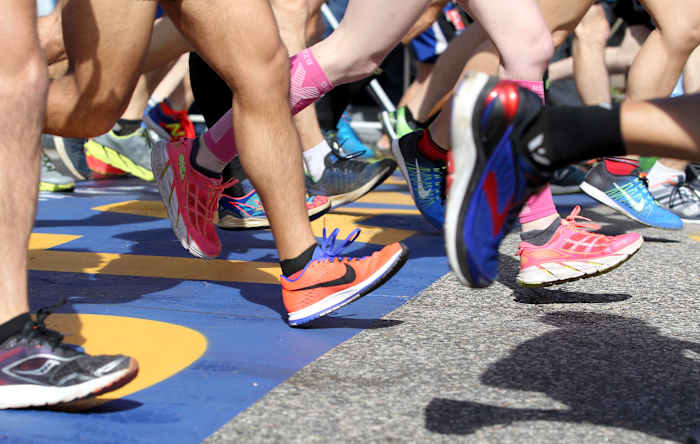
The air at 5:00 AM in Pietermaritzburg is a physical weight. It is cold, sharp, and smells of deep-rub liniment and the collective nervous sweat of twenty thousand human beings. This is the start of the Comrades Marathon, a 90-kilometer "Ultimate Human Race" that breaks bodies and defines souls. For most, the goal is simple: finish before the twelve-hour gun. For the elite women, the stakes are different. They are running for history, for grueling prestige, and for prize money that pays the bills for a year.
But as the sun began to bake the asphalt on the road to Durban, something felt wrong.
In the 2024 edition of this brutal pilgrimage, the spirit of the race was met with a shadow. It wasn't a failure of stamina or a collapse of spirit. It was a calculated deception. Several men were caught wearing female race bibs, crossing the timing mats under the identities of women, and physically occupying spaces in the women’s starting pens and rankings.
This is not a story about a simple clerical error. It is a story about the erosion of the sacred pact between an athlete and the road.
The Anatomy of a Heist
To understand why this matters, you have to look at the woman standing on the starting line who didn’t get her medal. Let’s call her Sarah. Sarah isn't a professional, but she is "elite-adjacent." She wakes up at 4:30 AM every day for eleven months. She tracks every gram of protein. She runs until her toenails fall off and her lungs feel like they’ve been scrubbed with sandpaper.
Sarah is aiming for a silver medal—a feat reserved for those who finish under seven and a half hours. In a race of this magnitude, the "seeding" matters. Being in the right pen at the start determines whether you spend the first five kilometers fighting through a crowd or finding your rhythm.
When a man puts on a woman’s bib, he isn't just running a race. He is a ghost in the machine. He takes up physical space in a restricted seeding pen. He crosses the timing mats, triggering data points that belong to a woman. In the chaos of 20,000 runners, a wig or a strategically placed cap is often enough to fool a tired volunteer at a water station.
The deception is layered. In some cases, these men were "mules." They ran the distance to ensure a woman—who might not have been physically present for the whole course—received a qualifying time or a specific medal. In other instances, it was a crude grab for the spotlight. Regardless of the motive, the result is a jagged tear in the fabric of fair play.
The Weight of the Bib
A race bib is more than a piece of waterproof paper. It is a contract. It says: I am who I say I am, and I will cover this ground using only the strength I have built.
When the Comrades Marathon Association (CMA) began investigating the anomalies in the 2024 results, they found a pattern that went beyond accidental swaps. They discovered men who had intentionally entered the female category to manipulate the outcome. This isn't just about the top ten finishers. It trickles down to the age-category awards, the club points, and the personal bests that runners use to qualify for other global events.
Think about the physical reality of the road. The Comrades is an "up" or "down" run. The 2024 race was a "down" run, meaning the descent into Durban punishes the quadriceps until every step feels like a lightning strike. The sheer physical advantage of male physiology—greater bone density, higher lung capacity, and explosive muscle power—is exactly why categories exist.
When a man inserts himself into the female category, he isn't competing; he is colonizing a space meant for a specific struggle.
The betrayal is felt most keenly at the finish line at Moses Mabhida Stadium. Imagine the roar of the crowd. Imagine the clock ticking down. A runner crosses, hears their name announced, and receives a medal. But if that runner is a man carrying a woman’s registration, he has stolen the oxygen from the room. He has silenced the announcement of the woman who actually earned that moment.
The Digital Trail and the Human Cost
In the modern era, you cannot hide from the data. Every few kilometers, an electronic mat records the "split" time of each runner. If a "runner" suddenly drops their pace from six minutes per kilometer to three minutes per kilometer, or if they appear at the 60km mark without ever having passed the 30km mark, the red flags go up.
The CMA used a combination of photographic evidence and electronic tracking to weed out the impostors. The fallout was swift. Disqualifications. Bans. The stripping of medals.
But the data doesn't capture the exhaustion of the women who were pushed aside at the start. It doesn't account for the psychological toll of looking at a leaderboard and seeing names that don't belong there.
We often talk about sportsmanship as a vague, Victorian ideal. In the heat of the Valley of a Thousand Hills, it is something much more primal. It is the honesty of the effort. If you take a shortcut—whether by car, by cutting the course, or by stealing a gender identity on a registration form—you aren't a marathoner. You are a tourist of someone else's pain.
Why They Do It
The question that lingers in the humid Durban air is: Why?
For some, it is the pressure of the "Green Number." In the South African running community, finishing ten Comrades Marathons earns you a permanent number and a place in the hall of legends. The desperation to maintain a streak or reach that milestone can drive people to do the unthinkable. They view the race not as a challenge to be met, but as a transaction to be completed by any means necessary.
For others, it is a misguided attempt to "help" a partner or a friend. A man runs the difficult middle section of the race with a woman's bib, then hands it off to her near the end so she can finish fresh. It is a bizarre, distorted version of gallantry that ends in disgrace for both parties.
Then there is the darker side: the intentional theft of prize money. While the top-tier professionals are closely watched, the "veteran" and "master" categories (for runners over 40 and 50) still carry significant prestige and smaller cash injections. In these categories, where the crowds are thinner and the scrutiny is less intense, the "ghost runners" hope to slip through the cracks.
The Integrity of the Long Haul
The Comrades Marathon is often called the "Ultimate Human Race" because it strips you down to your most basic elements. You cannot fake a 90-kilometer run without leaving a trail of evidence, whether it’s in your blood chemistry or on a digital server.
When we allow deception to go unchecked, we tell every honest runner that their sacrifice is worth less than a lie. We tell the woman who finished 101st—missing the prestigious gold medal by one spot—that her heartbreak was caused by someone who didn't even have the courage to run as themselves.
The organizers have promised even tighter controls for the next year. More cameras. More biometric checks. More marshals. It is a shame that the world's greatest ultramarathon has to be policed like a high-stakes heist, but the purity of the finish line is worth the effort.
The road from Pietermaritzburg to Durban is a long one. It is a path of suffering, of camaraderie, and of profound personal truth. Those who seek to skip the suffering by stealing a category don't just lose their medals; they lose the very thing the race is supposed to give them. They finish the race, but they never truly arrive.
As the sun sets over the Indian Ocean and the final cut-off gun fires at the twelve-hour mark, the stadium falls into a heavy silence. The winners have their trophies. The finishers have their medals. And the ghosts? They are left with nothing but the weight of a bib they never earned and a name that wasn't theirs to carry.
True victory in the Comrades is not found in the ranking. It is found in the ability to look at yourself in the mirror the next morning and know that every agonizing inch of those 90 kilometers was bought with your own breath.
Anything less is just a long walk to nowhere.