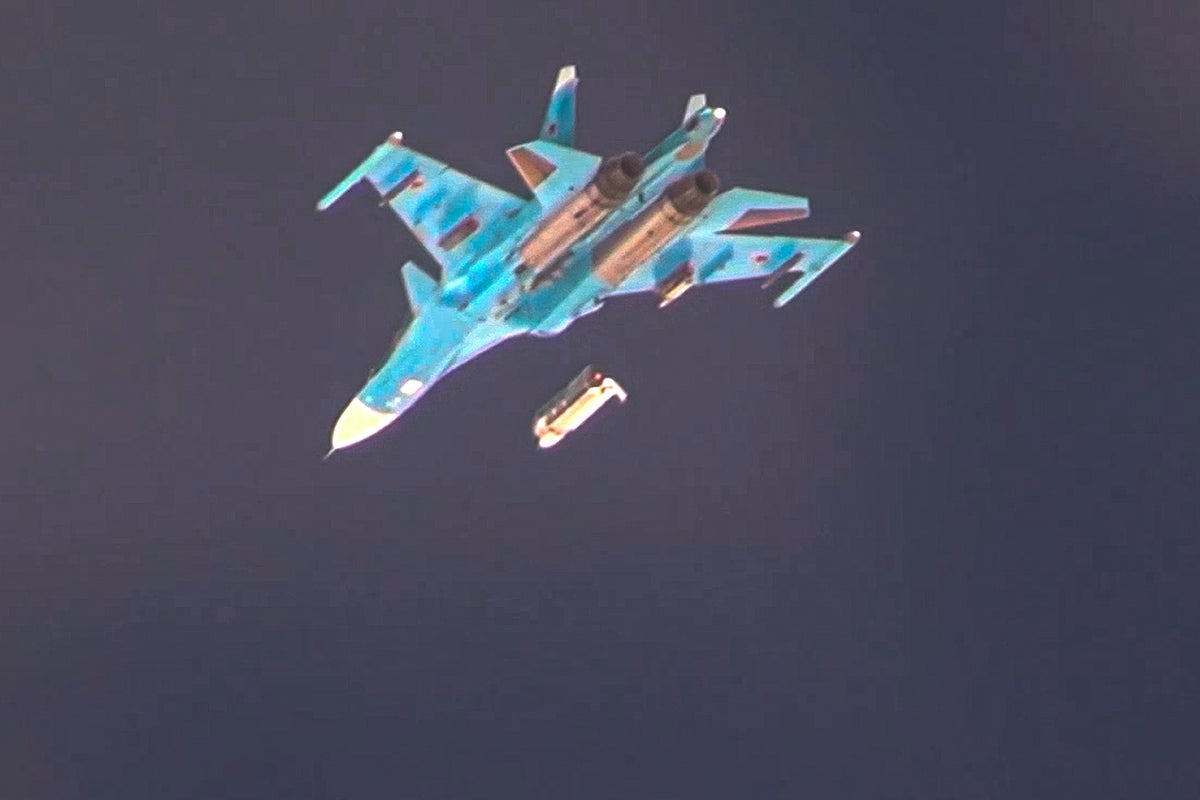
Military analysts love a silver bullet. For the past two years, the defense commentariat has filled pages with breathless commentary about how cheap, satellite-guided glide bombs—specifically Russian UMPK kits and Western equivalents like JDAM-ER—have fundamentally rewritten the rules of modern attrition. The narrative is comforting in its simplicity: bolt some wings and a GPS tracker onto an obsolete Soviet iron bomb, drop it from forty miles away, and watch tactical deadlock dissolve.
It is a neat story. It is also completely wrong.
The lazy consensus views the glide bomb as a revolutionary technological pivot. It is treated as a weapon that renders traditional artillery obsolete and establishes a new doctrine of cheap, precision standoff warfare. This view misinterprets tactical adaptation for strategic revolution. Glide bombs are not a glimpse into the future of global conflict. They are a desperate, brilliant, but ultimately limited workaround for a very specific, temporary problem: the inability of either side to establish air supremacy over a dense, integrated air defense network.
When you strip away the hype, these weapons are nothing more than a crude bridge between industrial-era mass and precision guidance. They are a symptom of a gridlocked airspace, not the weapon that unlocks it. To understand where peer conflict is actually going, we have to look past the dramatic footage of exploding bunkers and analyze the brutal, unglamorous physics of the radar horizon, manufacturing bottlenecks, and electronic degradation.
The Standoff Illusion
The core argument for the supremacy of the glide bomb rests on the concept of safe standoff range. Analysts point to the fact that a pilot can release a modified FAB-500 or FAB-1500 from a distance of 40 to 60 kilometers, well outside the engagement envelope of most short and medium-range surface-to-air missile (SAM) systems.
This argument ignores the basic laws of aerodynamics and altitude.
To achieve maximum range, a glide bomb must be released at high altitude—typically above 30,000 feet—and at high speed. The moment a fighter-bomber climbs to those altitudes, it lights up on long-range early warning radars like a flare in a dark room. It becomes visible hundreds of kilometers away, far beyond the actual release point.
I have spent years analyzing flight profiles and radar cross-section data for high-intensity contingencies. The reality of the modern battlespace is that altitude is a death sentence if your opponent possesses long-range strategic SAM systems like the Patriot PAC-3 or the S-400. A pilot trying to maximize a glide bomb's range is forced to play a high-stakes game of chicken with enemy radar.
If the enemy moves a long-range battery close to the front lines, the safe standoff window vanishes instantly. We saw this clearly in early 2024 when a series of successful ambushes brought down multiple high-end fighter-bombers in rapid succession. The response was immediate and predictable: strike aircraft were forced back to lower launch altitudes, which drastically reduced the range of the bombs, forcing them closer to the very dangers they were trying to avoid.
The standoff range is not a fixed, reliable metric. It is a highly volatile variable that shrinks the moment a competent adversary adapts.
The Electronic Warfare Wall
The second major flaw in the glide bomb hype train is the naive assumption that GPS and GLONASS guidance will remain reliable in a peer-to-peer fight.
Most low-cost glide kits rely heavily on commercial-grade or slightly hardened satellite navigation receivers to achieve their advertised accuracy. When those signals are clean, these weapons can achieve a circular error probable (CEP) of under ten meters. That is precise enough to destroy a hardened command post or collapse a trench line.
But what happens when the satellite signal disappears?
The electromagnetic environment in modern high-intensity conflict is the most hostile in human history. Entire geographic zones are blanked out by powerful GPS jamming complexes like the Russian Pole-21 or R-330Zh Zhitel. Western operators quickly discovered that the accuracy of certain precision-guided munitions dropped precipitously when subjected to localized, high-power electronic warfare (EW).
When a glide bomb loses its satellite lock, it must fall back on its internal Inertial Navigation System (INS). A cheap INS kit, put together with components designed to keep production costs low, suffers from rapid drift. Every second the bomb spends gliding through the air without a satellite update, the internal gyroscope loses accuracy. Over a forty-mile flight, a drift of even a few degrees means the bomb misses its target by dozens of meters.
Against a reinforced concrete bunker or a narrow trench network, a miss by fifty meters is functionally equivalent to a miss by five miles. You have simply converted an expensive precision weapon into a highly inefficient, unguided conventional bomb.
The Industrial Bottleneck
We are constantly told that glide bombs are a hyper-scalable solution because the world is full of old, unguided bomb casings. The narrative suggests that you can just manufacture wing kits on a massive scale and turn every warehouse of Cold War ordnance into a precision arsenal.
This ignores the industrial realities of modern aerospace manufacturing.
While the steel bomb casings themselves exist in vast quantities, the components that make them smart do not. A guidance kit requires:
- Solid-state gyroscopes
- Actuators for the control surfaces
- Thermal batteries
- Hardened microelectronics capable of surviving extreme vibrational stress
These components cannot be stamped out of sheet metal in a converted automotive plant. They require specialized supply chains, cleanroom assembly, and rare components that are subject to strict international sanctions and resource scarcity.
Even if you can scale the production of the wing kits, you encounter a second, much harder bottleneck: the launch platforms.
An artillery tube can fire hundreds of rounds a day until the barrel wears out, at which point you swap the barrel in the field. A supersonic fighter-bomber is a fragile, temperamental machine. It requires dozens of hours of intensive maintenance for every single hour of flight time. The airframes suffer from structural fatigue caused by carrying heavy, unguided munitions on external hardpoints at high speeds.
If an air force drops a hundred glide bombs a day, it is running through the structural life of its fleet at an unsustainable rate. Tires wear out. Engines ingest debris. Spars crack. You cannot scale a strategic bombing campaign using a limited fleet of tactical aircraft as delivery trucks. Eventually, the logistical footprint of the air force collapses under the weight of its own maintenance schedule.
The Cost-Efficiency Fallacy
Let us look at the math, because this is where the contrarian reality becomes undeniable. Proponents argue that a glide bomb kit costs a fraction of the price of a cruise missile or a ballistic missile. A standard wing kit might cost anywhere from $20,000 to $50,000 to produce, compared to over $1 million for a Kalibr or a Storm Shadow.
That looks like incredible value on a spreadsheet. It is a total accounting fiction.
To calculate the true cost of a glide bomb strike, you must include the cost of the delivery mechanism. You are putting a $30 million to $50 million aircraft into the air, burning thousands of gallons of specialized jet fuel, and risking the life of a pilot who took years and millions of dollars to train. If that aircraft is shot down by a long-range SAM while climbing to its release altitude, the cost-per-strike equation is ruined for the next year.
Furthermore, consider the target set. Glide bombs are being used to reduce tactical fortifications, tree lines, and individual buildings on the frontline. They are being used as a substitute for heavy artillery because artillery stockpiles are depleted or constrained by counter-battery fire.
Using a multi-million-dollar aviation infrastructure to deliver fifty kilograms of high explosives to a trench line because your artillery cannot do it is not a sign of technological superiority. It is a sign of operational desperation. It is a highly inefficient way to project power across a frontline.
The Brutal Return of Mass over Precision
The obsession with precision guidance has blinded the defense establishment to the foundational law of continental warfare: mass still rules the battlefield.
Imagine a scenario where an army faces an adversary dug into a three-tier defensive line stretching across a hundred miles. The line consists of thousands of reinforced bunkers, deep anti-tank ditches, and millions of mines.
To breach this network using precision glide bombs, you would need to identify, track, and target every single individual bunker and trench segment. You would need thousands of perfect sorties, flawless satellite connectivity, and an absolute absence of enemy air defenses. It is an operational impossibility.
Traditional, heavy tube and rocket artillery does not care about satellite jamming. A standard 155mm or 152mm high-explosive shell does not have an internal gyroscope that drifts when the EW trucks turn on. When fired in sufficient volume, artillery creates a zone of absolute destruction through sheer kinetic mass. It suppresses the enemy, destroys minefields by sympathetic detonation, and alters the physical topography of the battlefield.
The glide bomb is an attempt to achieve artillery-like effects without the necessary artillery supply chain. It is a boutique solution to an industrial-scale problem.
The Vulnerability of the Fixed Base
The final, fatal flaw in the glide bomb doctrine lies not in the air, but on the ground.
Artillery is highly mobile. A modern self-propelled howitzer can pull up, fire six rounds in two minutes, and drive away before the first shell even impacts. It is incredibly difficult to target and destroy a dispersed, mobile artillery force.
Aircraft do not enjoy this luxury. A Sukhoi or an F-16 cannot park in a forest or hide in a standard trench line. They require massive, fixed, easily identifiable airbases with two-mile-long concrete runways, specialized fuel storage tanks, ammunition depots, and hundreds of support personnel.
In an era of ubiquitous satellite reconnaissance and long-range ballistic missiles, these airbases are massive targets. A single tactical ballistic missile equipped with cluster submunitions can shred a dozen aircraft parked on a tarmac, destroying an entire squadron's worth of glide-bomb delivery platforms in a single strike.
By shifting the burden of the bombardment from mobile ground systems to fixed aerial infrastructure, you are moving your offensive capability from a highly survivable posture to a highly vulnerable one. You are trading the resilience of a thousand scattered artillery pieces for the fragility of three or four major airfields.
The Actionable Reality
For defense planners and procurement officers, the takeaway is clear, stark, and deeply uncomfortable for those invested in high-tech defense contracts.
Stop pretending that cheap precision kits can replace the unglamorous necessity of industrial manufacturing capacity. The side that wins a protracted conflict between peer states is not the side with the cleverest wing kits. It is the side that can manufacture three million conventional artillery shells a year and maintain a thousand crude, reliable barrels on the frontline.
Invest in hardening the electromagnetic spectrum. Rebuild the basic industrial supply chains for explosives, steel casings, and simple primers. Understand that the airspace in a real peer conflict will be a denied, lethal environment where high-altitude flight is a suicide mission.
The glide bomb is a temporary tactical adaptation born of specific operational limitations. Treating it as the future of warfare is a dangerous misunderstanding of military history. Mass, volume, and industrial resilience remain the unchanging pillars of victory. Everything else is just noise.