The air in the Situation Room doesn't move. It sits heavy, filtered through high-grade ventilation systems that strip away the smell of the city outside, leaving only the scent of ozone and expensive wool. Men and women sit around a table that has seen the maps of every modern conflict, watching screens that pulse with the digital heartbeat of a world on the brink. Somewhere, thousands of miles away, a centrifuge spins. Somewhere else, a drone engine hums. But the most powerful sound in the world right now is the silence of a telephone that hasn't rung.
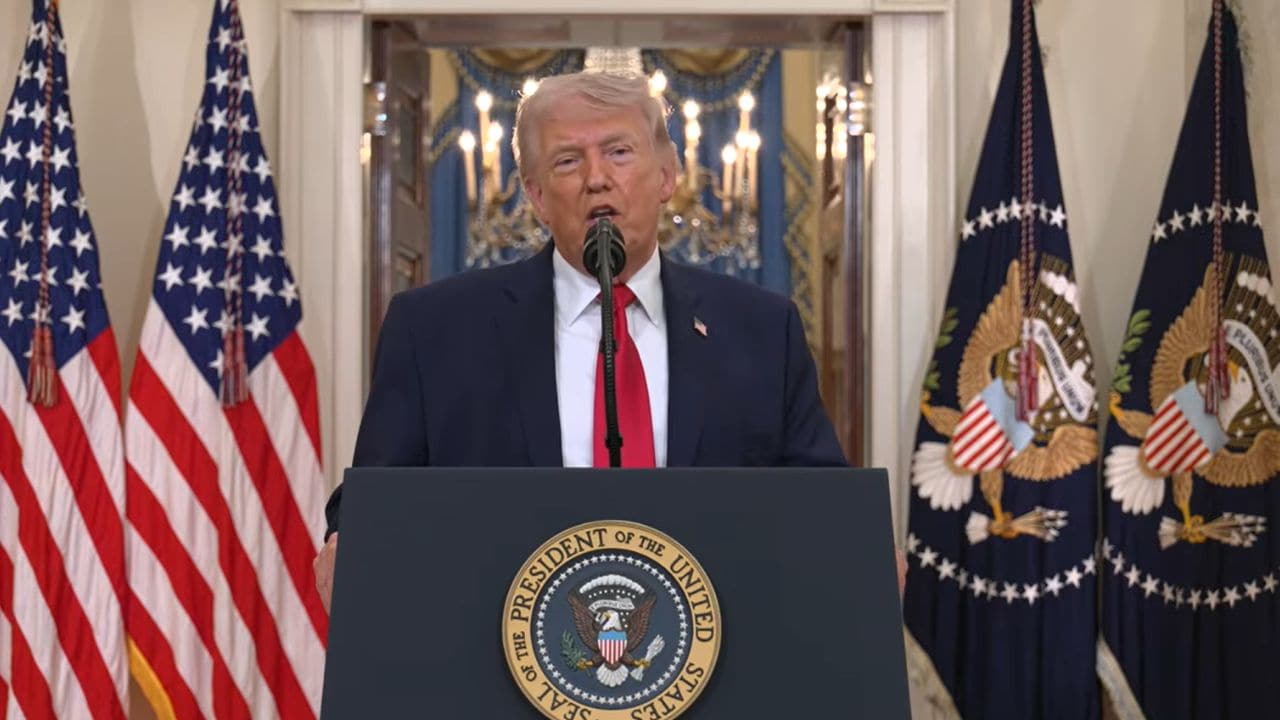
Donald Trump is a man who believes in the chemistry of the room. He views the world not as a series of rigid treaties or dusty bureaucratic filings, but as a sequence of deals waiting for a handshake. According to recent reports channeled through the New York Post, the former and perhaps future architect of American foreign policy is signaling that the silence might be about to break. He suggests that talks with Iran—the kind of high-stakes, high-wire diplomacy that defines eras—could resume within the next forty-eight hours.
Two days.
In the grand arc of history, forty-eight hours is a blink. But when you are talking about the Persian Gulf, two days is long enough for a ship to be seized, a missile to be fueled, or a decade of hostility to find a sudden, unexpected crack in the wall.
The Ghost at the Table
Imagine a shopkeeper in Tehran named Abbas. He doesn’t care about the intricacies of the Joint Comprehensive Plan of Action (JCPOA). He doesn’t read the white papers issued by think tanks in D.C. What he cares about is the price of chicken. He cares about the fact that the rial in his pocket loses value while he sleeps, a casualty of the "maximum pressure" campaign that has defined the last several years of his life.
For Abbas, and millions like him, the news of "talks" isn't a headline. It is a gasp of air.
The strategy employed during the first Trump administration was one of total economic strangulation. The goal was simple: force the regime in Tehran to choose between its nuclear ambitions and its survival. It was a gamble of immense proportions. It turned the Iranian economy into a pressure cooker. But pressure without an outlet eventually leads to an explosion.
The suggestion that talks could resume signals a shift from the squeeze to the sit-down. It acknowledges a fundamental truth about human nature that often gets lost in geopolitics: eventually, everyone has to talk. Even enemies. Especially enemies.
The Art of the Impossible Opening
Why now? Why this sudden acceleration?
The timing isn't accidental. The Middle East is currently a mosaic of jagged glass. Between the shadows of "axis of resistance" proxies and the direct exchange of fire between Jerusalem and Tehran, the region is more volatile than it has been in decades. When the world is this close to a general conflagration, the bravado of the campaign trail often meets the cold reality of the nuclear clock.
Trump’s approach to diplomacy has always been idiosyncratic. He ignores the traditional State Department playbook, preferring the direct line, the personal overture, and the theatricality of the summit. To the career diplomat, this is chaos. To the pragmatist, it is the only way to bypass forty years of institutionalized hatred.
Consider the mechanics of a "talk." It starts with a flicker. A back-channel message sent through a Swiss intermediary. A nod in a hallway at a summit. Then, the heavy lifting begins. The Iranians are masters of the long game. They play chess on a board that spans centuries. They view themselves not as a rogue state, but as a displaced empire seeking its rightful seat at the head of the table.
Trump, conversely, plays the short game with maximum intensity. He wants the deal. He wants the photo. He wants the "win."
When these two styles collide, the result is rarely a boring policy shift. It is a seismic event.
The Invisible Stakes
We talk about enrichment levels. We talk about $U^{235}$ and breakout times. We talk about ballistic missile ranges and the "breakout period" to a functional warhead. These are the metrics of the experts.
The real stakes are more intimate.
They are the young protesters in the streets of Isfahan who want a world where they can access the global internet without a VPN. They are the sailors in the Strait of Hormuz who go to sleep wondering if a stray spark will turn the water into a graveyard. They are the families in northern Israel and southern Lebanon who have become internal refugees in their own countries.
If these talks actually materialize within the next two days, they won't be about friendship. They will be about de-escalation. In the language of power, "talking" is often just a way to ensure that the other side isn't currently aiming.
But there is a danger in the rush. Diplomacy is a delicate surgery. If you move too fast, you sever the wrong artery. If you move too slow, the patient dies on the table. The "two-day" window suggested by the reports implies an urgency that is both exhilarating and terrifying. It suggests that something is moving behind the scenes—something the public hasn't seen yet.
The Weight of the Handshake
There is a specific kind of tension that exists right before a major diplomatic breakthrough. It’s the feeling of a rubber band stretched to its absolute limit.
For years, the narrative has been one of inevitable collision. We have been told that there is no path back to the table, that the bridges have been burned and the ashes scattered. Yet, here we are, staring at a headline that suggests the impossible might be forty-eight hours away.
It reminds us that history is not a straight line. It is a series of pivots.
If a call is placed, if a meeting is set, the world will hold its breath. The hawks will scream betrayal. The pacifists will pray for a miracle. And the men in the Situation Room will lean closer to their monitors, watching for any sign of movement in the dark.
The shopkeeper in Tehran will wait. The sailor in the Gulf will wait. The world, exhausted by the constant threat of "what comes next," will look at its phone and wonder if this is the moment the silence finally breaks.
Power isn't just about the ability to destroy. It’s about the ability to stop the destruction just before the point of no return.
The clock is ticking. Forty-eight hours.
In that time, a world can end, or a new conversation can begin. Everything depends on who picks up the phone.