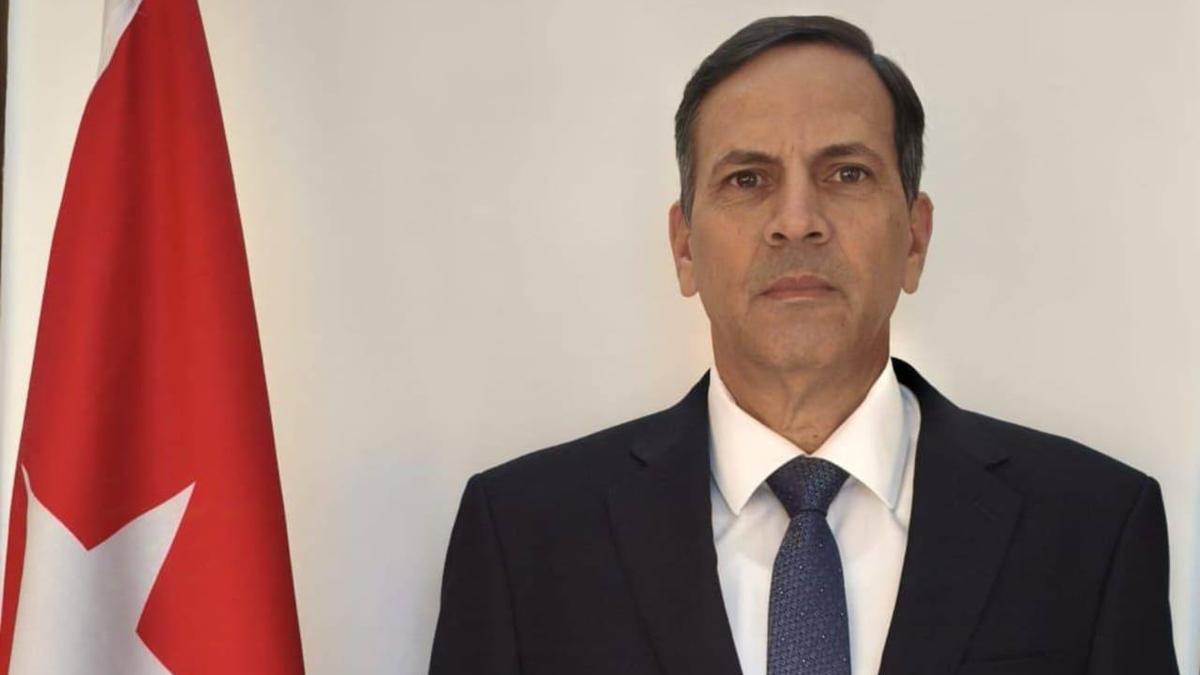
The air in Havana tastes of salt and exhaust. It is a thick, humid presence that clings to the skin, mirroring the political atmosphere that has defined this island for sixty-five years. When Juan Carlos Marsán, the deputy head of the International Relations Department of the Communist Party of Cuba, speaks about the future of his nation, he isn't just reciting policy. He is defending a fortress.
To understand the friction between Washington and Havana, you have to look past the trade charts and the diplomatic cables. You have to look at the Cuban constitution not as a legal document, but as a survival manual. Marsán recently reinforced a line in the sand that has been drawn, erased, and redrawn since 1959: Cuba’s political system is not, and never will be, up for negotiation. For a more detailed analysis into similar topics, we suggest: this related article.
The Architect and the Occupant
Consider a hypothetical resident named Elias. He lives in a crumbling Art Deco building in Vedado. He spends his mornings looking for coffee and his afternoons repairing a 1954 Chevy with parts salvaged from a Soviet tractor. For Elias, the "system" is the water that flows through his pipes and the ration book in his kitchen drawer. When American diplomats talk about "democratic transition," Elias hears the sound of his foundation being jacked up. When Marsán speaks of "sovereignty," Elias hears a promise that, for better or worse, the house stays as it is.
The conflict isn't merely about economics or human rights. It is a clash of fundamental definitions. To the United States, democracy is a process of multi-party elections and free-market competition. To the leadership in Havana, democracy is the preservation of social gains—healthcare, education, and security—achieved through a singular, unified socialist path. To get more context on this issue, in-depth reporting can also be found at The Washington Post.
Marsán’s recent declarations serve as a cold shower for those expecting a sudden thaw. He makes it clear that while Cuba is open to dialogue on equal footing, the "Socialist character of the Revolution" is an immutable fact. It is the granite wall.
The Weight of 1902
History in Cuba isn't a school subject. It is a ghost that sits at the dinner table. The Cuban psyche is haunted by the Platt Amendment of 1902, a provision that gave the United States the right to intervene in Cuban affairs. Every modern refusal to discuss "political change" is a direct response to that century-old scar.
When a superpower suggests that a smaller neighbor should adjust its internal governance to facilitate trade, it doesn't sound like a suggestion to a Cuban diplomat. It sounds like an ultimatum. It sounds like a return to the era of the protectorate.
The tragedy of this stalemate is that it is built on a foundation of mutual exhaustion. The U.S. embargo, or el bloqueo, has been in place longer than most Cubans have been alive. It is a blunt instrument designed to create enough misery to force a political pivot. Yet, the pivot never comes. Instead, the pressure hardens the resolve of the leadership. The harder the push from the north, the more the Cuban government justifies its centralized control as a defensive necessity.
The Invisible Stakes of the Dinner Table
The abstract debates in marble halls have very real, very physical consequences for the people on the ground. The current economic crisis in Cuba is the most severe since the "Special Period" of the 1990s. Fuel is scarce. Electricity flickers. Young people are leaving the island in record numbers, crossing borders and oceans to find a different kind of life.
This is the human cost of the granite wall.
The Cuban leadership argues that their system is the only thing protecting the island from becoming a playground for foreign capital, where the poor are pushed to the margins. They see the political system as the shield. The United States sees that same system as the cage.
Marsán’s insistence that the system is not on the table creates a paradox. How do you move forward with a neighbor who demands you change your identity before they will trade with you? And how do you survive as a nation if you refuse to adapt to the reality of the global economy?
The Myth of the Blank Slate
There is a common misconception in the West that if the Cuban government simply "opened up," the island would instantly transform into a Caribbean paradise. This ignores the complexity of the transition. It ignores the millions of people whose lives, pensions, and identities are tied to the current structure.
Change in Cuba is happening, but it is a slow, tectonic shift. Small businesses are now legal. Private property is being recognized in ways that would have been unthinkable twenty years ago. But these are economic concessions, not political ones. The Communist Party remains the only legal political force.
For the men and women in the halls of power in Havana, the survival of the party is synonymous with the survival of the nation. To negotiate the political system is to negotiate their own existence. It is a non-starter.
The Ghost of the Cold War
The world has changed, but the U.S.-Cuba relationship remains trapped in a time capsule. The Cold War ended decades ago, yet the rhetoric used by both sides remains remarkably consistent. The U.S. continues to list Cuba as a State Sponsor of Terrorism—a designation that Marsán and his colleagues view as a cynical tool of economic warfare.
This label makes it nearly impossible for Cuba to access the international banking system. It strangles the very private entrepreneurs the U.S. claims to want to help. It is a cycle of contradictions. We want the Cuban people to thrive, yet we maintain policies that ensure they struggle. We want the government to talk, but we set conditions we know they will never accept.
The Silence Between the Words
In the streets of Havana, the silence is often more telling than the speeches. People go about their lives with a weary resilience. They have heard the rhetoric from both sides for generations. They have seen the "thaw" under the Obama administration and the "freeze" under the Trump administration. They know that regardless of what is said in Washington or at a podium in Havana, their reality remains a struggle for the basics.
Marsán’s message is a reminder that the Cuban government is not looking for a savior. They are looking for a neighbor who will accept them as they are. Whether that is possible in the current political climate of the United States is another question entirely.
The tragedy of the "not on the table" stance is that it leaves very little room for the table itself. If the core of the disagreement is the very soul of the nation, then the dialogue is destined to be a series of monologues.
The Last House on the Street
Imagine a street where two neighbors have been feuding for sixty years. One neighbor is wealthy and powerful, demanding the other renovate his house to match the rest of the neighborhood. The other neighbor is proud and stubborn, insisting that his house, though in disrepair, is his own and he will paint the walls whatever color he chooses.
The wealthy neighbor cuts off the electricity. The proud neighbor locks the gates.
Eventually, the house becomes a symbol of defiance rather than a place to live. The windows are boarded up to keep out the wind, but they also keep out the light. The children of the house start climbing over the back fence to find somewhere else to stay.
This is the state of the Cuban-American dialogue. It is a battle of wills played out over the lives of eleven million people.
Juan Carlos Marsán isn't just a politician; he is a guardian of a legacy. But legacies are heavy things to carry. As the sun sets over the Malecón, casting long shadows across the salt-stained stone, the wall remains. It is unyielding, firm, and silent, standing between a revolutionary past and an uncertain future, while the sea continues to beat against the shore, indifferent to the treaties that will never be signed.