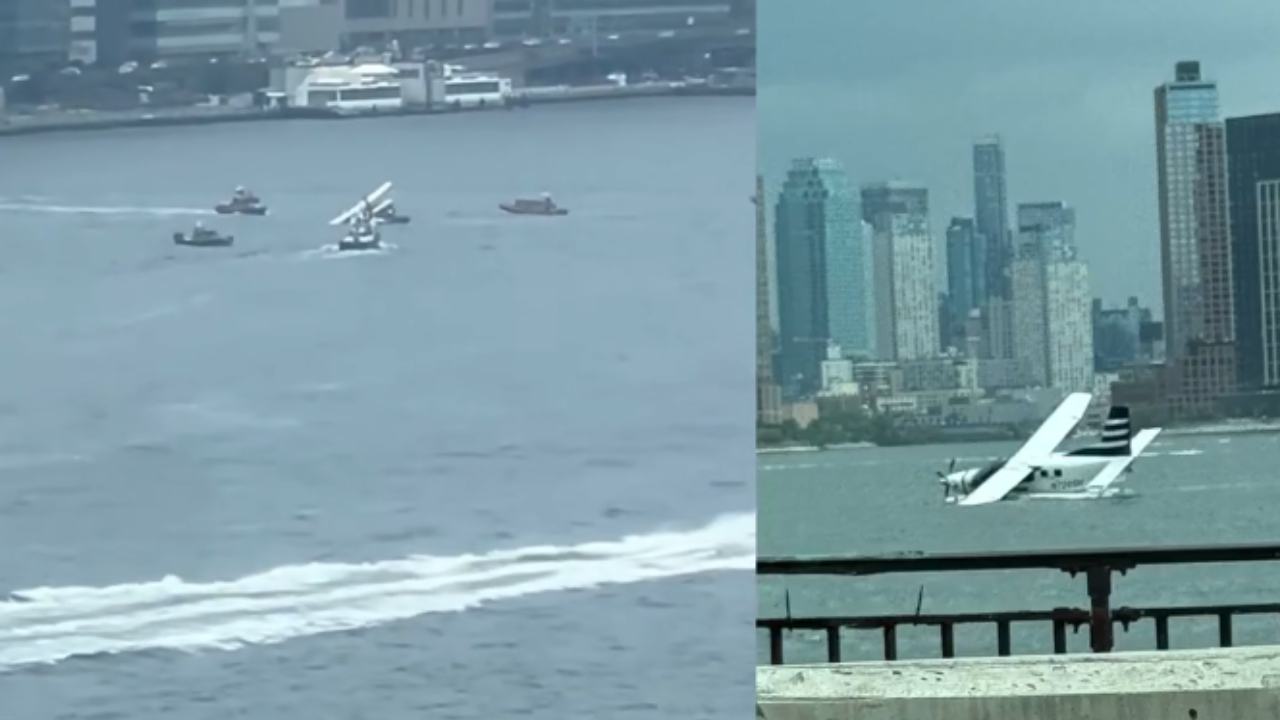
The transition from a pristine summer afternoon in the Hamptons to the freezing panic of an aviation emergency takes exactly forty-seven minutes.
On a bright Sunday in July, eight people boarded a Kodiak 100 seaplane at the Town of East Hampton Airport. They were expecting a quick, scenic commute over Long Island, culminating in a smooth water landing at the East 23rd Street Skyport terminal in Manhattan. Instead, they became the center of a chaotic rescue operation that stopped traffic along the FDR Drive.
I know the deceptive nature of these waterways. When you look down at the East River from an office building or a riverside park, it looks like a flat, metallic ribbon tracing the edge of Manhattan. It is anything but. The East River is actually a tidal strait, a turbulent confluence where the Long Island Sound meets the Atlantic Ocean. The currents are violent, the wakes from passing ferries create erratic swells, and the wind tunnels created by the city's skyline can change a pilot's trajectory in a fraction of a second.
When the Kodiak 100 hit the surface just past noon, the water was not a runway. It was concrete.
The Friction of a Hard Landing
An airplane is designed to slice through the air, but a seaplane must also master the physics of fluid dynamics. For a hypothetical passenger sitting in that cabin—let us call her Sarah—the flight was entirely unremarkable until the final descent. You glide past the bridges, the skyline rises to meet you, and you brace for the familiar, reassuring hiss of the hulls meeting the river.
Then comes the impact.
A "hard landing" is an aviation euphemism that fails to capture the sheer violence of the event. When a fuselage hits choppy water at high speed, the decelerating forces are immense. On this Sunday, the impact was severe enough to snap a wing strut—the heavy structural pole connecting the wing to the main body of the aircraft.
Consider what happens next: a sudden lurch, the sound of tearing metal, and the sickening sensation of the aircraft tilting as one wing submerges into the brackish water.
Over the airwaves, the calm routine of New York air traffic control shattered.
"Mayday, mayday, mayday," an NYPD helicopter pilot radioed in, his voice cutting through the standard technical chatter. "Plane down in the water."
The aircraft was partially capsized, dead in the water off the Manhattan marina. For the eight souls on board, the cabin suddenly became a tilting, unstable room with water slapping against the windows.
Minutes into Seconds
In a water ditching, the clock is your primary adversary. The human brain does not process a crisis in a linear fashion; it slows down, trapped in a loop of disbelief. You look at your watch, you look at the person next to you, and you wonder if the floor is genuinely slanting.
But New York City's emergency infrastructure is built for worst-case scenarios.
The New York City Fire Department received the emergency call at 12:01 p.m. Within minutes, a massive technical response materialized on the river. Five rescue boats tore through the wakes, sirens echoing off the brick facades of the FDR Drive.
For the passengers waiting inside the listing Kodiak 100, those minutes must have felt like hours. The East River is notorious for its swift undertows. If the plane turned completely over, escaping a submerged, darkened cabin requires a level of composure that few untrained civilians possess.
When the FDNY Marine units arrived, the transition from victims to survivors began. Firefighters pulled all eight individuals from the crippled aircraft onto rescue vessels. Two passengers were evaluated for minor injuries; both ultimately refused further medical attention. No one drowned. No one was trapped.
By the grace of rapid response and a resilient fuselage, it was a catastrophe averted.
The Pattern in the Water
It is tempting to view this incident as an isolated stroke of bad luck, but seasoned aviators know that convenience always battles against environmental reality. This hard landing occurred less than a month after another seaplane malfunctioned and began taking on water near the Throgs Neck Bridge in Queens.
The sky above New York is crowded, but the water below is increasingly treacherous for aviation.
The Federal Aviation Administration and the National Transportation Safety Board have launched an investigation into the structural failure of the wing strut and the environmental conditions at noon on that Sunday. They will pore over wind data, tidal charts, and maintenance logs to understand why a routine commuter flight ended with five rescue boats towing an upright airplane back to a Manhattan dock.
We live in an era where we expect mechanical precision to completely erase the volatility of nature. We book flights like we book Ubers, forgetting that flying an aircraft onto a moving, tidal body of water requires an intricate dance with thermodynamics, fluid mechanics, and human judgment.
When the rescue boats finally towed the Kodiak 100 back to the pier, the adrenaline faded, leaving only the quiet reality of what almost was. The passengers walked away into the Manhattan afternoon, their clothes damp, carrying the heavy, indelible realization that the line between a routine commute and a fight for survival is as thin as a snapped piece of aluminum.