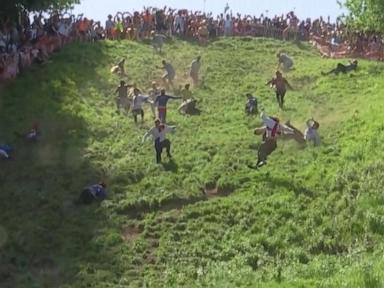
The grass at the crest of Cooper's Hill is not normal grass. By late May, baked under a relentless Gloucestershire sun that has pushed the thermometer toward an unprecedented thirty degrees Celsius, it turns into a slick, deceptive thatch. Beneath it lies a cliff masquerading as a hill. A one-to-two gradient.
Stand at the top, look down the two-hundred-yard drop, and your stomach hits your shoes. The horizon disappears. You are looking straight down into a basin of thousands of screaming spectators, their faces blurred by the shimmering heat.
Then, an old man in a white smock steps forward. He holds an eight-pound wheel of Double Gloucester cheese, bound tight like a heavy wooden wheel.
He lets it roll.
A fraction of a second later, you must jump.
The Weight of Twenty-Three Wheels
To understand why a grown man flings himself off a precipice in pursuit of dairy, you have to understand the geography of belonging. Brockworth is a quiet parish. But on the spring bank holiday, it becomes the center of a brutal, beautiful universe.
Chris Anderson is thirty-eight years old. He is a local hero, a soldier, and the undisputed titan of the hill. Between 2005 and 2022, he took home twenty-three wheels of cheese. His name is etched into the Guinness World Records. His body bears the invisible scars of a legacy built on concussions, torn ligaments, and broken bones. He had retired. He had given his ankles and his youth to the slope. He was done.
But legacy is a fragile thing when the world comes knocking at your door.
Enter Tom Kopke. He is twenty-four. He is a YouTuber from Munich with half a million subscribers, a man who fills his digital life with underground Thai fighting and reindeer racing. He represents the new world: fast, filmed, and fiercely unbothered by tradition. Kopke had won the last two years while Anderson watched from the sidelines. The young German publically challenged the old master. He wanted the king back on the hill.
So, Anderson climbed.
"I was so scared at the top," Anderson confessed later. The fear never truly leaves, no matter how many times you have stared down the drop. It is a rational response to an irrational act.
Beside him stood Kopke, a man whose entire strategy relies on a form of psychological erasure. "Shut off your brain and go for it," the younger man says. It sounds like an internet caption, but on Cooper's Hill, it is a survival mechanism. If you think about what you are doing, your muscles tense. If your muscles tense, the hill breaks you.
The whistle blew.
Gravity Always Wins
There is no elegant way to descend Cooper's Hill. It is a violent negotiation with physics.
Consider what happens next: the cheese accelerates to speeds exceeding seventy miles per hour. It has a head start. The human bodies behind it do not run; they tumble. They bounce. They perform involuntary, terrifying cartwheels through the dry air, limbs flailing against a sky that keeps swapping places with the dirt.
For the first hundred yards, the script followed the legend. Anderson took the lead. He possesses what locals call the technique—a way of sliding on the hip, using the body like a toboggan to maintain momentum without losing control. He refuse to sacrifice control for speed. "Obviously you need to be fast," Anderson notes, "but overall it's better to stay in control rather than going flat out."
But the hill has its own ideas. The ground, baked hard by the historic heatwave, offered no traction, only impact.
Kopke was haring down behind him, a chaotic force of pure velocity. He didn't care about control. He gave everything to the fall. In the middle of the hill, where the slope drops away into a stomach-churning void, Kopke found a momentary, miraculous recovery. He caught his footing for a split second, converted gravity into a sprint, and launched himself forward.
"I saw Tom come past me," Anderson said, "and knew it was over."
They crossed the bottom line almost together, crashing into the muddy catch-crew of local rugby players whose sole job is to stop human projectiles from smashing into the barriers.
Kopke had won. Three in a row.
At the bottom, covered in dust and sweat, the young upstart and the old king embraced. There was no bitterness. The hill burns away pettiness. "If that hill is hell, I'm the devil," Kopke yelled to the crowd, hoisting the eight-pound Double Gloucester above his head. "This year's cheese will taste the sweetest of all the cheeses I have won."
The Globalized Slope
The hill is changing. What used to be a hyper-local rite of passage for Gloucestershire villages has become an international proving ground. The BBC broadcasted the event live. The crowd was a mosaic of languages.
Every single downhill race that afternoon was won by an outsider.
The second men's downhill race went to Niels Wennemars, a twenty-one-year-old from the Netherlands. His father, Erben, and brother, Joep, are world-champion speed skaters. He knows about speed, but ice is flat. This was different. "If you can stand and stay on your feet, you will win," Wennemars said, bewildered by the thousands of people clamoring to take a photo with him. "I am a god here!"
Then came Alix Heugas, a twenty-seven-year-old woman from the Basque region of France, who claimed the women's title with a philosophy that summed up the entire afternoon: "I had no technique, no training, just wing it."
An American teenager from Florida, nineteen-year-old Otto Linkogle, took the final downhill race, his heart pounding in his chest as he ran a track that felt less like athletics and more like an escape room with no doors.
But beneath the influx of global influencers and international athletes, the roots of Brockworth still run deep into the soil of Cooper's Hill.
While Chris Anderson sat at the bottom, his second-place finish signaling a passing of the torch, he wasn't the last Anderson on the mountain. The family legacy simply shifted its weight. His eleven-year-old son, Will, lined up at the bottom for the brutal, sweaty children's uphill race—a contest where you fight the incline rather than surrender to it.
Will won.
Minutes later, Chris’s sixteen-year-old nephew, Xander, won the teenager’s race.
The younger generation went home with their own blocks of cheese, secured not by falling, but by climbing. Young Will already has his eyes on the summit. He plans to keep the family tradition going by competing in the downhill race the moment he is old enough.
The cheese itself, crafted by long-time cheesemaker Rod Smart for over a quarter of a century, remains the ultimate, absurd prize. It is kept in a fridge until the final moment, wrapped carefully to survive a descent that breaks bones. It is a symbol of something ancient, a stubborn refusal to let modern safety culture completely flatten the sharp edges of human daring.
As the sun began to drop behind the ridge, the crowds started to thin, leaving the hill scarred, flattened, and silent once more. The winners walked away with their dairy, their bruises, and their stories.
You can live your life carefully, measuring every step, avoiding the steep drops and the hard landings. But at the top of that ridge, looking down into the green abyss, a different truth becomes clear. If you live scared, you are going to die scared, and that is the worst way to live.


