The narrative is as predictable as a Parisian strike: American higher education is in a "death spiral" because of the political climate. The pundits claim that French students are fleeing the U.S. university system, terrified by shifting visa policies or the aesthetic of the current administration. They paint a picture of empty lecture halls at NYU and Columbia, with French elites supposedly opting for the "safety" and "prestige" of homegrown Grandes Écoles or the cheaper pastures of Canada.
It is a beautiful story. It is also completely wrong.
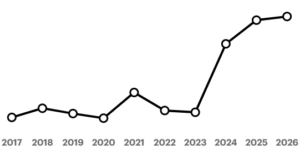
The data suggests a superficial dip, but the underlying mechanics tell a different story. What we are witnessing isn't the "loss of allure" for the American degree. We are seeing a market correction. The weak, the uninspired, and those looking for a four-year vacation are dropping out. The high-performers? They are doubling down.
The Myth of the Political Exodus
The "Trump Effect" is the favorite boogeyman of academic administrators who can't explain their own declining enrollment numbers. Yes, international applications saw a wobble. But zoom out. The students who are "deterred" by a headline are rarely the ones who were going to revolutionize a field or lead a multinational.
In the corridors of power in the 8th Arrondissement, nobody cares about a tweet. They care about the Network Effect.
An American degree remains the only global currency that trades at a premium in every single market. A degree from HEC Paris is prestigious, certainly, but its utility drops significantly once you leave the Eurozone. A degree from Stanford or MIT is a skeleton key for the global economy. To suggest that French students are trading that for a local alternative because of a four-year political cycle is to fundamentally misunderstand how the French elite operate. They are cynical, they are calculated, and they are long-term investors.
The Luxury Good Paradox
Higher education in the United States has transitioned from a service to a luxury Veblen good. In economics, a Veblen good is something for which demand increases as the price increases because it serves as a status symbol.
By making the U.S. harder to get into—whether through stricter visa vetting or astronomical tuition—the American university has inadvertently increased its brand value. If everyone can get a visa, the visa is worthless. When the process becomes a gauntlet, surviving it becomes a badge of merit.
I have consulted for families in Lyon and Bordeaux who are willing to spend $400,000 on an undergraduate education. They aren't paying for the "knowledge." You can get the knowledge on YouTube or through a $15 book. They are paying for the Institutional Imprimatur. They are buying a seat at the table where the world’s future capital is being allocated.
Why Canada and Europe are Consolation Prizes
The media loves to highlight the surge in French applications to McGill or the University of Toronto. "Look!" they cry. "They’re going to Montreal instead!"
Montreal is a wonderful city. McGill is a fine school. But let’s be brutally honest: Nobody goes to McGill because they prefer it to Harvard. They go to McGill because they didn’t get into Harvard, or they couldn't afford the entry fee.
Canada is the "safe" choice. The United States is the "high-beta" choice. If you want a comfortable, subsidized life with a reasonable ceiling, you stay in the Francophonie. If you want to build a company that changes the way $100 billion moves across borders, you go to the place that invented the venture capital model.
The French startup scene, often called "La French Tech," is built almost entirely on the backs of founders who spent time in the U.S. They returned to Paris not because they hated America, but because they wanted to arbitrage American "blitzscaling" tactics in a less competitive European market.
The Visa Scarcity Value
We need to address the "People Also Ask" obsession with the H-1B visa. The common logic is: "If I can't stay and work, why should I go?"
This is the wrong question. The value of the American degree for a French national isn't necessarily the right to work in a cubicle in New Jersey. It’s the Reverse Brain Drain.
France is currently obsessed with "sovereignty"—digital sovereignty, industrial sovereignty, academic sovereignty. A French student who secures an American degree and then "returns to the fold" is treated like a conquering hero. They are immediately fast-tracked into leadership positions because they possess the one thing the French system cannot produce: an American-style "fail fast" mentality.
The difficulty of the visa process actually helps this. It forces the rotation of talent back to France, where these individuals become the new gatekeepers.
Dismantling the "Prestige" Argument
The competitor article suggests that French universities are catching up. Let’s look at the "Shanghai Ranking" or the "QS World University Rankings."
| University | Global Rank (Average) | Endowment (Approx) |
|---|---|---|
| Harvard | 1 | $50 Billion |
| Stanford | 2 | $36 Billion |
| Université Paris-Saclay | 15-20 | $1 Billion |
Money is the mother’s milk of innovation. You cannot compete with a system that has more capital in a single university endowment than some countries have in their entire GDP.
French education is brilliant at theory. It produces world-class mathematicians and philosophers. But it is terrible at the Applied Commercialization of those ideas. The American university is a lab-to-market pipeline. As long as the U.S. maintains the world’s most liquid capital markets, the allure of its universities will remain untouchable.
The Quality of the "Alternative"
What are these French students supposedly choosing instead? The Grandes Écoles like Polytechnique or HEC are elite, but they are insular. They are echo chambers of the French state.
In an era of global fragmentation, being "elite in France" is a dangerous strategy. It’s a hedge against the world, not a bet on it. The French students who are "opting out" of the U.S. are generally those who were never going to thrive in a high-pressure, meritocratic environment anyway. They are choosing the path of least resistance.
The truly ambitious French student knows that the "Trump Era" or whatever political label you want to slap on the current moment is noise. The signal is the research output, the alumni network, and the sheer density of talent concentrated in places like Cambridge, Palo Alto, and Chicago.
The Actionable Truth
If you are a student or a parent reading the "decline of American education" headlines and feeling relieved that you can just stay in Europe—you are being lied to. You are being sold a narrative of comfort that will lead to professional stagnation.
- Ignore the politics. Universities are 500-year institutions. Presidents are 4-to-8-year temporary tenants. Do not make a 40-year career decision based on a 4-year news cycle.
- Follow the R&D spend. Look at where the patents are being filed. Look at where the AI breakthroughs are actually happening. It’s not in the Sorbonne.
- Value the friction. If it’s harder to get into the U.S. right now, the value of being there is higher. Arbitrage the fear of others.
The "loss of allure" is a myth designed to make those who stayed behind feel better about their choices. The French elite aren't leaving the U.S. market; they are just getting quieter about how they dominate it.
Stop looking for reasons to stay comfortable. The American degree isn't a piece of paper; it’s a license to operate at the edge of the possible. If you can’t see that because you’re distracted by the headlines, you’ve already lost the game.
Go where the capital is. Go where the risk is rewarded. Everything else is just local theater.