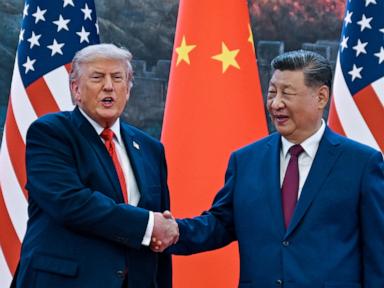
Donald Trump and Xi Jinping walked into the Great Hall of the People today with a shared mission that has nothing to do with global stability and everything to do with domestic survival. After a decade-long drought of presidential visits to Beijing, the pageantry was dialed to a maximum, but the substance remains dangerously thin. The primary takeaway from Day 1 is that both leaders are effectively using each other as a political shield to buy time against failing domestic agendas.
The meeting is less a diplomatic breakthrough and more a compliance checkpoint for the "Busan truce" signed last October. Trump needs a win to distract from a sagging approval rating and a persistent inflationary crisis, while Xi is desperate to keep the American tariff hammer from falling harder on a Chinese economy that is still gasping for air.
The Taiwan Pawn in a High-Stakes Game
Xi Jinping did not waste time with pleasantries when the doors closed for their two-hour private session. He told Trump directly that missteps on Taiwan could push the two nations into an outright collision. This isn't just standard rhetoric. Beijing is testing a president who has shown a transactional streak that makes Taipei nervous.
Trump’s recent comments casting doubt on the delivery of an $11 billion arms package to Taiwan have created a vacuum of certainty. Xi is stepping into that vacuum. He is looking for a specific verbal concession—something as small as "opposing" rather than "not supporting" Taiwan independence—that he can take back to the Politburo as a victory. For Trump, Taiwan is a bargaining chip to be traded for "massive" agricultural buys that appease his base in the American Midwest.
The Board of Trade Illusion
A new mechanism is being floated called the "Board of Trade." It sounds official, but it is essentially a pressure valve designed to separate "non-sensitive" goods from the high-tech trade war.
The idea is simple: lower tariffs on things like soybeans, Boeing jets, and liquified natural gas (LNG) while keeping the restrictions on semiconductors and AI hardware. It is a tactical retreat for both sides. Trump gets to claim he is bringing back the "Phase One" glory days, and Xi gets to ensure that Chinese factories can keep exporting consumer goods without the looming threat of 60 percent across-the-board tariffs.
However, this board is a hollow structure. It ignores the reality that the definition of "national security" in 2026 has expanded to include almost everything with a battery or a circuit board.
The Hidden Iran Factor
While the public focus was on trade, the shadow of the Strait of Hormuz hung over the Great Hall. The ongoing conflict in Iran has spiked global energy prices, and Trump is looking for a way out. He knows that Beijing is the only player with enough economic leverage over Tehran to force a reopening of the shipping lanes.
Xi sees this as his ultimate leverage. He is unlikely to lift a finger to help the U.S. energy crisis unless Trump offers a significant rollback on the export controls that are currently strangling China’s domestic AI development. It is a brutal trade-off: lower gas prices at the pump for Americans in exchange for handing the keys of the future tech economy to the CCP.
Rare Earths and the Fragile Truce
China's decision last October to suspend export controls on rare earth minerals—gallium, germanium, and graphite—was the only thing that kept the American tech sector from a total cardiac arrest. That suspension is set to expire.
Trump’s mission today was to make that suspension permanent. Xi’s response has been a calculated "maybe." He knows that the moment he grants a permanent license, he loses his best weapon in the next round of negotiations. The U.S. is trying to build alternative supply chains via the "Pax Silica" initiative, but those factories won't be online for years. For now, the American high-tech industry is still on a leash held by Beijing.
The CEO Delegation and the Optic of Success
Trump didn't travel alone. He brought a phalanx of American CEOs, turning the diplomatic mission into a corporate trade show. This is classic Trumpian theater. By surrounding himself with captains of industry, he frames the summit as a business deal rather than a geopolitical concession.
These CEOs are desperate for market access, but they are also terrified of the "Unreliable Entity List" that Beijing uses to punish firms that comply with U.S. sanctions. The presence of these executives is meant to signal that the "decoupling" of the last few years was just a bad dream. The reality is that the decoupling is still happening; it’s just getting more expensive and more complicated to manage.
The Fentanyl Performance
There was the expected talk about fentanyl precursors. China recently shut down 200 websites and arrested a handful of low-level players, but as any veteran investigator knows, this is "tactical cooperation."
Beijing uses the fentanyl issue like a thermostat. They turn the pressure down when they want something from Washington and let it rise when they are angry. Trump needs these arrests to show he’s winning the "war on drugs" at home, but there is no evidence that the actual volume of chemicals leaving Chinese ports has decreased in any meaningful way.
A Stalemated Superpower Reality
The Day 1 "takeaways" being blasted across cable news focus on the smiles and the Temple of Heaven tour. Don't be fooled by the scenery. This is a meeting between two men who are deeply weakened at home and are using a fake sense of "strategic stability" to keep their respective houses from falling down.
There were no signatures on a grand bargain today. There were only promises to keep talking about the things they have already been talking about for ten years. The "new positioning" Xi mentioned is just a fancy way of saying they have reached an asymmetric stalemate. Neither side can afford a war, but neither side can afford to look like they are backing down.
The summit continues tomorrow, but the script is already written. Expect a "joint statement" that is heavy on adjectives and light on binding commitments. Trump will fly home claiming the biggest deal in history, and Xi will go back to his office knowing he has successfully frozen American policy for another six months.
The real danger isn't that the summit will fail. It’s that it will "succeed" in a way that allows both sides to ignore the structural rot that is pushing them toward a much larger conflict toward the end of the decade.