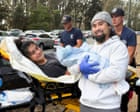
The Anatomy of an Urban Paralysis
San Francisco traffic has long tested the boundaries of human patience. Commuters expect delays on the Bay Bridge, crawl at glacial speeds down Lombard Street, and accept that getting from Mission to the Marina during rush hour requires a calculated psychological surrender. But the systemic breakdown of municipal infrastructure reaches a terrifying milestone when routine gridlock intercepts an emergency birth.
When a woman delivers a child inside a stagnant sedan trapped between unmoving lanes of metal and asphalt, the story transcends a bizarre local anecdote. It exposes a structural failure in urban mobility and emergency response corridors. The incident highlights an uncomfortable reality about modern metropolitan planning. When congestion locks down a city artery, critical response times stretch past the breaking point, turning public thoroughfares into accidental delivery rooms. Recently making news in this space: What Most People Get Wrong About Far Right Gains in German Elections.
Understanding how this occurs requires looking beyond the driver's immediate panic. Urban density creates high-stakes pressure cookers. When vehicles fill every available inch of asphalt, emergency vehicles find themselves trapped alongside the citizens they need to rescue.
When the Golden Gate Corridor Becomes a Parking Lot
Urban planners talk endlessly about throughput, lane optimization, and transit-first initiatives. They map out bike lanes and design pedestrian plazas while the core arterial roads choke on single-occupancy vehicles and delivery vans. San Francisco possesses a unique topography. Its narrow corridors, historic grid layouts, and dense population centers make traffic management an exercise in geometric impossibility. Additional insights regarding the matter are explored by Associated Press.
During peak hours, major routes through the city resemble blocked arteries. An unexpected stall, a minor fender-bender, or sudden construction triggers a cascading slowdown that ripples across neighborhoods within minutes. For a pregnant woman in active labor, this systemic fragility transforms a standard hospital commute into an impossible gauntlet.
First responders operate under sophisticated dispatch protocols, yet even the most efficient ambulance service cannot levitate above bumper-to-bumper traffic. Motorists frequently lack the physical space to pull aside. When vehicles are packed shoulder-to-shoulder with zero clearance on the shoulders or medians, the path forward simply does not exist.
The Human Cost of Congested Infrastructure
Public discourse often treats traffic as an economic nuisance or a psychological annoyance. Commuters lose billable hours, fleets burn excess fuel, and collective blood pressure spikes. Yet the true cost measures in emergency metrics.
When a vehicle stalls in traffic with a medical crisis unfolding inside, the occupants face total isolation. Cell service can falter in urban concrete canyons. Dispatchers struggle to pinpoint moving vehicles trapped in shifting blocks of traffic. Bystanders can offer little beyond worried glances through tinted windows.
This specific incident in San Francisco forces a reevaluation of how cities manage unexpected crises on the road. Infrastructure must account for the statistical certainty of medical emergencies occurring during transit delays. Without dedicated emergency corridors that remain clear of regular vehicular overflow, citizens remain entirely vulnerable to the whims of gridlock.
Rethinking Urban Transit Realities
Municipal authorities must confront the widening gap between traffic volume and emergency preparedness. Relying on drivers to spontaneously create a miraculous parting of the sea during peak congestion is a flawed strategy. Cities require automated traffic management systems that can instantly flush specific lanes when an emergency vehicle signals distress.
Furthermore, public awareness campaigns regarding pedestrian and motorist cooperation during high-stress medical transport remain sparse. Drivers receive minimal instruction on how to handle an emergency vehicle trapped behind them when there is literally nowhere to move.
The image of a baby entering the world amid the roar of idling engines and honking horns serves as a stark warning. It is a symbol of a transportation network stretched past its functional limits. Until cities engineer resilience directly into their concrete and traffic algorithms, the daily commute will remain a gamble where the stakes are far higher than simply arriving late to work.