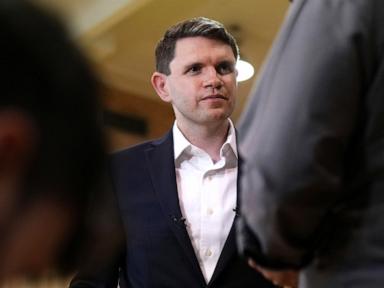
Picture the hum of a television set at eight o'clock on a Tuesday evening in a living room somewhere outside Waco or Corpus Christi. The air conditioner rattles through its cycle. Outside, cicadas drone in the darkening cedar trees. A tired parent sits with a bowl of soup, half-watching a local news broadcast, when the screen snaps bright with harsh lighting, ominous violin stings, and sharp, rapid-fire accusations aimed at a candidate named James Talarico. Seconds later, another spot hits. Then another. A digital banner follows them onto their phone while they scroll in bed before sleep.
Money. Read more on a connected issue: this related article.
That is what those commercials actually are once you strip away the voiceovers and the dramatic zoom-ins. Not just ink and pixels and airtime, though there is plenty of all three. They are concentrated weight. When James Talarico compares his uphill political battle to the biblical story of David standing across a valley from Goliath after Republican aligned groups pour more than $158 million into opposing him, he is reaching for an old, familiar myth to explain a very modern shockwave.
To be honest, hearing a politician invoke David and Goliath can make even sympathetic listeners roll their eyes. Every underdog campaign in American history has reached for that sling at some point. Usually, it sounds like campaign theater—a neat soundbite designed for a fundraising email or a cable news clip. Yet when the opposing spend crosses $158 million, the metaphor stops feeling like mere rhetoric and starts feeling like a question about scale, endurance, and what kind of voice can still be heard over a deafening roar. Additional journalism by Al Jazeera explores related views on this issue.
The Weight of Nine Figures in a Single Race
Numbers that large lose their texture fast. Once a figure passes ten million, or fifty million, or $158 million, the human brain tends to treat it like weather—something vast, distant, and outside anyone's direct control.
A quick reality check helps put that sum in perspective. Suppose a single household earns $75,000 a year and saves every penny of it without paying taxes, rent, groceries, or electric bills. Reaching $158 million would take more than two thousand years. Even in modern American politics, where statewide media markets gobble up cash like dry brush in a July wind, $158 million aimed against one candidate is an extraordinary concentration of firepower. It buys wall-to-wall broadcast slots across sprawling media markets, relentless digital targeting, mailers stacked knee-high on kitchen counters, polling operations, and narrative framing repeated until strangers feel as though they already know everything bad there is to know about a man they have never met.
If you have ever stood in a crowded room where someone with a megaphone is shouting your name and distorting every word you say, you know the peculiar exhaustion of trying to speak in a normal voice against amplified noise. Every time you explain your record on public schools or health care or affordability, ten ads are already running in three counties telling voters what to fear instead.
That imbalance is why the biblical comparison resonates so strongly with Talarico and his supporters, even if critics dismiss it as self-serving drama. In the ancient account from the Book of Samuel, the mismatch is visible before a single stone is thrown. Goliath wears heavy bronze armor and carries weapons meant for crushing formations; David has a shepherd's pouch, a leather sling, and stones picked from a stream bed. The drama isn't subtle. The whole point of the story is that the giant looks inevitable.
A Metaphor Under the Microscope
Hold on—let's be clear about what this comparison is and what it isn't. This is a metaphor, and like every metaphor, it stretches if you pull it too hard.
Modern elections are not ancient valleys, and political opponents are not cartoon villains twirling mustaches in bronze helmets. A campaign spending over $158 million against Talarico isn't casting a magic spell over voters' minds. People still choose what to watch, what to believe, and whom to trust. Voters in a massive, diverse state have their own frustrations with the cost of groceries, property taxes, housing, and leadership, and no amount of television spending automatically erases a person's lived experience at the checkout line.
At the same time, ignoring the mechanics of massive outside spending would be just as naive as pretending it guarantees victory. Advertising works incrementally, like water dripping on limestone. One ad rarely flips a hardened voter. Fifty ads over two months, paired with targeted digital feeds and coordinated messaging, shape the boundaries of what feels normal, urgent, or disqualifying. They define the terms of the fight before the other side can even unpack its bags.
To ground this abstract dynamic in everyday reality, consider a hypothetical character—let's call her Marta, a retired nurse living outside Austin who votes regularly, pays close attention to state politics, and considers herself independent. Marta doesn't watch partisan cable shows all day. She catches twenty minutes of evening news while cooking dinner and checks her tablet with her morning coffee. Over six weeks, she sees Talarico's name dozens of times—almost always framed through glossy, urgent attack spots funded by outside committees. Even if Marta is skeptical of negative ads, repetition leaves a mark. A question plants itself in the back of her mind: Wait—why are so many people spending so much money to warn me about this guy?
That is the quiet power of a $158 million headwind. You don't have to persuade every voter to love the attack. You only have to create doubt, fatigue, or distance at the margins—and in tight elections, margins are where outcomes live.
Why David and Goliath Still Hooks Us
Why do we keep coming back to David?
Partly because most of us know what it feels like to be outmatched. Maybe it's a small family business trying to survive when a massive chain opens down the road. Maybe it's a parent fighting a school district or an insurance company over a denied claim. Maybe it's a young organizer knocking on doors in ninety-degree heat while watching a rival flood the airwaves with cash from donors thousands of miles away.
When someone faces a $158 million tide and says, in effect, "We don't have their money, so we have to rely on something else," they are tapping into an old emotional current. That "something else," in campaign lore, usually means shoe leather, face-to-face conversations, volunteers who actually care rather than getting paid by the hour, and a message simple enough to carry without a hundred-million-dollar megaphone.
Yet there is a catch in that story that people often gloss over. In the biblical narrative, David isn't just plucky; he is practiced with a tool he already knows how to use, and he refuses to put on King Saul's heavy armor because it isn't built for him. Translated into modern politics, a cash-disadvantaged candidate can't win by trying to out-Goliath Goliath. You can't match a nine-figure war chest dollar-for-dollar in a single race without turning the whole enterprise into a pure fundraising treadmill. You have to fight on terrain where money has diminishing returns—in kitchen-table conversations, local trust, clarity of voice, and relentless presence in places that get ignored when campaigns focus only on cheap media buys.
Even then, there are no guarantees. Ancient myths wrap up cleanly in a few paragraphs; real campaigns unfold across months of grueling travel, bad polling days, sleepless nights, and unpredictable turns. Sometimes the stone misses. Sometimes the giant has more stamina than expected.
What Invisible Stakes Are Really on the Line?
When headlines focus on the dollar figure—over $158 million spent against Talarico—it's easy to treat the whole affair like a sporting event with unusually high ticket prices. Who is winning the money race? Who is airing more spots? Who has the sharper comeback?
A sportswriter's lens misses the deeper stakes.
First, there is the question of who gets to set the agenda. When outside groups deploy more than $158 million against a single candidate, a massive share of public attention gets steered toward conflict, fear, and caricature. Nuance gets flattened. Complex policy disagreements—how to fund public schools fairly, how to keep energy grids reliable, how to make healthcare affordable without crushing working families—get compressed into fifteen-second emotional jabs.
Second, there is the question of democratic scale and representation. Voters often feel a quiet alienation from politics when they sense that their local concerns are being drowned out by megadonors and national political machinery. If a candidate can survive—or push back against—a $158 million opposition blitz by connecting directly with ordinary people, it suggests that human connection still has teeth in an era of algorithmic targeting and industrial-scale ad spending. If the sheer weight of money crushes everything in its path, cynicism grows a little thicker.
I won't pretend this is simple or neat. Anyone who has watched modern elections closely knows how messy they are. Voters aren't passive sponges, nor are campaigns pure fairy tales of virtue versus villainy. Real politics is a tug-of-war between institutional muscle and grassroots energy, between polished persuasion and lived trust.
Standing at the Edge of the Valley
Think back to that living room at eight o'clock. The television hums. Another ad flashes across the screen, bright and sharp and expensive, trying to claim the last word before the commercial break ends.
Across the valley, real people are still talking over fences, in grocery aisles, at church potlucks, and around kitchen tables—deciding whom they actually believe when the noise dies down. A sling doesn't look like much next to a wall of armor. Sometimes, though, all anyone has is a steady hand, a clear aim, and the nerve to step onto the field anyway.