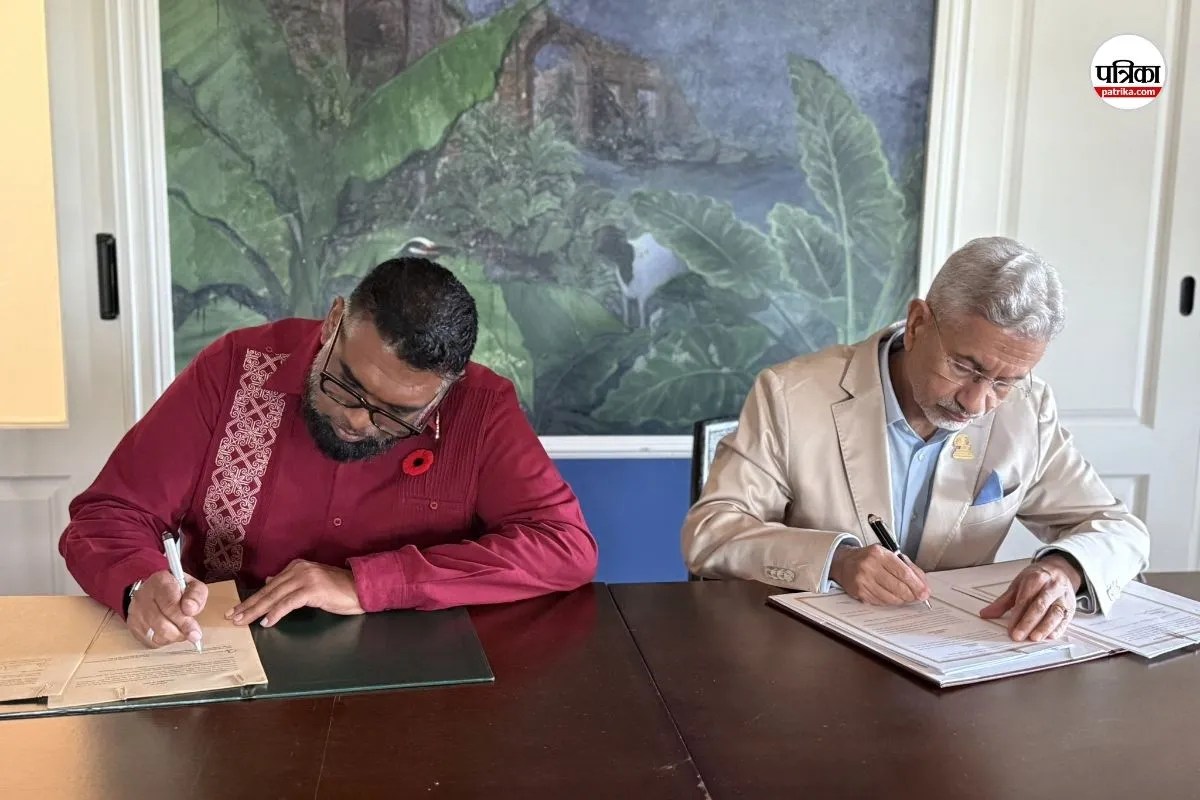
Humidity clings to Georgetown like a second coat. Even in an air-conditioned diplomatic chamber, the Atlantic breeze carries the scent of wet laterite, river silt, and sudden tropical rain.
Sovereignty. Expanding on this idea, you can also read: When a Gambler Bets the House on Someone Else's Table.
That single word sits across the table whenever a foreign minister meets a head of state, heavier than any leather-bound folder. In diplomatic dispatches, a meeting between India's External Affairs Minister S. Jaishankar and Guyana's President Mohamed Irfaan Ali looks tidy: two leaders shake hands, cameras flash, officials sign three agreements, and correspondents file a brief item about bilateral ties.
Cold. Neat. Forgettable. Experts at BBC News have also weighed in on this trend.
Yet treaties do not live inside press releases. They land on docks where cranes lift steel pipes at dawn. They hum inside hospitals where a nurse checks a digital monitor that worked only intermittently last month. They echo in classrooms where an engineering student opens a textbook in English and sees a future that once required a plane ticket across two oceans.
I have watched enough trade corridors and diplomatic summits from close range to know how easy it is to mistake paper for progress. Ink dries fast. Trust takes years. And when an Indian foreign minister sits down with Guyana's president to sign three bilateral pacts, the real question is never just what the documents say on page one. The real question is who feels the shift six months later when the rain stops and the work begins.
The Weight of Atlantic Salt and Distant Memory
Distance is never measured in miles alone. It is measured in friction.
Georgetown sits on the northern coast of South America, facing the Atlantic where the Demerara River meets the open sea. New Delhi sits thousands of miles away across oceans and time zones. For anyone reading a standard news report about S. Jaishankar meeting President Mohamed Irfaan Ali and signing three agreements, that geography can feel abstract—almost like two pins stuck into opposite corners of a wall map.
To make that distance tangible, let us use a metaphor. Think of diplomatic relations between two distant countries as a ferry crossing a wide, choppy estuary. For decades, small boats made the trip—carrying shared history, cultural memory, and occasional goodwill—yet the crossing remained slow, seasonal, and dependent on calm weather. Signing formal agreements is like laying down pilings for a deeper pier. The pilings alone do not carry cargo, but without them, larger ships cannot moor safely.
History already gives this relationship an emotional pulse that most headline summaries gloss over. Guyana is a nation where people of Indian origin form a major part of the population, carrying surnames, recipes, festivals, and family memories that stretch back generations to the indentured labor era of the nineteenth century and forward into modern civic life. When a senior Indian leader meets Guyana's president, family memory and statecraft brush against one another in the same room.
I still remember sitting in a portside cafe years ago, listening to a dockworker argue about why foreign trade deals never seemed to lower the price of roofing sheets or spare parts in his town. He was cynical—not out of cruelty, but out of experience. Politicians promise bridges; workers see invoices.
That skepticism is healthy. Diplomatic agreements only matter when they solve real bottlenecks rather than creating another layer of committee meetings. When S. Jaishankar and President Mohamed Irfaan Ali sit down together and move to three signed agreements, they are trying to push past ceremonial rhetoric into practical cooperation across sectors that shape daily life and national capacity.
Consider what happens next when a small, fast-growing economy meets a large, diversified industrial and technological power. A smaller nation can gain speed, specialized training, and supply diversification without surrendering its independence. A larger partner gains trust, regional goodwill in the Caribbean and South America, and long-term economic presence in a country undergoing rapid transformation.
Still, I have to admit something honest: diplomatic language often hides what is actually being negotiated behind closed doors. Public summaries tell us that three agreements were signed after a meeting between the External Affairs Minister and the president, yet they rarely spell out every commercial clause, timeline, or implementation hurdle on the spot. Pretending we know every line item that was not released would be dishonest. What we can trace—with clear eyes—is why three targeted agreements in a high-level bilateral meeting carry weight far beyond a photo op.
Why Three Signatures Matter More Than Headlines
Why three?
Not ten. Not a vague declaration of eternal friendship that nobody reads by Friday. Three specific agreements suggest focus, prioritization, and an effort to anchor cooperation in concrete pillars rather than scatter attention across twenty wish lists.
To ground how these agreements can operate in real life without inventing unverified treaty text, let us construct a clearly labeled hypothetical scenario. Suppose one agreement focuses on capacity building or technical cooperation, a second targets health or pharmaceuticals and supply resilience, and a third addresses energy, infrastructure, or digital and economic collaboration. Even as a hypothetical illustration, it shows how three distinct tracks reinforce one another instead of sitting in silos.
Picture a young technician in Georgetown—let us call her Priya, a hypothetical character created to show how policy hits the ground. She works at a clinic or light-industrial facility where equipment reliability decides whether a shift runs smoothly or stalls in heat and humidity. Training programs, technical exchanges, and dependable supply chains do not sound glamorous in a television studio. Yet for Priya, a spare part arriving on time or a practical skills workshop means she is not spending her afternoon improvising fixes with tools that were never meant for the job.
Now imagine a second hypothetical character, Marcus, a small business owner in Guyana watching his country's economy expand while prices, logistics, and service demands shift around him. Fast growth brings opportunity, and it brings strain. Roads crowd. Clinics fill up. Suppliers stretch thin. When a government signs bilateral agreements with an experienced partner like India, entrepreneurs like Marcus look for one thing above all: lower friction. Can goods move more reliably? Can technical know-how transfer locally rather than staying locked behind expensive external contractors?
Look at the behavioral pattern behind successful partnerships between nations of different sizes. Partnerships fail when the larger country treats the smaller one as an afterthought or a mere export outlet. They also fail when expectations are set so high that ordinary delays look like betrayal. Partnerships endure when both sides respect sovereignty, keep commitments realistic, and build local skills that stay behind long after delegations fly home.
But the real problem lies elsewhere.
Signing three agreements is the easy part of diplomacy. Implementation is the quiet marathon that starts the next morning. Ministries have to coordinate. Standards have to align. Budgets have to clear. Weather, shipping schedules, and shifting global markets will test every assumption written on paper.
When S. Jaishankar meets President Mohamed Irfaan Ali, the value of the encounter lies in political will meeting operational intent. A foreign minister's presence signals that New Delhi treats Georgetown not as a footnote on a world map, but as a serious partner in a changing hemisphere. A president's engagement signals that Guyana wants diversified partnerships that strengthen its own institutions and people.
What Happens When Diplomacy Meets the Real World
Too often, readers are offered a binary choice: either celebrate every handshake as a historic triumph or dismiss every diplomatic meeting as empty theater.
Both reactions miss reality.
Diplomacy is neither magic nor fraud. It is craft. Like carpentry, good craft leaves visible joints that hold weight when stress hits. Bad craft hides weak joints under fresh varnish until the first heavy load warps the frame.
When two leaders sign three agreements, they are cutting those joints. Whether the structure holds depends on follow-through—on ambassadors, civil servants, business chambers, educators, and engineers turning broad language into working systems.
Think about what a country like Guyana faces at this moment in its history. Rapid economic change creates huge promise and sharp growing pains at the same time. Every decision about infrastructure, health, skills, and international partnerships shapes who benefits and how resilient the society becomes when global commodity cycles turn.
And think about what India brings to that table: decades of navigating development challenges at massive scale, growing capabilities in digital public infrastructure, pharmaceuticals, engineering, and training, alongside a deep historical bond with Guyanese society. When those strengths meet Guyana's priorities through formal agreements, the potential is real—provided execution stays disciplined and transparent.
I do not romanticize summits. I have seen too many grand announcements fade into quiet silence because nobody owned the details in month four. Yet I also know that without high-level political alignment and signed frameworks, practical teams rarely get the mandate or resources to move fast.
Three agreements between India and Guyana will not remake the world overnight. They will not erase every challenge of distance, cost, or bureaucracy.
Rain still falls on Georgetown. Planes still cross vast oceans. People still wake up early, check their phones, brew their tea, and measure government promises against what actually changes in their own streets.
A signature on a treaty is just ink on paper—until the first shipment docks, the first trainee steps into a lab, and a quiet life shifts just enough to feel possible.