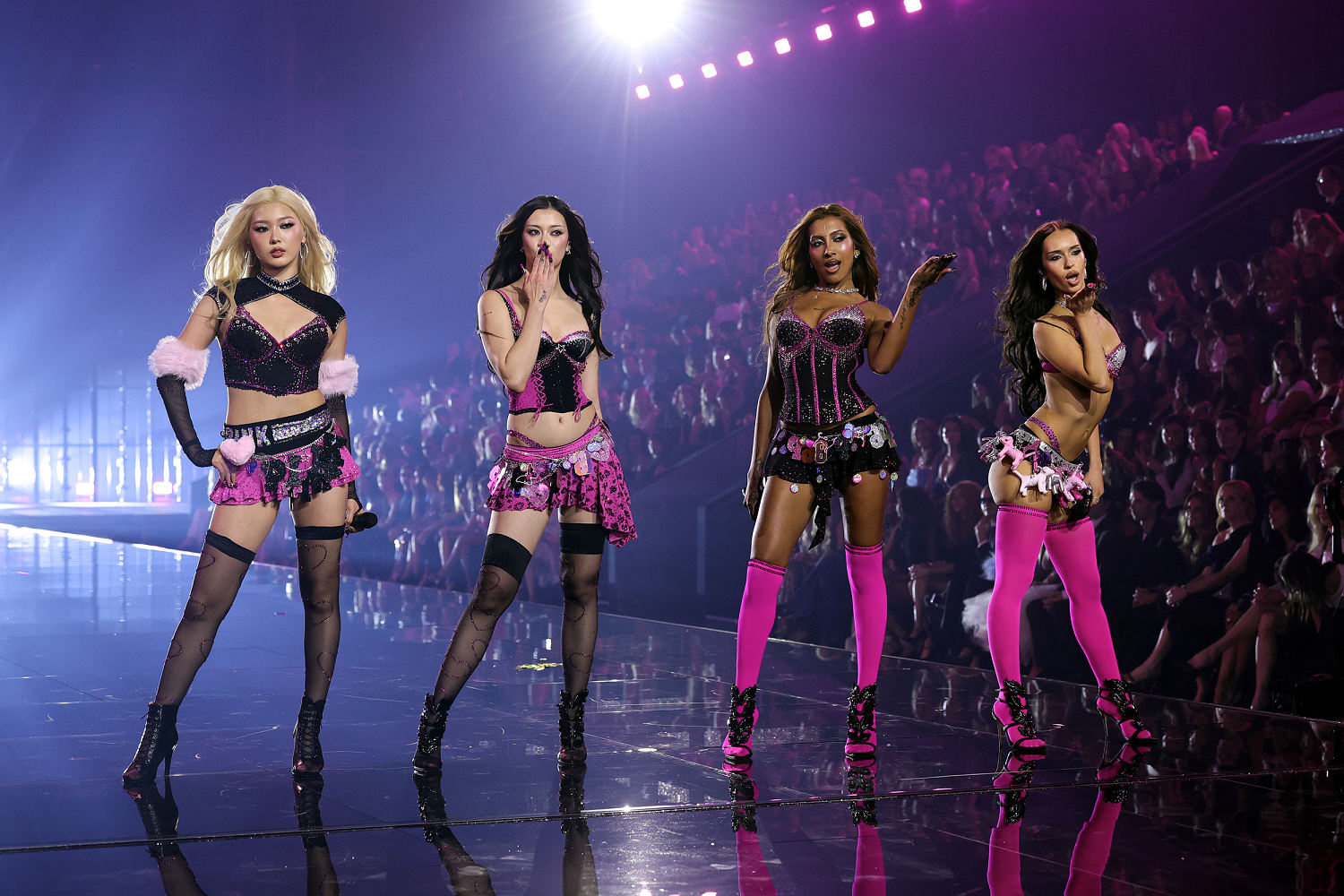
The lights at a modern pop concert do not merely illuminate. They assault.
Thousands of watts of strobing LEDs, pyrotechnic flashes, and razor-sharp spotlights sweep across an arena at speeds designed to trigger an adrenaline spike in the back row. For the person standing at the center of that storm, the sensory load is immense. Now imagine experiencing that wall of light and bass with a bruised brain.
That is the exact reality that confronted millions of fans scrolling through social media clips of global girl group KATSEYE. On stage, five members executed razor-sharp choreography with the breathless precision that has made the HYBE and Geffen-backed group a worldwide phenomenon. Beside them, seated in a chair, was Megan Skiendiel. She was not dancing. She was wearing dark sunglasses under the stage lights.
Within minutes, a single question began trending across fan forums, TikTok comment sections, and entertainment feeds. Is KATSEYE okay?
On the surface, the facts are straightforward. Megan Skiendiel had recently suffered a concussion. Rather than pulling out of the appearance entirely, she took the stage seated, shielded from the blinding glare by tinted lenses, singing her parts while her bandmates covered the physical formations around her. Yet the viral reaction exposed something far deeper than simple celebrity gossip. It revealed the invisible war every modern performer fights between the fragile biology of the human body and the relentless, unforgiving machine of the global pop industry.
The Architecture of an Invisible Injury
To understand why a pair of sunglasses on a pop stage triggered such visceral alarm among fans, you have to understand what a concussion actually does to the human nervous system.
When we see a cast on a broken arm or a brace on a twisted knee, our empathy has an immediate anchor. We understand structural damage. A concussion offers no such visual shorthand. Inside the skull, the brain—a delicate organ with the consistency of soft gelatin—floats in cerebrospinal fluid. When a sudden jolt, fall, or impact occurs, that soft tissue slams against the rigid, bony ridges of the interior cranium.
Think of an egg yolk shaken violently inside its shell without the shell ever cracking. From the outside, everything looks intact. Inside, delicate cellular structures have been stretched, sheared, and thrown into a metabolic crisis.
I know the specific, suffocating terror of that internal chaos firsthand. Years ago, a minor collision left me with what doctors called a "mild" traumatic brain injury. There was nothing mild about the aftermath. For weeks, walking into a brightly lit grocery store felt like staring directly into a welding torch. Fluorescent bulbs did not just hum; they drilled straight into my temples. Every sudden movement triggered a wave of nausea so profound that sitting upright required total concentration.
In that state, your brain is essentially running on an emergency backup generator. Normally, your neural networks filter out background noise and excess light automatically. After a concussion, those filters break down. Every photon hitting the retina and every decibel hitting the eardrum floods the conscious mind at full volume.
Look again at Megan Skiendiel sitting in that chair. Those dark sunglasses were not a stylistic choice or a cool stage prop. They were a medical shield. Photophobia—extreme light sensitivity—is one of the hallmark symptoms of post-concussion syndrome. Without tinted lenses, the strobing stage rigs of a live pop show would not just cause discomfort; they could trigger blinding migraines, dizziness, and an immediate setback in neurological recovery. Sitting down was equally necessary. Sudden shifts in posture or rapid head movements disrupt the vestibular system, the inner-ear balance network that almost always takes a hit during head trauma.
The Cruel Math of the Modern Pop Machine
Why, then, was she on that stage at all?
To answer that question, we have to examine the brutal economics and emotional pressures of modern pop stardom. Groups like KATSEYE are not built overnight. Formed through the grueling global survival program The Debut: Dream Academy, these six young women—Sophia, Lara, Yoonchae, Daniela, Manon, and Megan—survived months of public elimination, relentless vocal and dance evaluations, and intense psychological scrutiny before ever releasing a single track.
When a group finally breaks through, momentum becomes a tyrannical master.
Consider a hypothetical scenario that plays out behind closed doors in record labels every single week. Imagine you are twenty years old. You have spent every waking hour for two years training in windowless studios, icing swollen ankles, and sacrificing a normal adolescence for one shot at a global career. Your group’s single is climbing the charts. A major promotional appearance is booked—one that took months of logistical coordination, travel visas, broadcast clearances, and sponsorship agreements. Then, forty-eight hours before showtime, an accident happens in rehearsal. A fall. A stray elbow. A concussion.
Now you face an impossible choice.
If you step back completely to rest in a dark room, the choreography has to be re-blocked overnight. Your five bandmates, who are already exhausted, must scramble to cover your vocal lines and fill the empty gap in every stage formation. Meanwhile, the internet notices your absence immediately. Rumors swirl. Are you leaving the group? Is there internal drama? Are you being sidelined?
On the other hand, if you push through and perform at full capacity, you risk second-impact syndrome or prolonged neurological damage that could sideline you for months—or permanently alter your cognitive health.
So you negotiate a middle ground. You ask the medical team, the management, and yourself: What if I just sit? What if I wear sunglasses?
This compromise has become increasingly common across both K-pop and Western pop industries. Over the past few years, fans have watched numerous idols and touring artists perform from stools, chairs, or backstage risers while nursing everything from torn ligaments to severe exhaustion. It is framed as dedication. Artists apologize profusely to their fans from the stage for not being able to dance, their voices thick with guilt for merely being human.
Reading Between the Lines of Fan Concern
When clips of Megan’s seated performance circulated online, the comment sections quickly split into two distinct emotional currents.
The first was pure, protective concern. Fans who have followed KATSEYE since their trainee days know Megan as one of the group’s fiercest, most dynamic dancers—a performer whose sharp musicality and boundless energy anchor many of their hardest routines. Seeing her motionless in a chair, eyes hidden behind dark frames, was jarring. Fans immediately began questioning whether she had been cleared properly by doctors, or whether label pressure had forced an injured artist under the spotlight before she was ready.
The second current was admiration for her grit. Supporters praised her professionalism for showing up for the crowd, singing live despite her injury, and refusing to let her bandmates stand on stage as a five-piece.
Both reactions come from love, yet both expose a deeper cultural blind spot. We have conditioned audiences to celebrate artists who perform through pain while simultaneously expressing shock when those artists look visibly unwell. We applaud the "show must go on" ethos until the reality of what that ethos looks like—a young woman shielding her bruised brain from strobe lights—forces us to confront the human cost of our entertainment.
Historically, the music industry treated physical and neurological injuries with casual indifference. In the seventies and eighties, rock musicians regularly took the stage with broken ribs, severe concussions from stage dives, or acute exhaustion, fueled by adrenaline and painkillers. Back then, the cameras were far away, and social media did not exist to zoom in on a performer’s wincing expression or dilated pupils.
Today, every performance is captured in 4K resolution from fifty different angles. Nothing is hidden. When an artist wears sunglasses indoors at a concert, millions of amateur detectives analyze every frame within seconds. That hyper-visibility is a double-edged sword. It strips artists of privacy during their most vulnerable moments, yet it also creates a powerful accountability mechanism. Labels know that fans will spot signs of distress immediately and demand answers.
The Invisible Stakes of Neurological Recovery
What makes a concussion uniquely treacherous compared to a sprained ankle is that you cannot "tough it out" without paying compound interest on the damage.
If you walk on a sprained ankle, it hurts, and you might delay healing by a week. If you subject a concussed brain to intense sensory stimulation—loud bass, flashing lights, cognitive stress, and sleep deprivation from travel—you actively prevent the brain from restoring its chemical balance.
After head trauma, brain cells experience a massive influx of calcium and a sudden drop in blood flow. The organ desperately needs energy to pump those ions back out and restore normal function, yet the reduced blood flow starves it of the very glucose and oxygen required to do the job. This is what neurologists call the "metabolic mismatch."
During this vulnerable window, resting is not passive laziness; it is active biological repair. Every time a concussed person forces their brain to process complex visual motion or loud auditory input, they drain the tiny energy reserves the brain is trying to use to heal itself.
There is also the emotional toll that rarely makes the headlines. Concussions frequently disrupt mood regulation, triggering sudden waves of anxiety, irritability, or brain fog. For a performer whose entire livelihood depends on spatial awareness, split-second timing, and radiating effortless joy to thousands of strangers, feeling disconnected from your own body is deeply frightening. You stand—or sit—in front of roaring crowds while feeling as though you are watching the world through thick, foggy glass.
When fans ask, "Is KATSEYE okay?", they are usually asking about group stability, upcoming tour dates, or album delays. But the more urgent question is whether the individuals inside the machine are being given the space to heal completely rather than merely patching themselves up enough to make the next call time.
A Quiet Shift in the Spotlight
Look closely at the footage of KATSEYE’s performance again, beyond the initial shock of the chair and the sunglasses. Watch how the other five members interact with Megan.
Notice the subtle glances checked in her direction between verses. Notice how the choreography subtly adjusts so she is never left isolated on the edge of the stage, how a hand reaches out to squeeze her shoulder during a chorus, how the group’s energy rallies around her chair so the performance feels unified rather than broken.
That small detail tells a different story than the panic in the comment sections. It shows a sisterhood adapting in real time to protect one of its own. And it shows an industry slowly, imperfectly, learning that modifying a performance is infinitely better than forcing a full-out routine—or hiding an injury behind closed doors.
In the past, an injured member of a pop group was often erased entirely from promotions until they were fully recovered, leaving fans in the dark and leaving the artist isolated at home watching their group ascend without them. Allowing Megan to participate on modified terms—seated, protected from harsh light, focusing solely on her vocals—acknowledges a vital truth. A performer does not lose their value the moment their body requires accommodation.
Still, the sight of dark lenses under arena spotlights should make all of us pause. It is a stark reminder that behind the glossy music videos, the immaculate styling, and the synchronized perfection of global pop, there are real, fragile human beings absorbing every impact.
The music swells, the crowd roars, and five figures leap across the stage in flawless unison while a sixth sits quietly behind tinted glass, guarding the fragile universe inside her head against the blinding glare of the show.


