The desert does not care about politics. It only understands survival.
When the sun dips below the horizon at Ketziot Prison, deep in the Negev desert, the temperature plummets. The wind howling against the watchtowers carries a dry, bitter chill. For years, the sounds here have been entirely human: the heavy thud of combat boots, the metallic rattle of handcuffs, and the low, anxious murmurs of thousands of detainees waiting out their sentences.
But a new sound is destined for the perimeter. It is the low, vibrating hiss of a prehistoric predator.
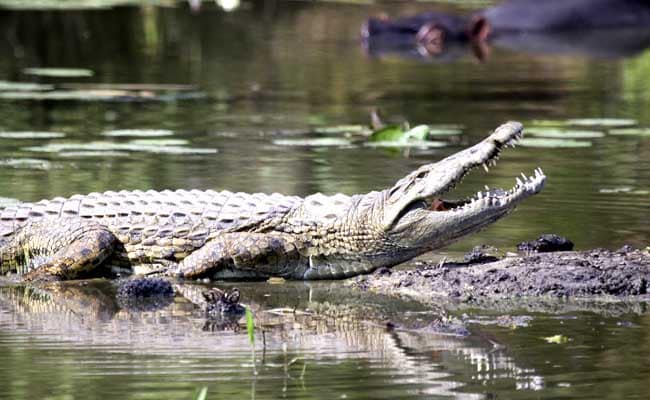
A bureaucratic shift recently reclassified the Nile crocodile from a protected wild animal into "managed wild wildlife." With the stroke of a pen by Environmental Protection Minister Idit Silman, a surreal political fantasy moved closer to reality. Security officials are legally cleared to surround high-security prisons with crocodile-filled moats. The project is championed by far-right National Security Minister Itamar Ben-Gvir, who even celebrated the regulatory shift by posting an AI-generated image of himself holding a crocodile on a leash.
To look at a headline about prison moats is to feel a bizarre sense of detachment, as if reading a medieval historical text or a dystopian movie script. But beneath the sensationalism lies a deeply unsettling human reality.
Consider the guards who walk these beats every night. A veteran warden, let's call him Avi, understands the mechanics of concrete, steel, and thermal cameras. These are predictable systems. They require maintenance, but they do not require feeding. They do not have instincts.
When the prison service sent a delegation to the Hamat Gader crocodile farm to study the feasibility of the plan, the zoologists there had to explain basic reptilian biology to security officials. The delegation learned that crocodiles cost between $8,000 and $20,000 each. They learned about dietary needs and habitat management. Most crucially, they learned that crocodiles become almost entirely inactive during the freezing desert winter months.
Imagine Avi standing over a dark trench in January, staring into the murky water. The expensive, apex predators meant to strike terror into the hearts of escaping prisoners are instead floating in a state of torpor, immobilized by the cold. Security cannot be outsourced to biology. Nature refuses to be drafted into human conflicts.
The pushback from the Israel Nature and Parks Authority was immediate and deeply philosophical. "We need to protect them; they don't need to protect us," one official argued during the internal debates. It is a profound statement on how easily a society can distort its relationship with the natural world when driven by a desire for total control.
This is not the first time a government has attempted to weaponize a landscape. The proposal draws direct inspiration from the "Alligator Alcatraz" concept used briefly in the Florida Everglades to deter migrants. That facility faced immediate legal challenges, environmental protests, and logistical nightmares before fading away. Swamps and deserts are fragile ecosystems. Forcing a non-native species into a military security role introduces a chaotic variable into an environment that demands absolute predictability.
What happens if a moat floods during a rare desert flash flood? What happens when a handler makes a mistake during a routine feeding? The invisible stakes are not just about prison breaks; they are about the psychological toll of living and working within an environment defined by ancient, unblinking eyes.
For the prisoners inside, the psychological landscape alters dramatically. Prison is already an exercise in sensory deprivation and extreme isolation. Adding a moat of apex predators removes the last abstraction of a border. It replaces a human barrier—one governed by rules, engagement protocols, and international laws—with an elemental, unreasoning threat. A wall can be climbed; a guard can be negotiated with or evaded. A crocodile simply consumes.
The debate over the crocodile moats reveals a deeper truth about the current moment. When technology, walls, and human guards are no longer deemed sufficient, the instinct is to reach backward into the ancient world for monsters to police the perimeters. It is an admission that the human architecture of security feels fragile, prompting a turn to something primal to fill the gaps.
The legal hurdles are cleared, the political declarations have been made, and the blueprints are being drawn. But as the winter wind sweeps across the Negev, the desert remains indifferent to the changing laws of men. The trenches may eventually fill with water, and the crocodiles may arrive, but they will not be serving a cause. They will just be cold, waiting for the sun to return.