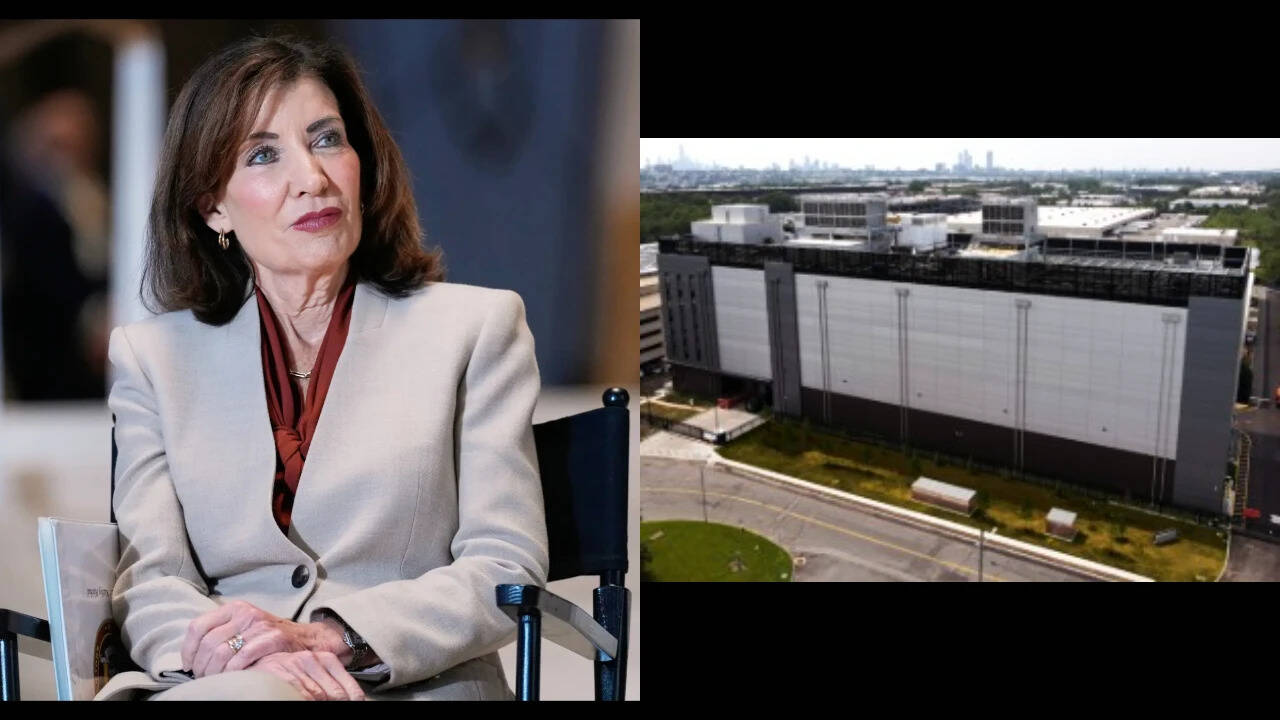
The physical manifestation of human memory used to be heavy. It was carved into granite blocks, bound in calfskin leather, or developed onto silver halide film. Today, it feels weightless. We treat our thoughts, our family photographs, and our late-night artificial intelligence queries as if they drift safely into an ether called the cloud.
But the cloud is not a cloud. It is a brick-and-mortar warehouse.
Inside these windowless monolithic structures, tens of thousands of silicon chips hum in unison, processing the dizzying computational demands of a society obsessively chasing the frontiers of machine learning. The air inside smells faintly of ionized copper and intense heat. To keep these digital minds from melting under the stress of their own brilliance, massive industrial chillers pump millions of gallons of water through a network of pipes, twenty-four hours a day.
On Tuesday, the state of New York looked at these gargantuan complexes and decided to pull the plug.
By signing Executive Order 62, Governor Kathy Hochul made New York the first state in the nation to enact a sweeping, one-year moratorium on the construction of massive "hyperscale" data centers—specifically those requiring 50 megawatts of power or more. To put that number into perspective, a single 50-megawatt facility pulls enough electricity to keep roughly 40,000 average American homes running simultaneously.
The state did not do this because it hates technology. It did this because the math of human survival was starting to conflict with the math of machine evolution.
The Friction of the Invisible
Consider the perspective of a resident in a small upstate town—let's call him Thomas. Thomas is not a politician, nor is he a silicon valley executive. He is a retired mechanic living on a fixed income near Ithaca, where a proposed 300-megawatt data center project recently sparked fierce community resistance.
For Thomas, the digital revolution has always been a quiet background companion. He uses a smartphone to video call his grandchildren. He streams classic movies. But over the last two years, his relationship with electricity has changed from a basic utility bill into an existential anxiety.
When a giant tech company wants to build a processing center in a rural or suburban county, they do not bring their own private power grid with them. They plug directly into the local infrastructure. The sheer volume of energy these facilities suck from the grid creates a supply-and-demand bottleneck. When demand spikes across an entire region, utility companies pass the costs of upgrading transmission lines and building new substations down to the people already living there.
Thomas noticed his monthly electricity bill creeping up by ten dollars, then twenty, then fifty. For a multi-billion-dollar tech conglomerate, a spike in operational costs is an acceptable line-item variable. For someone trying to balance a fixed retirement budget against the rising cost of groceries, it is a crisis.
Then comes the water.
Hyperscale data centers are notoriously thirsty. In states like Georgia and Virginia, residents living down-gradient from massive server farms have reported mysterious drops in local water pressure and sediment showing up in their kitchen taps. A single large-scale facility can consume hundreds of thousands, sometimes millions, of gallons of fresh water daily just to evaporate the heat generated by your generative AI image prompts. In a world grappling with shifting precipitation patterns and climate-induced droughts, letting a single corporate entity drain a local aquifer to cool a warehouse full of chatbots feels less like progress and more like a gamble.
The Tug-of-War in the Capitols
The decision in Albany did not happen in a vacuum. It represents the boiling over of a quiet, multi-year civil war taking place inside statehouses across America.
For the past decade, politicians courted big tech with open arms. Legislators eagerly handed out lucrative sales tax exemptions and zoning fast-tracks, desperate to claim they were bringing the jobs of the future to depressed manufacturing towns. But the economic promise turned out to be hollow. A data center takes hundreds of union laborers to build, but once the concrete cures and the servers are bolted into their racks, it requires only a skeleton crew of a few dozen engineers and security guards to keep it running.
The tax revenue looked good on paper, but the strain on local resources was immediate.
Earlier this year, the Maine legislature tried to pass its own data center pause, only for the governor to veto it out of fear of killing economic development in a struggling mill town. But New York’s political landscape is different. With critical congressional races looming and voters screaming about the skyrocketing cost of living, affordability has become a potent political shield.
The opposition to Hochul's move was swift and furious. Labor leaders and business coalitions slammed the executive order as a short-sighted stunt that would kill high-paying construction jobs. They warned that a one-year freeze would simply cause the tech industry to take its billions of dollars in infrastructure investments elsewhere—to Texas, to Georgia, or to Northern Virginia, the undisputed data center capital of the world.
The federal government has dropped subtle hints of anxiety, too. Proponents of unregulated AI development argue that slowing down the construction of data infrastructure puts domestic innovation at a severe disadvantage against foreign rivals like China. In their view, computing power is the new uranium; the nation with the most servers wins the global economic and military future.
But New York officials decided that global dominance shouldn't be funded by a hidden tax on local ratepayers.
Rules of the Road
The moratorium is a tactical timeout. For the next twelve months, the state's Department of Environmental Conservation will freeze all discretionary permits for new facilities over that 50-megawatt threshold.
During this intermission, the Department of Public Service is tasked with conducting a comprehensive Generic Environmental Impact Statement. They will finally calculate the real, unvarnished cost of these facilities: how they impact air quality, how much noise pollution their massive cooling fans emit into quiet rural nights, and exactly how much water they can safely pull from New York’s lakes and rivers.
When the pause lifts, the rules of engagement will be fundamentally altered.
The state is already designing a blueprint known as the Energize NY proceeding. The premise is simple: if a tech giant wants to operate a massive computational hub on New York soil, they will no longer be allowed to cannibalize the public grid for cheap power. They will either have to pay a steep premium for their energy—subsidizing the utility bills of the residential consumers around them—or they will have to build and fund their own independent, renewable energy sources.
Furthermore, the state plans to eliminate the cozy sales tax exemptions that these multi-trillion-dollar companies have enjoyed for years. If you want to use New York's resources to build the future of artificial intelligence, you are going to pay retail price for the privilege.
We are entering an era where the digital world can no longer hide its physical footprint. Every email archived, every video streamed, and every line of code generated requires a piece of the earth to turn, a gallon of water to cool, and a watt of power to burn. New York's moratorium is a stark reminder that before we build an infinite digital future, we have a finite physical present to protect.