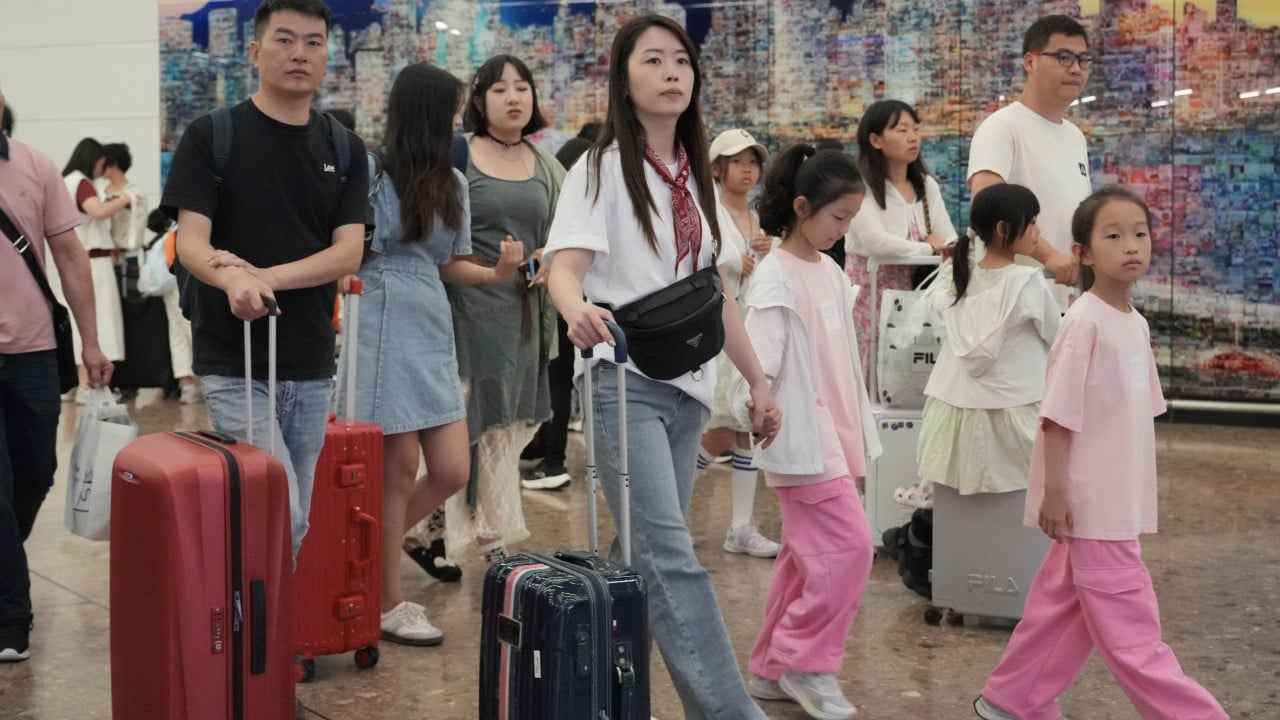
The headlines coming out of the Hong Kong Immigration Department this week sound like a victory lap. As the city prepares for the Labour Day "Golden Week" break starting May 1, officials are projecting 980,000 inbound trips from mainland China. It is a figure designed to instill confidence in a retail sector that has been gasping for air. But for those who have spent decades tracking the pulse of the city’s economy, the number feels less like a recovery and more like a statistical mask.
Hong Kong is indeed welcoming more people, but it is welcoming a different kind of consumer. The era of the "big-spending" mainland tourist—the one who arrived with an empty suitcase and left with five luxury watches—is dead. In its place is a budget-conscious traveler who uses the city as a backdrop for social media rather than a department store. While the government celebrates the 7 percent year-on-year increase in arrivals, the treasury and the shop owners in Tsim Sha Tsui are looking at a much bleaker reality.
The Spending Gap No One Wants to Discuss
The math of the modern Golden Week is sobering. In 2018, the average overnight visitor spent roughly HK$6,600. By 2025, that figure had slipped toward HK$5,600, and early 2026 data suggests the slide hasn't stopped. The projected 980,000 visitors will likely generate a high volume of foot traffic, but the "spend-per-head" is cratering.
Retailers are facing a "scissors effect" where operating costs—driven by a rigid labor market and stubborn commercial rents—are rising while individual transaction values are shrinking. We are seeing a shift from luxury handbags to "city walk" tourism. Visitors are now more interested in the aesthetics of a specific blue wall in Central or a vintage red taxi than they are in the inventory at Harbour City. This is a structural change, not a seasonal dip.
The High Speed Rail Trap
Infrastructure has become a double-edged sword. The expansion of the High-Speed Rail network to 110 direct mainland destinations was meant to be the city’s savior. It has succeeded in bringing people in, but it has also made it incredibly easy for them to leave.
Because a traveler from Shenzhen or Guangzhou can now reach West Kowloon in under 20 minutes, the necessity of an overnight stay has vanished. This "day-trip" culture is the silent killer of the hotel industry. While luxury segments still boast occupancy rates above 90 percent for the holiday, the mid-tier hotels are fighting for scraps.
- Day-trippers typically spend 60 percent less than overnight guests.
- The "Two-Way Movement" means locals are also fleeing. For every visitor coming south, a Hong Konger is heading north to Shenzhen where their dollar goes twice as far.
- Logistical strain at the border points creates a "hassle factor" that deters higher-net-worth individuals who value time over a cheap ferry ticket.
The government’s response has been to launch "Hello Hong Kong 2.0" and distribute e-coupons, but these are band-aids on a femoral artery. You cannot buy loyalty with a HK$100 voucher when the entire value proposition of the city is being questioned by a younger, more frugal generation of mainlanders.
Cultural Fatigue and the Service Deficit
The "why" behind the shift is uncomfortable. For years, Hong Kong treated mainland visitors as a captive market. Service standards slipped, and the city became a monoculture of jewelry stores and pharmacies. Now, with the rise of Hainan’s duty-free zones and the ease of travel to Japan or Thailand, Hong Kong is no longer the only game in town.
The city is currently attempting to pivot toward "Mega Events." The 50th-anniversary Hong Kong Sevens and various art fairs are noble efforts to attract a global elite, but they do little for the rank-and-file shopkeepers who rely on the May Day surge. There is a palpable disconnect between the government's "events capital" narrative and the reality of a retail sector that is still 15 percent below its 2018 peak.
The Zero Tolerance Myth
To combat the image of "coerced shopping" tours—a long-standing stain on the city's reputation—authorities have promised a zero-tolerance stance. This is a reactive policy. The fact that the Travel Industry Authority even has to mention coerced shopping in 2026 shows that the industry is still struggling to provide a high-quality, organic experience.
If the city has to police its tour guides to ensure they don't kidnap tourists into jade shops, it has already lost the brand war. Modern travelers want authenticity, not a choreographed visit to a pre-approved souvenir stall. The 770 inbound tour groups expected this week are a vestige of an old model that is increasingly irrelevant to the Gen-Z traveler.
A City at a Crossroads
If Hong Kong wants to thrive, it must stop obsessing over the 980,000 figure. Raw headcount is a vanity metric. The real measure of success is the length of stay and the diversity of spending.
The city needs to lean into what the mainland cannot replicate: its internationalism, its unique blend of colonial history and Cantopop grit, and its proximity to nature. Promoting "green tourism" and island hiking is a start, but it requires a total overhaul of the hospitality mindset. We are moving from a city that sells products to a city that must sell experiences.
The upcoming Labour Day break will be a "stress test," but not just for the immigration counters. It is a test of whether Hong Kong can still convince the world—and its closest neighbors—that it is worth the premium price tag. Without a radical shift in the value proposition, those 980,000 visitors will come, take their photos, and leave their wallets at home.