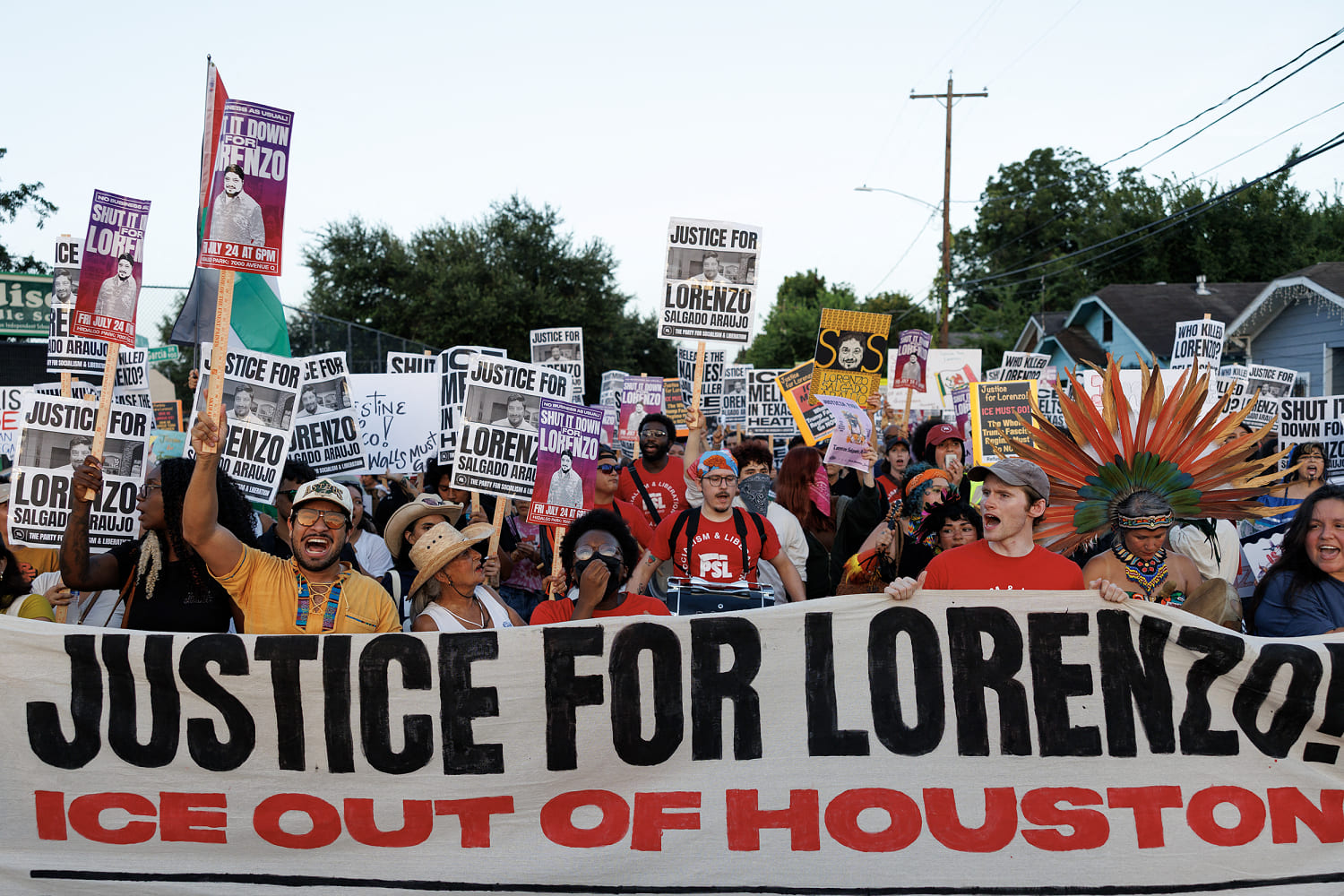
The fatal shooting of a Houston father by local law enforcement has done more than spark localized grief; it has exposed a deepening political fracture among Texas Latino voters. For years, national strategists treated the state's largest demographic group as a predictable voting bloc, assuming that shared cultural heritage guaranteed uniform political behavior. That assumption is dead. Instead, a single tragedy in Harris County has become the flashpoint for a fierce internal debate over policing, public safety, and institutional accountability—forcing both major political parties to confront a constituency that refuses to be taken for granted.
To understand why this specific incident has resonated so far beyond Houston's city limits, you have to look at the mechanics of modern Texas politics. Latinos now represent the largest share of the state's population, outnumbering non-Hispanic white residents. Yet political power does not automatically follow demographic growth. It requires mobilization, clear messaging, and an alignment between community priorities and party platforms. When a working-class father loses his life in an encounter with police, the immediate reaction is heartbreak. The secondary reaction, however, is intensely political, and it splits right down the middle of the Hispanic electorate. You might also find this related coverage interesting: The Structural Mechanics of Public Space Violence A Systems Failure Analysis.
The Myth of the Monolithic Bloc
Political consultants in Washington and Austin love simple narratives. For decades, the standard operating procedure was to view Latino voters through the single lens of immigration policy. If a candidate spoke favorably about pathways to citizenship, the thinking went, the votes would follow.
That playbook is obsolete. As extensively documented in recent coverage by Reuters, the implications are significant.
Today, a third-generation Tejano business owner in the Rio Grande Valley and a second-generation Mexican American service worker in Houston's East End share a demographic label, but their daily economic and security concerns often diverge sharply. In the aftermath of the Houston shooting, two distinct narratives emerged almost immediately within the same neighborhoods.
On one side, progressive organizers and civil rights advocates seized on the incident as proof of systemic failure. They pointed to the lack of immediate transparency, the slow release of body-camera footage, and a history of disproportionate force in predominantly minority precincts. For this faction, the shooting was an indictment of local leadership and a call to overhaul police oversight mechanisms in Harris County.
On the other side, a growing contingent of moderate and conservative Latinos pushed back against rhetoric they viewed as anti-police. Many of these residents live in high-crime areas and rely heavily on law enforcement to protect their families and small businesses. While they demanded answers regarding the specific officers involved, they rejected broader calls to defund or dismantle police departments. This tension—between demanding justice for a victim and maintaining robust neighborhood security—is the exact fault line reshaping Texas elections.
How Local Tragedy Becomes Statewide Leverage
In Texas, Harris County is the ultimate political bellwether. With nearly five million residents, it is the third-most populous county in the United States and the engine that drives statewide Democratic turnout. When political energy shifts in Houston, state lawmakers in Austin feel the tremors.
The response to the shooting revealed a sophisticated, multi-tiered mobilization strategy that differs sharply from the protests of previous decades. Rather than relying solely on street demonstrations, local activists immediately targeted the institutional levers of power:
- The District Attorney’s Office: Organizers pressured prosecutors to bypass standard grand jury delays and implement independent review protocols for officer-involved shootings.
- City Council Budget Hearings: Community coalitions used public comment periods to demand the reallocation of municipal funds toward mental health crisis intervention teams rather than traditional patrol expansions.
- Voter Registration Drives: Nonpartisan civic groups set up tables directly outside vigils and community meetings, converting raw emotional outrage into tangible electoral data.
This hyper-local focus is strategic. Statewide races in Texas remain an uphill battle for Democrats, but county-level seats—judges, district attorneys, sheriffs, and commissioners—are entirely winnable. By focusing on the specific officials who oversee law enforcement budgets and prosecutorial decisions, Latino organizers are exercising direct, measurable influence over the criminal justice system.
The Republican Counter-Offensive
While progressive groups worked to channel anger into institutional reform, Texas Republicans saw an opening of their own. Over the past several election cycles, the GOP has made documented inroads with Hispanic voters, particularly men and working-class families in South Texas and the suburbs surrounding Houston.
Republican strategists recognize that public safety is a winning issue when framed around stability and economic opportunity. In response to the Houston shooting, conservative Latino leaders avoided defending the specific actions of the officers prior to an investigation. Instead, they pivoted to broader themes of law and order, arguing that Democratic leadership in Houston had allowed violent crime to spiral out of control, thereby creating the volatile environment in which deadly encounters occur.
"You cannot ask police officers to work in increasingly dangerous conditions with dwindling support and then act surprised when tragedies happen," one prominent Houston-area business leader noted during a local town hall. "We want accountability when an officer crosses the line, yes. We also want to know someone is going to show up when we call 911."
This messaging resonates with voters who feel caught between two extremes. Many Hispanic residents harbor a deep skepticism of government bureaucracy—a sentiment rooted in both American experiences and family histories in Latin America. When Democrats appear overly hesitant to address street crime, and Republicans appear dismissive of police misconduct, a massive segment of the electorate becomes politically homeless. Whichever party figures out how to occupy that middle ground—combining strict police accountability with uncompromising neighborhood safety—will control Texas for a generation.
The Transparency Bottleneck in Harris County
Beneath the political rhetoric lies a structural problem that fuels public distrust every time a fatal shooting occurs in Texas: the state's public information laws.
Under the Texas Public Information Act, law enforcement agencies routinely invoke what is known as the "dead suspect loophole." This legal provision allows police departments to withhold records, dashcam video, and internal reports indefinitely if an investigation does not result in a conviction or deferred adjudication. When a suspect is killed during an encounter with police, there is obviously no criminal trial to follow. Consequently, agencies can legally block the public from ever seeing the full investigative file.
In Houston, the delay in releasing critical evidence after the father's death poured gasoline on an already volatile situation. Community leaders argued that withholding video footage while simultaneously releasing selective details about the victim's background amounted to character assassination.
Transparency is not a partisan luxury. When the state takes a human life, the public has an absolute right to see the evidence promptly. Until the Texas Legislature closes these statutory loopholes and mandates strict timelines for the release of body-camera footage, every officer-involved shooting will automatically trigger a crisis of legitimacy, regardless of whether the officers' actions were ultimately justified.
The Generational Divide at the Ballot Box
A frequently overlooked factor in the political fallout from Houston is the stark generational split within Latino households.
Older Hispanic voters, many of whom remember the overt discrimination and civil rights struggles of the mid-twentieth century, tend to operate through established civic organizations like LULAC and traditional church networks. Their approach to political change is incremental, emphasizing civic duty, military and police service, and institutional respect.
Younger Latinos—Millennials and Gen Z—view the world through a completely different prism. Raised in the era of smartphones and viral video, they have watched high-profile police killings unfold in real time on their screens for over a decade. They are far less patient with institutional delays and far more willing to challenge local officials directly, regardless of party affiliation.
For a Democratic candidate in Houston, simply having a Spanish surname or running ads in Spanish is no longer enough to secure the youth vote. Younger activists are scrutinizing voting records on police union contracts, bail reform, and municipal budgets. If an incumbent fails to deliver tangible policy shifts following a community tragedy, these younger voters will either back a primary challenger or stay home altogether. In a state where elections are decided by razor-thin margins, depressed turnout among young urban Latinos is fatal to Democratic ambitions.
Why National Pundits Keep Getting Texas Wrong
Every two years, national media outlets descend on Texas to declare that this is finally the cycle when demographic destiny turns the state blue. And every two years, they leave baffled when Republicans sweep statewide offices.
The mistake lies in viewing Texas Latinos through the lens of East Coast or California politics. Texas has its own distinct political culture—one that is fiercely independent, culturally conservative, economically populist, and deeply skeptical of outside interference.
The aftermath of the Houston shooting illustrates this complexity perfectly. A single event simultaneously energized progressive criminal justice reformers in the urban core and reinforced the law-and-order instincts of suburban homeowners ten miles away. Both reactions are authentically Latino. Both are rooted in a desire to protect families and build a secure future.
Political parties cannot manufacture loyalty with focus-grouped slogans or last-minute ad buys. Trust is built in the quiet months between elections, through consistent presence in the community and a willingness to listen to uncomfortable truths. The grieving family in Houston did not ask to become the center of a statewide political tug-of-war, yet their loss has forced a necessary reckoning. Until politicians in Austin and Washington stop treating Hispanic voters as a convenient demographic checkbox and start addressing the complex, often contradictory realities of their daily lives, the political ground beneath Texas will continue to shift.