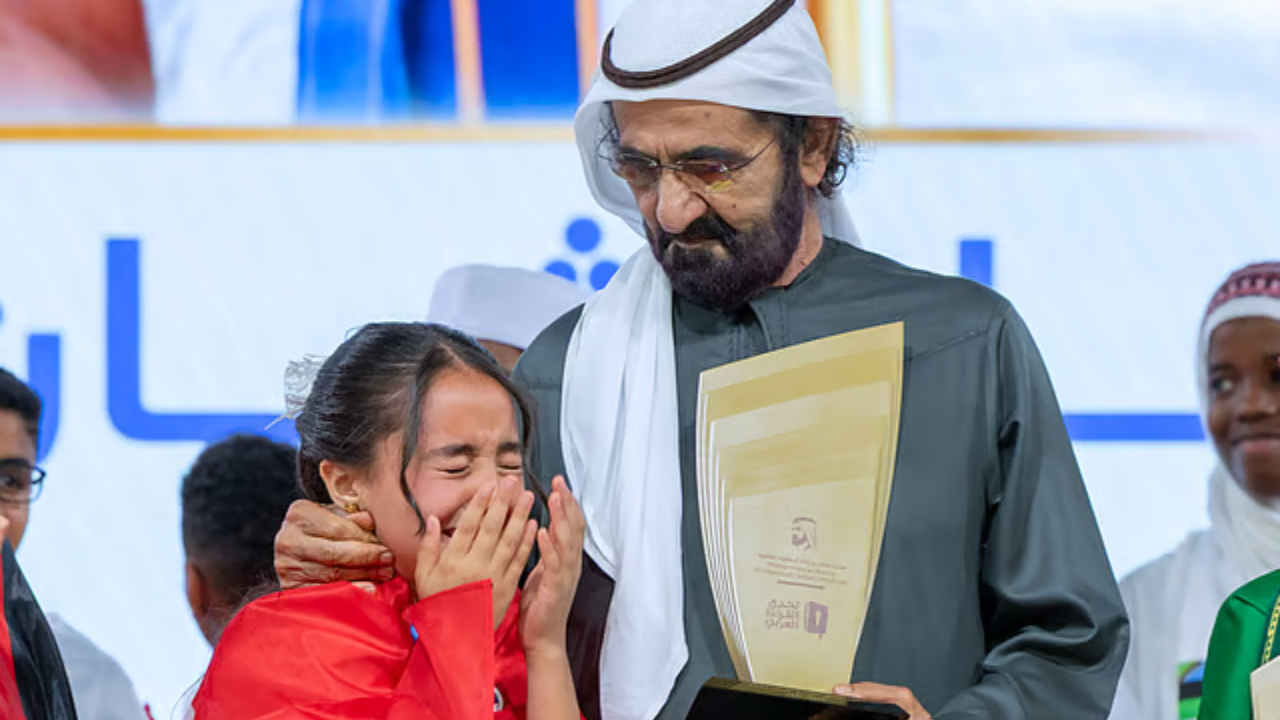
Soft power rarely scales through press releases, yet a single ceremony in Dubai demonstrated how a state-backed literacy initiative converts mass youth participation into geopolitical equity. When an 11-year-old Egyptian student outpaced more than 40 million competitors in the Arab Reading Challenge and received direct, public recognition from the Ruler of Dubai, Sheikh Mohammed bin Rashid Al Maktoum, regional media framed the event as an emotional triumph. That framing misses the structural mechanics at play. Behind the human-interest narrative sits a disciplined cultural investment model designed to solve a regional human capital deficit while cementing the United Arab Emirates as the intellectual clearinghouse of the Middle East.
The Structural Architecture of the Arab Reading Challenge
Launched in 2015 under the Mohammed bin Rashid Al Maktoum Global Initiatives, the Arab Reading Challenge operates less like a traditional school spelling bee and more like a multi-tiered talent acquisition funnel. Most regional educational interventions fail because they rely on static curriculum mandates that lack extrinsic incentives or social status markers. The Dubai model bypasses bureaucratic inertia by introducing tournament economics into basic literacy.
To understand how a single competition aggregates tens of millions of participants across dozens of countries, the initiative must be broken down into its operational components:
- Standardized Consumption Thresholds: Participants are required to read and summarize 50 extracurricular books within a single academic year. This metric shifts the evaluation criterion from passive classroom attendance to verifiable, self-directed throughput.
- Multi-Stage Elimination Filtering: Students progress from school-level evaluations to educational districts, national ministries, and finally to the regional finals in Dubai. At each gate, evaluation committees assess comprehension, critical articulation, and Arabic linguistic fluency rather than rote memorization.
- Asymmetric Prize Incentives: The financial rewards—often totaling millions of dirhams distributed among the overall champion, top schools, and outstanding supervisors—create economic alignment across the entire educational value chain. Principals and teachers are incentivized to coach high-performing students because institutional grants flow directly to winning schools.
The scale of participation, crossing the 40-million-student mark in recent cycles, reflects the demographic reality of the Middle East and North Africa. With youth under the age of 25 comprising roughly half the region's population, any state actor capable of capturing the cognitive bandwidth of this cohort gains long-term cultural influence. By anchoring the competition in Modern Standard Arabic, the initiative also addresses a persistent linguistic fragmentation across Arab states, where local dialects often supersede formal literacy in digital spaces.
The Economics of Regional Talent Identification
The victory of an 11-year-old student from Egypt illustrates a critical dynamic in regional human capital distribution: the divergence between demographic scale and institutional capacity. Egypt possesses the largest student population in the Arab world, creating an immense statistical base for cognitive outliers. Yet public educational infrastructure in high-population states frequently struggles with overcrowding and resource constraints, limiting the domestic visibility of exceptional young talent.
Dubai’s institutional apparatus acts as a regional aggregator for these outliers. By underwriting the logistics, judging, and media production of the finals, the UAE positions itself as the primary patron of Arab intellectual achievement regardless of the winner's nationality. This dynamic mirrors venture capital scouting in emerging markets. Rather than building every primary school from scratch across 22 nations, the sponsoring entity builds the championship stage, sets the performance standards, and captures the reputational halo when top performers emerge from neighboring jurisdictions.
This mechanism produces three distinct structural outcomes:
- Validation of Cross-Border Mobility: High-achieving students from Cairo, Amman, or Casablanca learn early in their cognitive development that excellence is recognized and rewarded in Dubai. This builds an affinity pipeline long before these individuals enter the university or labor markets.
- Benchmarking Against Global Literacy Deficits: International assessments such as PISA and PIRLS have historically shown lagging reading comprehension scores across several Arab states compared to OECD averages. The challenge establishes an internal, culturally native benchmark that rewards high-volume reading without waiting for decade-long ministerial reforms.
- Institutional Spillover: Because awards recognize the "Best School" and "Outstanding Supervisor" alongside the student champion, the competition forces local administrators to adopt structured mentorship programs to remain competitive in subsequent cycles.
Decoding Executive Signaling and Soft Power Mechanics
Public interactions between heads of state and civilian champions are carefully calibrated instruments of political communication. When Sheikh Mohammed bin Rashid Al Maktoum personally honored the young Egyptian winner—a moment widely circulated across regional broadcast and social networks—the gesture executed a specific set of strategic functions that traditional diplomatic channels cannot replicate.
In political science, Joseph Nye’s framework of soft power relies on attraction and co-optation rather than coercion or financial payment. However, attraction requires a visible, emotionally resonant conduit. An 11-year-old child articulating complex ideas in classical Arabic serves as an unimpeachable symbol of regional potential. By placing the highest executive authority of Dubai beside the winner, the state links its own governance brand directly to youth empowerment, meritocracy, and pan-Arab solidarity.
The viral amplification of the ruler's gesture follows predictable media economics. Regional news ecosystems are saturated with geopolitical friction, economic inflation, and security crises. Content featuring an authoritative leader displaying warmth toward a gifted child creates sharp narrative contrast, driving organic algorithmic distribution across platforms like X, Instagram, and TikTok. The state achieves millions of earned media impressions at zero marginal advertising cost, reinforcing its image as a benevolent, forward-looking hub in an otherwise turbulent neighborhood.
Limits of Tournament-Based Literacy Interventions
While the competition demonstrates high efficiency in generating visibility and motivating top-tier students, treating tournament-based initiatives as a comprehensive solution to regional educational deficits introduces analytical blind spots. A rigorous assessment requires accounting for the structural limitations inherent in prize-driven models:
- Selection Bias and Survivor Effects: A funnel that narrows 40 million entrants down to a single champion inherently spotlights outliers. While tens of millions participate at the entry level, the depth of engagement varies widely between initial registration and completing the 50-book threshold. High-performing students typically benefit from preexisting household literacy, parental involvement, or private tutoring that the competition rewards rather than creates.
- Quantity Versus Cognitive Depth: Setting a 50-book target prioritizes volume and summarization speed. Without rigorous longitudinal tracking, it remains difficult to measure whether participants retain complex analytical frameworks over time or merely optimize their reading habits to satisfy judging rubrics.
- Infrastructure Dependency: Reading 50 books requires physical or digital access to diverse, age-appropriate literature. In rural or underfunded districts across the Arab world, library inventory remains a primary bottleneck. Digital reading platforms mitigate this constraint, yet broadband penetration and device access remain uneven across income brackets.
- Post-Competition Attrition: Once the ceremony concludes and the prize capital is disbursed, winners return to their domestic school systems. Unless national ministries integrate these students into accelerated research tracks or gifted-education fellowships, the momentum generated during the tournament risks dissipating during secondary education.
The Strategic Play for Regional Cultural Institutions
For ministries of education, sovereign wealth foundations, and private sector sponsors operating across the Middle East and North Africa, the lesson of the Arab Reading Challenge is not to replicate another televised finale. The market for ceremonial prestige is already dominated by Dubai’s first-mover advantage and institutional scale.
Instead, competing or complementary institutions must capture the second-order value that the tournament leaves unaddressed: longitudinal talent retention and applied cognitive output. Cultural foundations in Cairo, Riyadh, and Amman should establish post-tournament fellowships that track the top one percent of regional finalists from age 11 through university matriculation. By converting passive reading comprehension into structured outputs—such as youth research grants, Arabic-language technical translation programs, and early-stage STEM incubators—institutions can transform a one-year media event into a decade-long human capital pipeline. The state that moves beyond rewarding the consumption of books to funding the production of original regional scholarship will secure the next tier of intellectual leadership in the Arab world.