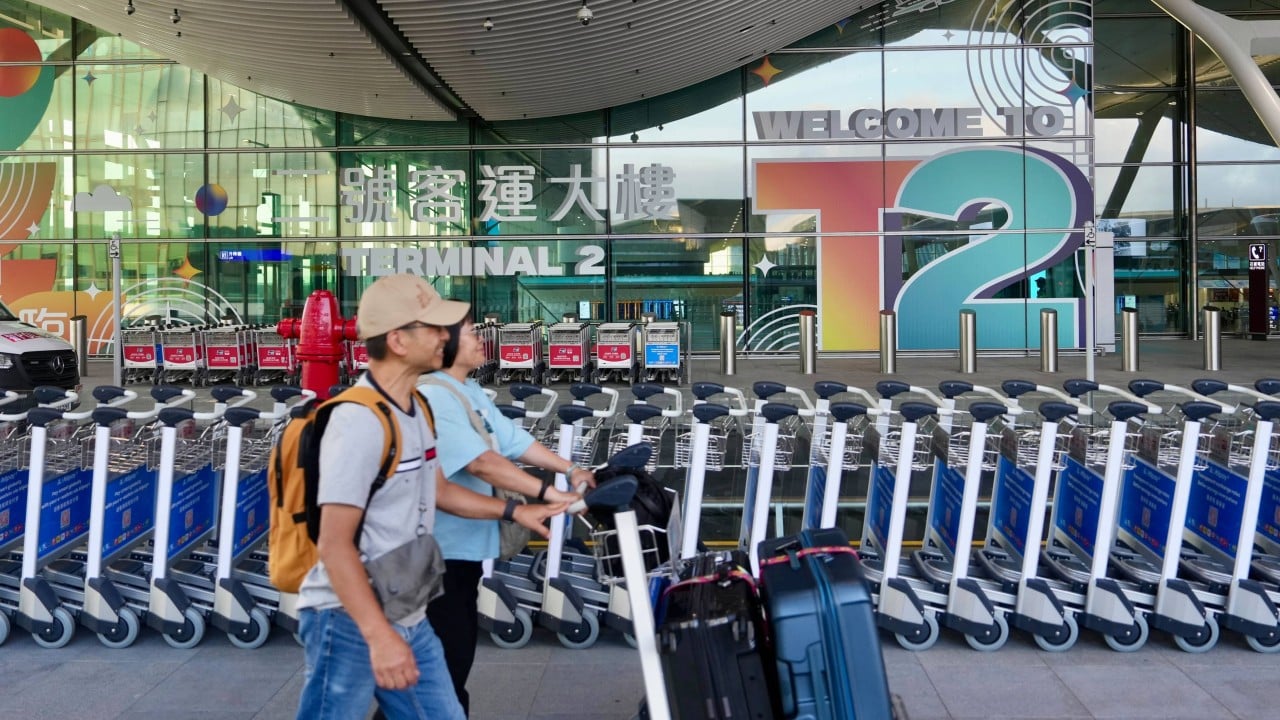
Hong Kong International Airport just initiated passenger departure operations at its completely rebuilt Terminal 2. The official narrative framing the launch focuses on a highly choreographed, low-volume introductory phase designed to project absolute operational readiness. Glossy press releases detail a handful of regional flights moving through a multi-billion-dollar architecture, while early media reports eagerly echo words like "very smooth."
This manufactured calm obscures a much harsher corporate and geopolitical reality. The opening of this facility is not a routine victory lap. It is an urgent, high-stakes attempt by the Airport Authority Hong Kong (AAHK) to rescue the city’s status as Asia’s premier aviation hub after years of crippling pandemic isolation, changing trade patterns, and aggressive competition from regional rivals.
Beneath the sleek, floating lines of the new departures hall lies an intricate, multi-year gamble. The city has bet HK$141 billion on a comprehensive Three-Runway System, of which this terminal is the customer-facing core. To understand whether this massive capital expenditure will actually pay off, one must look past the carefully staged ribbon-cutting and examine the operational bottlenecks, labor deficits, and shifting passenger demographics that the shiny new facade is designed to hide.
The Phased Relocation Architecture
The primary reason the opening day appeared so orderly is that airport planners engineered it to be virtually empty. Rather than risking a chaotic, overnight mass migration of airlines, the authority opted for a highly restricted, multi-week phased transition.
Terminal 2 Initial Phase Migration Timeline (May – June 2026)
┌──────────────┬────────────────────────┬─────────────────────┐
│ Phase Date   │ Primary Airline Move   │ Key Target Region   │
├──────────────┼────────────────────────┼─────────────────────┤
│ May 27       │ Hong Kong Airlines     │ Mainland / Regional │
│ May 28       │ AirAsia Group, Batik   │ Southeast Asia      │
│ June 3       │ Greater Bay Airlines   │ Regional Hubs       │
│ June 10      │ HK Express Airways     │ Low-Cost Regional   │
└──────────────┴────────────────────────┴─────────────────────┘
By filtering only a fraction of the daily traffic through the 300,000-square-meter facility on day one, the airport essentially ran a live, public trial. This slow-burn rollout gives ground handlers, catering trucks, and security personnel room to breathe.
However, this structural pacing reveals an immediate operational compromise. While passengers can now check in, drop their luggage, and clear customs within the new terminal, they cannot actually board an aircraft there. The actual passenger concourse and its 27 dedicated boarding gates will not be operational until 2027.
Consequently, travelers are being funneled into the underground Automated People Mover train system to be sent right back to the old Terminal 1 or its midfield concourses to catch their flights. For the next year, Terminal 2 is effectively a massive, high-tech processing lobby rather than a self-contained gateway. This creates an awkward, two-step journey that tests the patience of frequent business travelers who prize speed over architectural aesthetics.
Automated Efficiency Meets the Human Deficit
The cornerstone of the authority's defense of the project is its heavy investment in biometric screening and automation. The facility boasts 58 smart check-in kiosks and 68 express self bag-drop counters featuring low-platform designs to minimize heavy lifting.
The security screening zone features 15 advanced smart channels that utilize computed tomography imaging. This allows passengers to keep laptops and liquids in their bags, theoretically accelerating the security checkpoint capacity to 3,000 passengers per hour. Additionally, the minimum age for facial-recognition e-Security Gates has been dropped to seven, widening the biometric net to include family travel.
But this heavy reliance on technology is not just an upgrade; it is a defensive necessity forced by an acute, structural shortage of airport labor.
- The Headcount Crisis: The aviation ecosystem in the territory lost thousands of experienced ground handlers, engineers, and logistics specialists during the prolonged border closures of the early 2020s. Many transitioned permanently to other domestic industries or emigrated.
- The Recruitment Bottleneck: Coinciding with the terminal launch, the airport held a massive career fair showcasing more than 4,400 vacancies in engineering, security, and baggage handling. The fact that thousands of roles remain unfilled as the summer peak season approaches is an existential threat to the airport's efficiency.
- The Training Lag: New biometric gates and automated baggage belts do not run themselves. They require tech-literate support staff to intervene when systems error out, a frequent occurrence when processing diverse, global passenger profiles.
Automation cannot entirely replace human personnel. If a baggage-handling system jams under the weight of a full summer peak load in July, a slick digital kiosk in the departures hall cannot clear the backlog. The real test of the infrastructure will occur when the staff vacancy rates collide with unmanaged, high-volume passenger surges.
The Low-Cost Regional Strategy
A glaring shift in strategy is evident in the types of airlines being moved to the new terminal. The facility is explicitly being positioned as a hub for budget and leisure travel. The anchor tenants are regional short-haul carriers, including local low-cost units like HK Express and regional heavyweights like the AirAsia group.
This is a stark departure from the historic identity of the airport, which built its reputation as a premium, long-haul fortress dominated by legacy carriers and premium business-class traffic. By dedicating its newest infrastructure to regional leisure, the airport authority is acknowledging a permanent shift in post-pandemic travel behavior.
Premium business travel has structurally changed. Corporate belts remain tightened, virtual meetings have permanently replaced a portion of regional executive hops, and multinational firms have decentralized some of their regional headquarters away from the city.
In contrast, leisure travel across Southeast Asia and the Greater Bay Area has surged. The new terminal features large 3D LED installations with ocean themes and a 24-hour food court, clear design cues aimed directly at capturing younger, cost-conscious holidaymakers. The economic reality is that while these passengers fill planes, they spend differently than high-net-worth business travelers, putting pressure on terminal retail yields and airport aeronautical revenues.
Geopolitical Headwinds and the Middle East Bypass
The launch coincides with broader, highly volatile shifts in global flight routings. Escalating regional instability in the Middle East has caused international airlines to repeatedly alter their schedules, with many actively reducing their exposure to Gulf hubs.
This geopolitical friction has created a sudden window of opportunity for major Asian hubs. Carriers looking for stable, predictable transit alternatives are redirecting traffic back through traditional East Asian corridors. The new infrastructure gives the city the raw capacity to absorb this displaced traffic, positioning itself as a reliable alternative to Western Asia.
Regional Passenger Processing Capacity (Targeted Annual Projections by 2035)
=============================================================================
Hong Kong International Airport (Full 3RS Completion):   120,000,000 / year
Singapore Changi Airport (Terminal 5 Completion):         140,000,000 / year
Incheon International Airport (Phase 4 Expansion):        106,000,000 / year
=============================================================================
However, the city does not operate in a vacuum. Singapore’s Changi Airport and Seoul’s Incheon have spent the last three years aggressively locking in market share, expanding their corporate flight networks, and refining their transit experiences.
Furthermore, Guangzhou Baiyun and Shenzhen Bao'an airports, located just across the border, have undergone massive expansions of their own. These mainland hubs are directly competing for the exact same domestic passengers that the territory hopes to draw in via its new T2 Coach Hall, which links the airport to 110 cities in the Greater Bay Area.
The Cross-Border Intermodal Gamble
The true commercial viability of the expansion rests on a concept known as intermodal connectivity. The terminal’s integrated Coach Hall, which opened its first phase late last year, features 41 dedicated bays designed to turn the airport into the primary international pier for the entire Pearl River Delta.
The strategy is elegant on paper: a traveler from Dongguan or Zhongshan can clear mainland customs, board a cross-boundary coach or ferry, arrive at Terminal 2, and check their bags straight through to an international flight without ever technically entering the domestic jurisdiction of Hong Kong.
This setup circumvents the traditional dual-customs bottleneck and effectively treats the entire Greater Bay Area as the airport’s domestic market. If successful, it expands the airport's immediate catchment area from seven million residents to over 80 million.
Yet, this intermodal machinery introduces immense operational vulnerability. It links the airport’s reliability directly to the performance of external transport networks, highway congestion, and cross-border regulatory shifts. A delay at a land checkpoint miles away can trigger a cascade of missed flights and stranded baggage at the terminal, complicating the delicate balancing act that ground handlers must perform daily.
The Verdict on the Grand Reopening
The opening day of Terminal 2 was smooth because it was designed to be a closed, highly controlled environment. It was an exercise in public relations, executed perfectly to reassure investors and the public that the city's aviation industry is back on track.
But a quiet terminal is an expensive terminal. The true metric of success for this infrastructure is not how elegantly it handles a few thousand passengers on a sunny morning in May. The real measure will be taken when the phased migration concludes, the summer typhoons disrupt regional flight schedules, and the automated baggage systems are forced to run at maximum capacity with an understaffed ground crew.
The Airport Authority has built a monument to future capacity. Now, it faces the far more difficult task of proving that the global aviation market still demands what it is selling.