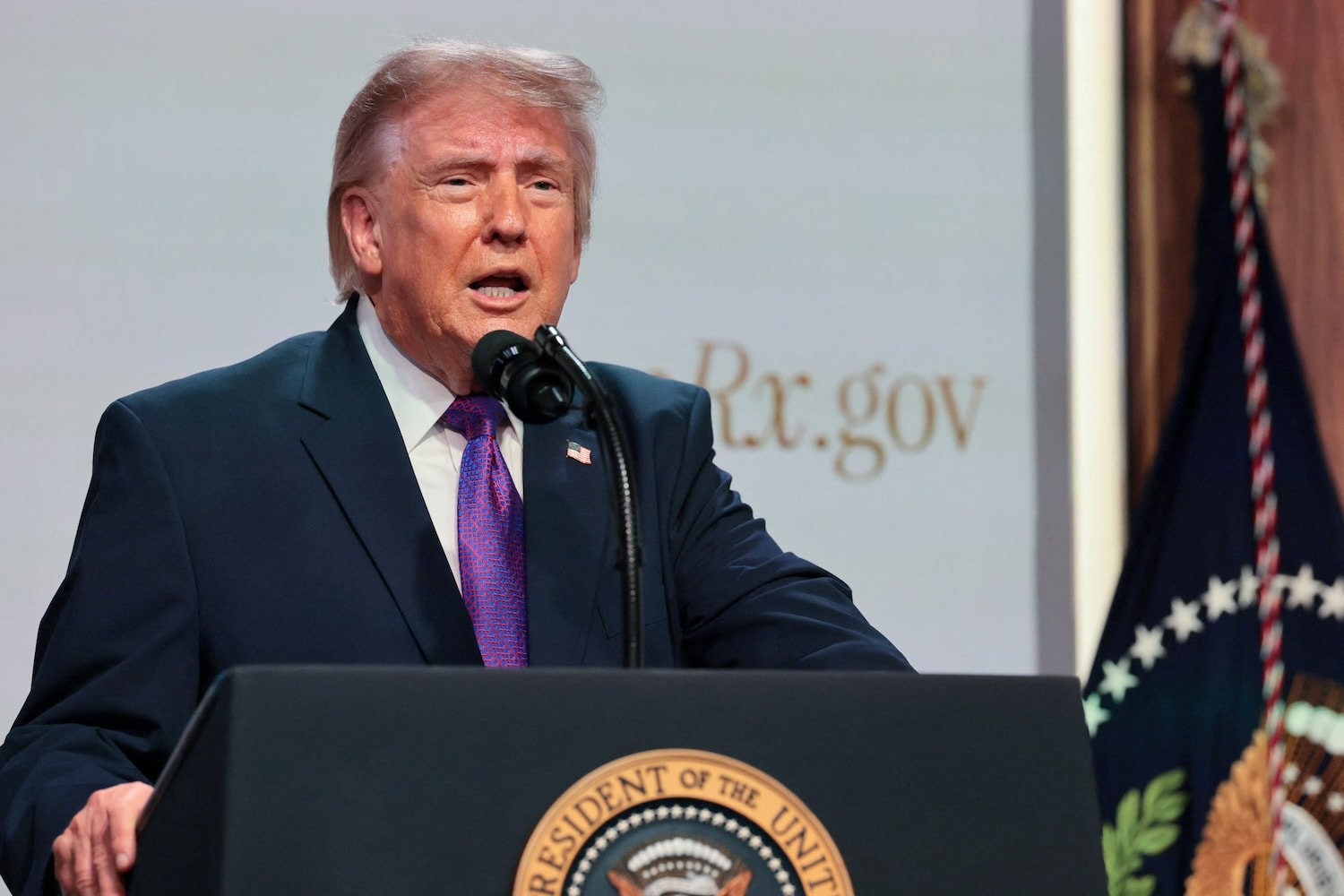
The heavy air of a Washington briefing room always smells faintly of stale coffee and damp wool coats. When Donald Trump steps to a microphone, the room shifts. It is not just the physical presence; it is the immediate acceleration of reality. He speaks in the cadence of a salesman who has survived a thousand hostile boardrooms, offering a singular, recurring promise: everything is negotiable.
During his presidency, and consistently in the years of political theater that followed, Trump leaned into a specific, intoxicating narrative regarding Iran. He claimed, with absolute certainty, that despite the crippling sanctions, the fiery rhetoric, and the brinkmanship that brought two nations to the edge of open conflict, Tehran was desperate to pull up a chair.
"Iran really wants to make a deal," he would say. He said it in hallways, on tarmac edges over the roar of Marine One, and via late-night social media declarations.
To understand the weight of that claim, you have to leave the briefing room. You have to look at what a deal actually means to the people who live under the shadow of its absence.
The Price of Admission
Imagine a small storefront in Tehran. Let us call the shopkeeper Reza. Reza does not read the English-language press releases from the White House, nor does he dissect the theological nuances of the Islamic Revolutionary Guard Corps. Reza sells spare automotive parts. For three decades, his business fed his family, paid for his daughter’s university tuition, and anchored him to his community.
Then came the maximum pressure campaign.
When the United States exited the Joint Comprehensive Plan of Action (JCPOA) in 2018, reinstated sweeping sanctions, and added new ones, the global banking system slammed its doors on Iran. Reza’s supply chains evaporated overnight. The German valves he used to import became black-market luxuries. The Iranian rial plummeted, transforming his life savings into a stack of beautifully printed, largely worthless paper.
For Reza, a "deal" is not a political trophy. It is a matter of oxygen.
This is the human bedrock of Trump’s assertion. When an American president says a foreign adversary is desperate to negotiate, he is tapping into a verifiable reality of economic strangulation. The sanctions were designed to hurt, and they bit deep. Inflation in Iran soared past forty percent. Medicine became scarce. The middle class, the very segment of society most open to Western ideals, found itself crushed into survival mode.
But hunger does not automatically breed surrender.
Consider how power actually functions in the corridors of Tehran. The supreme leader, Ayatollah Ali Khamenei, has spent a lifetime constructing a worldview predicated on a single, unshakeable thesis: the United States cannot be trusted. Every broken agreement, every covert operation, and every round of economic warfare is used by the hardliners to validate this premise.
When Trump declared that Iran wanted a deal, he was looking at Reza’s empty storefront and assuming the pressure would force the leadership’s hand. He viewed international diplomacy through the lens of New York real estate. If you squeeze the tenant hard enough, they will sign the lease.
International relations, however, possess a different gravity.
The High-Stakes Pokers of the Middle East
The core conflict of this narrative lies in a profound misunderstanding of leverage. In a traditional business negotiation, both parties generally agree on what victory looks like. It is usually a number. In geopolitical standoffs, victory is defined by survival and prestige.
During the period where Trump insisted Iran was ready to talk, the Iranian government did something counterintuitive to the corporate mind. They did not sue for peace. Instead, they accelerated their uranium enrichment. They targeted oil tankers in the Persian Gulf. They shot down a sophisticated American drone.
This was not the behavior of a party preparing to capitulate. It was the strategic response of a regime that understood a fundamental rule of asymmetric conflict: if you appear too eager to talk when you are weak, you have already lost.
The strategy was dangerous. It brought the world to the precipice of a broader regional war, particularly after the assassination of Iranian General Qasem Soleimani in early 2020. That moment showed the terrifying fragility of the transactional approach. For days, the world waited to see if the cycle of retaliation would ignite a conflagration that could not be contained.
Even then, amidst the smoke and the funerals, the American administration maintained that the door was open. The underlying theory was that the sheer display of American might would ultimately compel Tehran to seek terms.
But what kind of deal was actually possible?
Trump wanted a comprehensive treaty. He wanted an end to Iran’s ballistic missile program, a cessation of its regional proxy wars in Yemen, Syria, and Lebanon, and a permanent halt to its nuclear ambitions. It was a grand vision.
It was also an impossible sell for the Iranian leadership. To accept those terms would be tantamount to signing the regime's own dissolution paperwork. A government built on the foundational myth of anti-imperialist resistance cannot simply dismantle its entire defense architecture because its economy is suffering. They would rather their people eat grass.
The Geography of Trust
There is a quiet tragedy in how these grand strategies play out on the global stage. The debate over whether Iran "wanted" a deal misses the deeper, more unsettling truth about modern diplomacy.
Desire is irrelevant without trust.
When the United States unilaterally walked away from the 2015 nuclear agreement—an agreement that Iran was verified to be complying with by international inspectors—it altered the psychology of negotiation for a generation. It demonstrated that an agreement with Washington is only as good as the term of the current president.
If you are an Iranian diplomat, how do you pitch a new deal to your superiors? How do you justify the political risk of shaking hands with an adversary who might rewrite the rules after the next election cycle?
You cannot.
So the dance continues. The statements made at rallies and press conferences are rarely meant for the ears of the diplomats in Tehran anyway. They are designed for domestic consumption. They project an image of strength, a narrative wherein the rest of the world is perpetually on the verge of bowing to American resolve.
Meanwhile, the reality on the ground shifts in ways that cannot be fixed by a signature on a piece of paper. Denied access to Western markets, Iran did not collapse. It pivoted. It forged deeper economic and military ties with Beijing and Moscow. It learned the dark arts of sanction evasion, creating a shadow economy that enriches smugglers and hardliners while continuing to starve the middle class.
The leverage that the United States possessed in 2018 has slowly eroded. The world has adapted to the fracture.
The Echoes of the Unsaid
We often view history as a series of definitive moments. A treaty signed. A bomb dropped. A speech delivered.
But the real history of the US-Iran relationship is written in the spaces between those events. It is written in the quiet desperation of families who cannot afford cancer medication because of banking restrictions. It is written in the secret laboratories where centrifuges spin silently, deeper underground than they were a decade ago.
The assertion that Iran wanted a deal was not entirely false, but it was dangerously incomplete. They wanted relief. They wanted normalcy. They wanted to re-enter the global community.
But they were never going to trade their sovereignty for it.
The sun sets over the Alborz mountains, casting long shadows across the concrete sprawl of Tehran. In his shop, Reza turns off the lights and locks the door. He has sold nothing today. He walks home through streets that are vibrant, defiant, and exhausted. He does not know if there will ever be a deal. He only knows that the politicians in far-off capitals will continue to talk about his life as if it were a chip on a velvet table, waiting for someone with enough audacity to call the bluff.