When you walk through the monumental gateways of Angkor Wat or stand before the soaring spires of Prambanan, you aren't just looking at local architectural triumphs. You're looking at a deeply connected, ancient world that crossed oceans without a single army. Today, a lot of people think heritage preservation is just about local museums or fixing up old fortresses down the street. It isn't. Some of the most significant architectural rescues are happening thousands of miles away from New Delhi, driven by the Archaeological Survey of India (ASI).
India’s biggest heritage conservation projects abroad are quietly rewriting how we think about cultural diplomacy. Just this week, in July 2026, Prime Minister Narendra Modi and Indonesian President Prabowo Subianto officially kicked off a massive joint conservation effort at the 1,000-year-old Prambanan Temple complex in Yogyakarta. It's the latest chapter in a long, gritty saga of engineering, diplomacy, and historical rediscovery that has spanned decades and saved some of the world's most spectacular ruins from literal collapse.
Let's clear something up right away. This isn't about claiming ownership. It's about shared civilizational roots and specialized technical knowledge. When the ASI steps onto a site like Angkor Wat or the earthquake-shattered plains of Bagan, they deal with challenges that would make modern skyscraper engineers sweat. Tropical monsoons, shifting foundations, exploding vegetation, and the complex chemistry of ancient stone require a level of hands-on experience that you can't just learn from a textbook.
The Bold Rescue of Angkor Wat
Think back to the 1980s. Cambodia was bleeding, recovering from the horrific reign of the Khmer Rouge. The country was politically isolated, broke, and desperately fragile. International organizations wouldn't touch the country. Western experts stayed away. Yet, the world's largest religious monument, Angkor Wat, was falling apart. Vegetation was ripping through stone joints, foundations were sinking into the soft Cambodian water table, and rainwater was eroding priceless bas-reliefs.
India stepped up alone. Between 1986 and 1992, the ASI sent teams of dedicated archaeologists and engineers into a country that was still facing active civil instability. They didn't have high-tech laser scanners or advanced digital modeling back then. They had sheer grit, traditional masonry skills, and a deep understanding of structural mechanics.
The team, initially led by experts like K.M. Srivastava, faced a logistical nightmare. They had to deal with massive stone displacement along the famous galleries. Over the centuries, water had seeped behind the carved stone walls, washing away the underlying soil and causing the heavy sandstone blocks to buckle outward.
The ASI team painstakingly disassembled sections of the collapsing corridors. They cataloged every single block, reinforced the foundations with concrete rafts where necessary, and reassembled the ancient jigsaw puzzle. They did it without losing the original alignment. They cleared away destructive vegetation using carefully measured chemical washes that killed the deep-seated root systems without eating away the 12th-century carvings.
Critics at the time, particularly from some Western institutions, love to nitpick the techniques used in the 1980s. Some complained about the use of concrete reinforcements. But honestly, without those emergency structural interventions, massive sections of Angkor Wat's third corridor would have pancaked into rubble long before the UN or international funds decided it was safe to return to Cambodia. It was a masterclass in crisis conservation under geopolitical pressure.
Entering Yogyakarta to Rebuild Prambanan
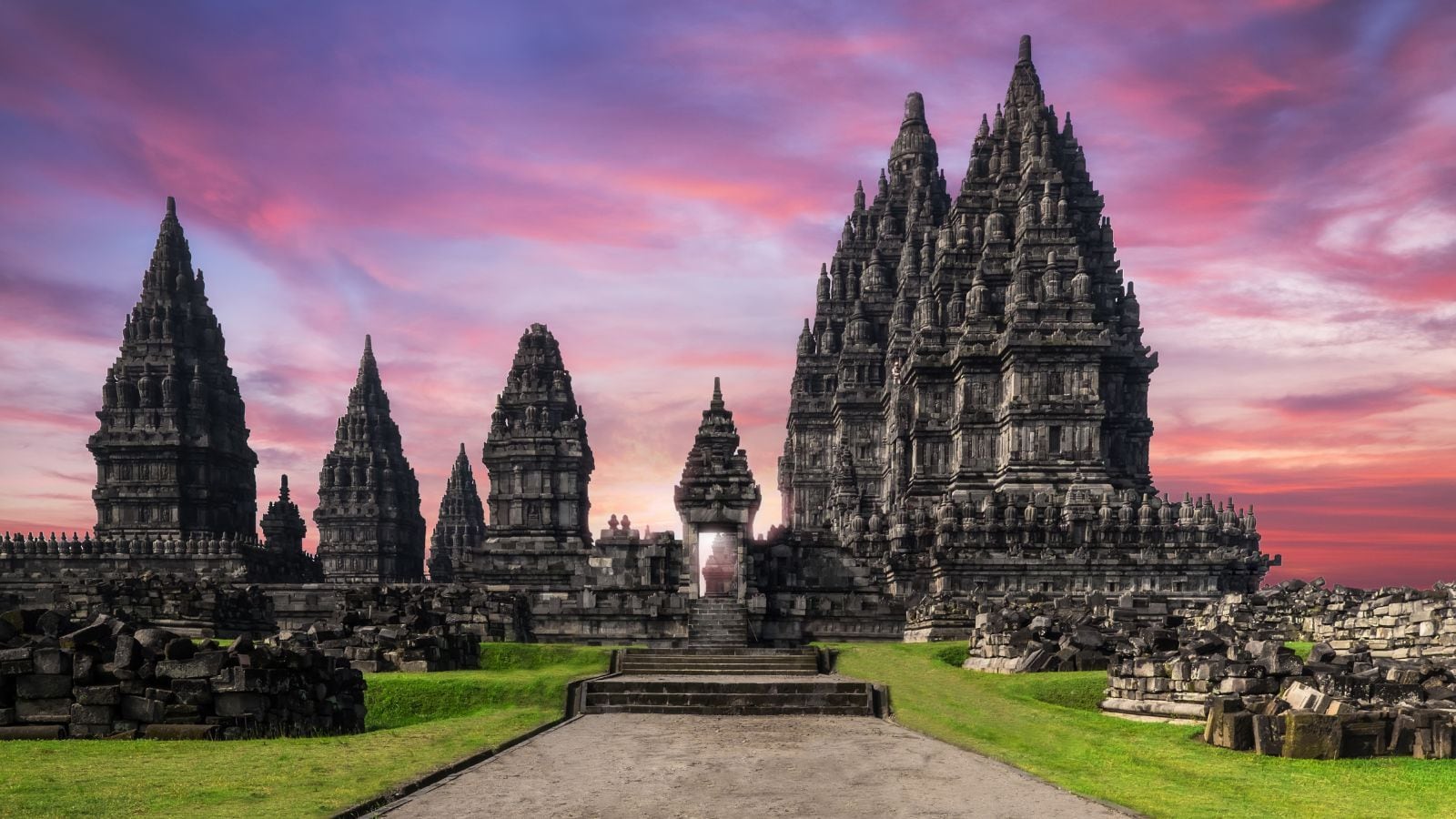
Fast forward to right now in July 2026. The spotlight has shifted to Indonesia. Prambanan is the largest Hindu temple site in Indonesia and the second-largest in Southeast Asia after Angkor Wat. Built in the 9th century during the Sanjaya dynasty, this complex originally contained 240 temples arranged in complex concentric squares. The central Shiva temple towers a staggering 47 meters into the Javanese sky.
Prambanan has taken brutal beatings from nature over the centuries. Volcanic eruptions from nearby Mount Merapi and violent tectonic shifts have repeatedly flattened these stone structures. The devastating Java earthquake in May 2006 was a massive setback, causing severe structural fractures, tilting walls, and collapsing stones across the central compound.
While Indonesian authorities have worked tirelessly since 1918 using traditional interlocking stone techniques, many smaller structures within the outer concentric zones remain incomplete, disorganized, or unstable. That's exactly where the new 2026 India-Indonesia partnership comes in. The ASI is deploying teams to Yogyakarta to help restore and conserve these smaller, fragmented shrines.
The technical challenge here is wild. You're dealing with anastylosis—the archaeological process of reconstructing a ruined monument using only the original architectural elements as much as possible. Imagine a puzzle with 20,000 heavy volcanic stone blocks scattered across a field, half of them broken, cracked, or smoothed out by centuries of weather.
ASI engineers use a mix of traditional interlocking methods and hidden modern reinforcements to make sure the temples can withstand future seismic activity. They don't just stack stone; they study the exact mineral composition of the Javanese volcanic rock to ensure any patching materials match perfectly in weight, porosity, and thermal expansion. It's a massive, slow-burning project that will take years of painstaking fieldwork.
Rejoining Shattered Bricks at My Son Sanctuary
If you travel to the Quang Nam province in central Vietnam, you’ll find the My Son Sanctuary. This was the spiritual heartland of the ancient Champa Kingdom, built between the 4th and 13th centuries. Unlike the massive stone blocks of Angkor or Prambanan, the Cham builders were absolute masters of red brick.
During the Vietnam War, this site became a hiding spot for Viet Cong forces, making it a target for heavy American carpet bombing. A catastrophic B-52 strike destroyed the main tower of the complex, leaving behind cratered earth and shattered brick structures wrapped in choking jungle vines.
Between 2017 and 2022, an ASI team took on the task of conserving the A, H, and K temple groups at My Son. Working with red brick is a completely different beast than sandstone. Ancient Cham builders didn't use visible mortar joints. They used a mysterious vegetable-based resin or specialized local sap that allowed them to rub the bricks together so tightly that you couldn't slide a knife blade between them.
The ASI didn't try to reinvent the wheel. They spent months experimenting with local materials to recreate a compatible mortar mix that could stitch structural cracks without damaging the soft, fragile ancient bricks. They meticulously cleaned the surfaces with wire brushes and gentle water sprays, removed decayed materials, and laid new, specially manufactured bricks to support the buckling walls.
During the cleanup inside the sanctum of the A10 temple in 2020, the team struck gold. They discovered a massive, monolithic sandstone Shiva Linga and a beautifully preserved Yoni Pitha in the A13 temple. Instead of moving these to a distant city museum, the conservation strategy focused on stabilizing the surrounding structures so these artifacts could remain in their original context. It preserves the spiritual integrity of the site, which is exactly what true conservation should do.
The Earthquake Battle on the Plains of Bagan
In Myanmar, the ancient city of Bagan is an otherworldly plain containing over 3,000 Buddhist monuments, stupas, and pagodas built during the Pagan Kingdom between the 11th and 13th centuries. It's a highly active earthquake zone. In August 2016, a massive 6.8-magnitude earthquake tore through the region, damaging nearly 400 historic buildings.
The ASI had already completed a highly successful restoration of the iconic Ananda Temple in Bagan in 2018, fixing damage from a 1975 quake. Following the 2016 disaster, India signed an agreement to take on the stabilization and restoration of dozens of other damaged structures, starting with a first phase of 12 critical pagodas.
Bagan presents a unique headache for conservationists: the weather. Between June and September, the relative humidity swings wildly, and the scorching tropical sun beats down on the brick and stucco walls. This intense climate loop causes masonry elements to expand and contract rapidly, causing historic plasterwork and internal murals to flake away.
Because of this, the ASI teams can only do effective structural work between October and May. Their work involves grouting deep structural cracks, binding separating walls with concealed steel tie rods, and performing delicate chemical preservation on centuries-old Buddhist frescoes. They have to work slowly, injected specialized lime-based grouts into internal voids to stabilize the walls without letting the moisture damage the delicate paintings on the inner surfaces.
Forgotten Triumphs in Laos and Beyond
We can't talk about India’s biggest heritage conservation projects without pointing to Vat Phou in Laos. Perched on the slopes of Mount Phu Kao, this pre-Angkorian Khmer temple complex stretches out over dramatic terraced landscapes. The ASI has been working here for years to stabilize structures that are literally sliding down a mountainside due to heavy monsoon rains and soil erosion.
The engineers had to create complex drainage networks to divert thousands of gallons of rainwater away from the temple foundations. They had to lift and reset massive sandstone blocks that had shifted out of alignment because the hillside beneath them was slowly turning to mud. It’s heavy civil engineering disguised as archaeology.
- Angkor Wat, Cambodia (1986–1992): Saved crumbling sandstone galleries during intense political instability.
- Ta Prohm, Cambodia (Ongoing): Balancing the preservation of ancient stone structures while maintaining the iconic, massive tree roots that wrap around them.
- My Son, Vietnam (2017–2022): Restored war-torn brick temple groups and unearthed significant hidden artifacts.
- Ananda Temple and Bagan Pagodas, Myanmar (2012–Present): Structural and chemical resurrection following devastating seismic shocks.
- Prambanan, Indonesia (Launched July 2026): A massive new initiative to reconstruct and stabilize seismic-damaged outer shrines.
What You Can Learn from Ancient Engineering
When you look closely at these projects, you realize that ancient builders knew exactly what they were doing. They designed structures using dry-masonry interlocking techniques that allowed buildings to flex slightly during earthquakes rather than cracking instantly like modern rigid concrete.
If you're planning to travel to Southeast Asia to see these sites, don't just take a quick selfie in front of the main towers and leave. Look at the joints. Look at the hidden drainage channels carved into the stone floors. Notice where the original stone ends and the carefully matched restoration stone begins.
If you want to understand the true scale of this work, change how you travel:
- Look for the details: When visiting places like Angkor Wat, Ta Prohm, or Prambanan, seek out the specific sectors restored by the ASI. You'll often find small, subtle plaques or informational panels explaining the exact engineering feats pulled off on that specific wall or pavilion.
- Read the walls chronologically: At Prambanan, the Ramayana reliefs are carved on the inner walls of the Shiva temple balustrades. To follow the narrative correctly, you need to enter from the east side and walk clockwise (pradakshina).
- Support local preservation economies: Heritage conservation isn't just about foreign experts flying in. It's about training local communities. When you hire local guides who are educated in the archaeological history of My Son or Bagan, you directly fund the ongoing security and maintenance of these fragile open-air ruins.
The work happening right now in places like Yogyakarta isn't an academic exercise. It's a race against time, climate change, and natural disasters to keep our shared human story standing on its feet.