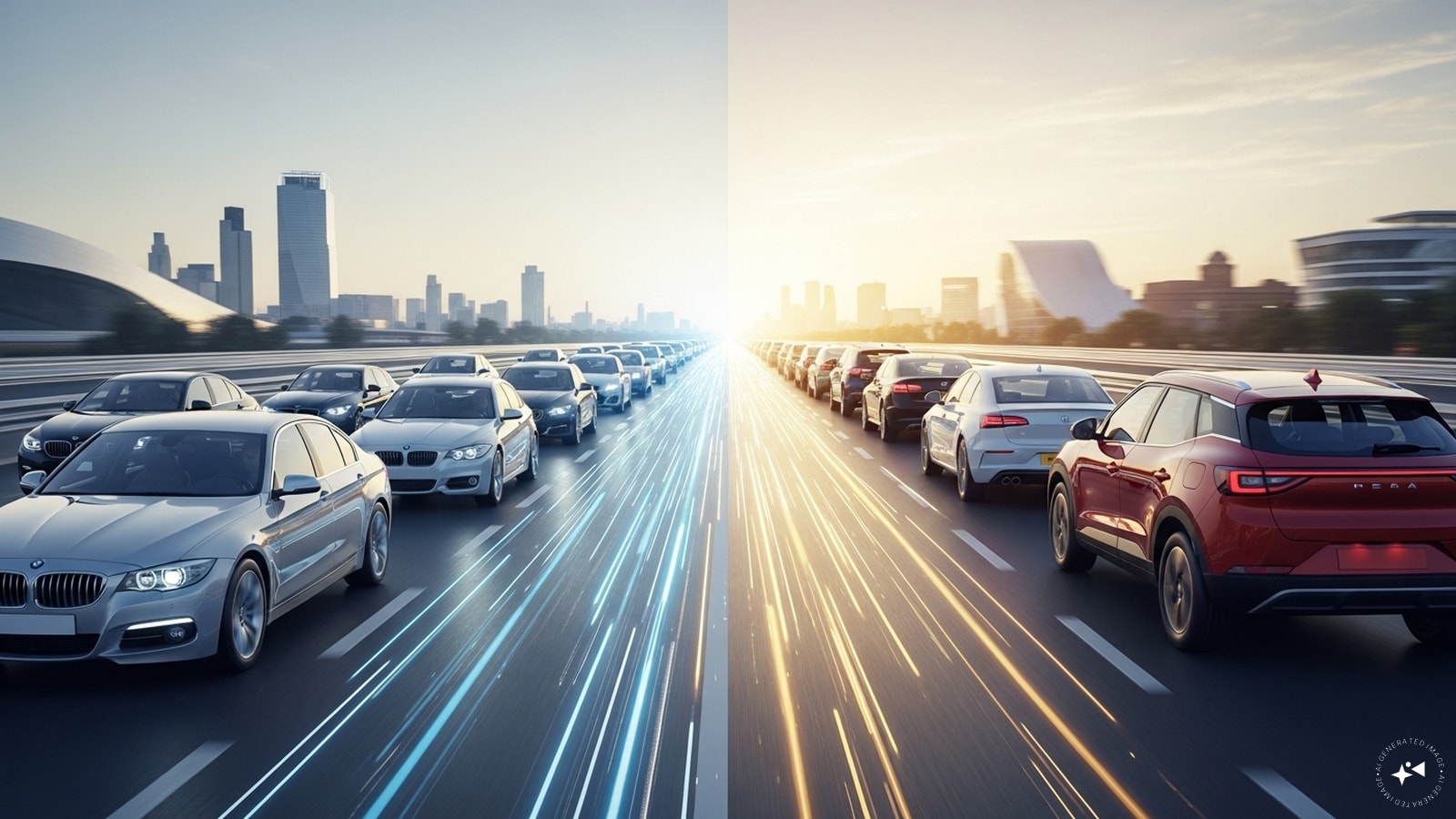
The auto industry is celebrating a phantom victory. Headlines are buzzing with the news that India will allow 378,000 UK-manufactured passenger cars into its borders at a concessional duty over the next 15 years. Trade negotiators are sipping champagne. Industry analysts are churning out bullish reports about a breakthrough in Anglo-Indian trade relations.
They are all missing the point. Recently making waves lately: The Architecture of Extreme Luxury: Analyzing the Rolls-Royce Droptail Capital Allocation Strategy.
This quota is not a golden ticket. It is a highly restrictive, carefully engineered statistical illusion designed to protect domestic Indian manufacturing while throwing a symbolic bone to British exporters. If British automakers think this policy is going to ignite a massive sales boom in Mumbai or Delhi, they are in for a brutal awakening.
The Math Behind the Illusion
Let us break down the actual numbers that the mainstream press refuses to look at closely. Allowing 378,000 cars over 15 years sounds like a massive number on a press release. In reality, that averages out to just 25,200 vehicles per year. Additional information regarding the matter are explored by The Economist.
To put that into perspective, India's domestic passenger vehicle market is rapidly scaling past 4 million units annually. A quota of roughly 25,000 cars a year represents a microscopic fraction—less than 1%—of the Indian automotive market.
More importantly, look at the composition of British automotive exports. The UK does not mass-produce cheap, high-volume hatchbacks for the global market anymore. British automotive manufacturing is heavily weighted toward high-end luxury vehicles and performance SUVs—think Jaguar Land Rover, Bentley, Aston Martin, and McLaren.
The Pricing Paradox
Even with a concessional duty, these vehicles face massive financial hurdles before they ever touch an Indian road.
- The Baseline Cost: A standard British-built luxury SUV often starts well above £60,000 ($75,000 USD) before taxes.
- The Residual Duties: "Concessional" does not mean zero. India’s baseline Basic Customs Duty (BCD) on imported completely built units (CBUs) has historically sat at 60% or 100% depending on engine size and CIF (Cost, Insurance, and Freight) value. Cutting that by a fraction still leaves the vehicle subjected to hefty import taxes, plus India’s Goods and Services Tax (GST) of 28%, plus an additional luxury cess that can climb up to 22%.
- The Final Retail Sticker: A vehicle that costs £70,000 to manufacture in Solihull or Crewe will still easily clear the equivalent of £150,000 by the time it reaches a showroom in New Delhi.
I have watched luxury brands sink tens of millions of dollars into emerging markets thinking tariff reductions would democratize their products. It never happens. The price elasticity of demand for a £150,000 car does not magically shift because the tariff dropped from 100% to 50%. The ultra-wealthy will buy it regardless; the upper-middle class still cannot afford it. The volume will not move.
The Real Winner is New Delhi, Not the West Midlands
This trade concession is a masterclass in economic statecraft from India’s Ministry of Commerce and Industry. It gives the appearance of a free-market concession while keeping the structural barriers firmly in place.
India’s overarching economic policy for the automotive sector is driven by the "Make in India" initiative and the Production Linked Incentive (PLI) scheme. The government has spent a decade forcing global automakers to set up local manufacturing plants, source local components, and invest in local infrastructure. They are not about to dismantle that entire domestic ecosystem just to let British factories run three shifts a day.
The Component Trap
Even within trade agreements of this nature, strict Rules of Origin apply. To qualify for the concessional duty, a specific percentage of the vehicle's value must originate from the UK.
This creates an operational nightmare for modern British car manufacturing. Many UK-assembled vehicles rely heavily on complex global supply chains, including electronics from Asia and specialized components from the European Union. If a vehicle fails to meet the rigid local content threshold stipulated in the trade agreement, it gets hit with the full, non-concessional tariff anyway.
The Wrong Question: "How Many Cars Can We Ship?"
Every executive asking how to maximize their share of this 3.78 lakh quota is asking the wrong question. They are operating on a 1990s playbook of international trade.
The question they should be asking is: "Why are we trying to export British steel to India when the entire Indian market is pivoting toward localized EV architectures?"
The Electric Pivot
The true battleground in India is not internal combustion engine (ICE) luxury cars. It is electrification. The Indian government is aggressively pushing for 30% of all private car sales to be electric by 2030.
Local giants like Tata Motors and Mahindra & Mahindra are pouring billions into localized EV platforms. Meanwhile, global players like Hyundai and Suzuki are rapidly expanding their local EV assembly lines.
The UK luxury brands lagging in pure EV architectures cannot compete in a market that is leapfrogging traditional automotive evolution. Shipping an ICE V8 British luxury sedan with a slight tariff discount into a market that is actively disincentivizing fossil fuels via fuel compliance and local emission zones is a strategy built on expiration dates.
Dismantling the Consensus
Let us address the common counter-arguments put forward by optimistic trade analysts.
| The Common Belief | The Hard Reality |
|---|---|
| "This agreement opens up a massive untapped middle-class luxury market in India." | The Indian luxury car market is structurally capped at around 40,000 to 50,000 units a year total. A minor tariff cut does not expand the buyer pool; it just shuffles the existing buyers between German and British brands. |
| "UK factories will see increased production volume and job security." | A quota cap spread over 15 years means the incremental volume per factory is statistically negligible. It won't justify adding a single extra assembly worker in the UK. |
| "This gives British brands a decisive advantage over European competitors." | European brands like Mercedes-Benz, BMW, and Audi already have deeply entrenched local assembly operations (CKD plants) in India, completely bypassing the highest CBU tariffs. |
The German premium brands figured this out twenty years ago. They do not ship fully built cars from Stuttgart or Munich to India in large volumes. They ship kits to places like Chakan or Chennai and assemble them locally to avoid the tariff wall entirely.
The UK industry’s reliance on exporting fully built luxury vehicles under a restricted quota is an admission that they lack the capital or the strategic will to deeply localize within the Indian subcontinent.
The Operational Risk Nobody Talks About
There is a distinct downside to chasing this quota that automotive boards are ignoring: the opportunity cost of compliance.
Altering supply chains, rewriting logistics contracts, and navigating the bureaucratic labyrinth of Indian customs to verify compliance for a few thousand vehicles a year sucks up enormous executive bandwidth. Engineering teams must ensure that these specific export models comply with India-specific regulations (such as Bharat Stage VI emission norms and specific local safety mandates) which often diverge from European standards.
When you calculate the cost of compliance, the cost of specialized logistics, and the razor-thin margin improvements offered by the tariff reduction, the net return on investment evaporates. You are burning dollar bills to chase dimes.
Stop looking at trade quotas as a victory condition. A 25,000-car annual cap spread across an entire national industry is not an open door; it is a gilded cage designed to keep foreign manufacturers compliant, quiet, and fundamentally outside the real market.