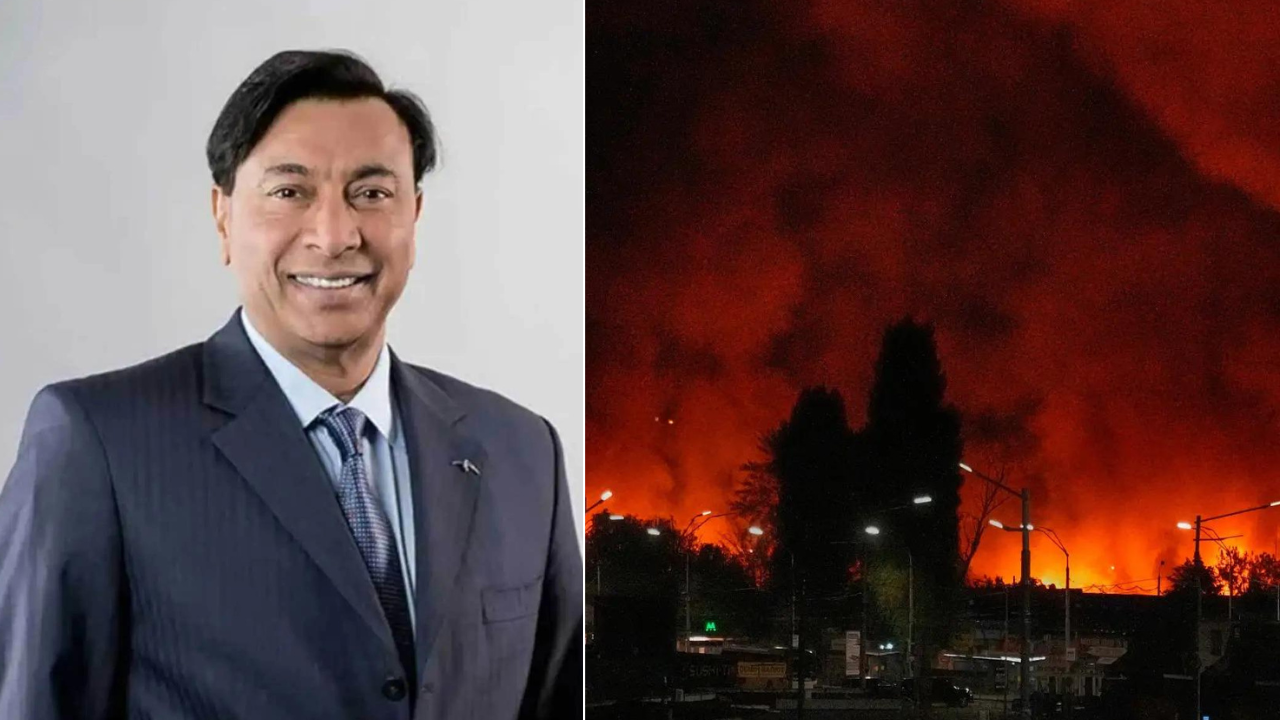
A precision-guided Russian ballistic missile strike slammed into the ArcelorMittal Kryvyi Rih metallurgical complex in central Ukraine, killing two workers, injuring 14 others, and forcing a partial suspension of production at the nation's largest steel facility. The attack on the plant—owned by billionaire Lakshmi Mittal’s global steel empire—highlights an aggressive shift in targeting industrial and energy grid components as long-range aerial exchanges between Moscow and Kyiv escalate.
The assault on President Volodymyr Zelenskyy’s hometown facility transcends a local tragedy. It exposes the extreme vulnerability of heavy manufacturing assets trapped inside active conflict zones and signals a calculated strategy to degrade Ukraine's remaining economic backbone.
The Anatomy of the Strike on ArcelorMittal Kryvyi Rih
According to corporate disclosures and local emergency services, the missile impact targeted critical infrastructure within the sprawling mining and metallurgical plant. Specifically, power generation units and blast furnace operations took direct hits.
Heavy industry cannot function without stable, high-capacity electricity and continuous thermal management. When power systems are compromised, blast furnaces face catastrophic cooling risks that can freeze molten metal inside the vessels, turning weeks of mechanical maintenance into a multi-million-dollar recovery nightmare.
Management confirmed that production processes were immediately throttled. Emergency responders deployed heavy equipment to clear rubble and suppress secondary fires while medical personnel treated the injured contractors and plant operators.
This is not the first time the giant steelworks has borne the brunt of the war. Since the full-scale invasion began, the facility has faced intermittent shelling, supply chain strangulation, and workforce depletion as thousands of workers joined military ranks. Yet, running a vital economic asset under the constant threat of aerial bombardment remains an operational tightrope walk unlike any other in corporate history.
The Broader Industrial Retaliation Cycle
The missile strike on the Kryvyi Rih plant did not occur in a vacuum. It unfolded amid a massive, synchronized escalation of long-range aerial campaigns. Hours before the explosion at the steelworks, Ukraine launched one of its largest drone offensives of the war, sending hundreds of unmanned aerial vehicles toward Russian territory, targeting oil refineries, logistics hubs, and industrial zones.
Moscow's defense ministry subsequently claimed the metallurgical plant in Kryvyi Rih was targeted due to its integration into the broader industrial capacity supporting the state. In total, regional reports indicate that waves of ballistic missiles, guided aerial bombs, and attack drones have battered multiple Ukrainian regions, pushing civilian and industrial infrastructure to the breaking point.
For global investors, the targeting of a multinational asset owned by ArcelorMittal underscores the profound risks of maintaining physical capital in contested geographic corridors. Multinational corporations face an impossible calculus: abandon strategic manufacturing assets at a staggering write-down, or maintain operations while risking the lives of local employees and absorbing direct military destruction.
Economic Fallout for Global Steel Markets
While ArcelorMittal Kryvyi Rih operates at a fraction of its historical pre-war capacity, it remains a critical symbol of industrial resilience for Ukraine's war-battered economy. Before the conflict, the plant produced millions of tons of crude steel, serving as a primary exporter to European markets.
The latest damage to its power infrastructure and blast furnaces ensures that output will remain constrained for the foreseeable future. European steel buyers, already grappling with volatile energy prices and structural overcapacity, must continually adjust to the permanent loss of reliable Ukrainian slab and finished products.
Furthermore, the human toll remains the most devastating metric. Two families are mourning workers who reported for a standard industrial shift, only to become casualties of a geopolitical conflict that treats heavy manufacturing hubs as legitimate strategic terrain. As long-range strikes continue to trade blows across borders, the physical safety of industrial laborers in Eastern Europe grows increasingly precarious