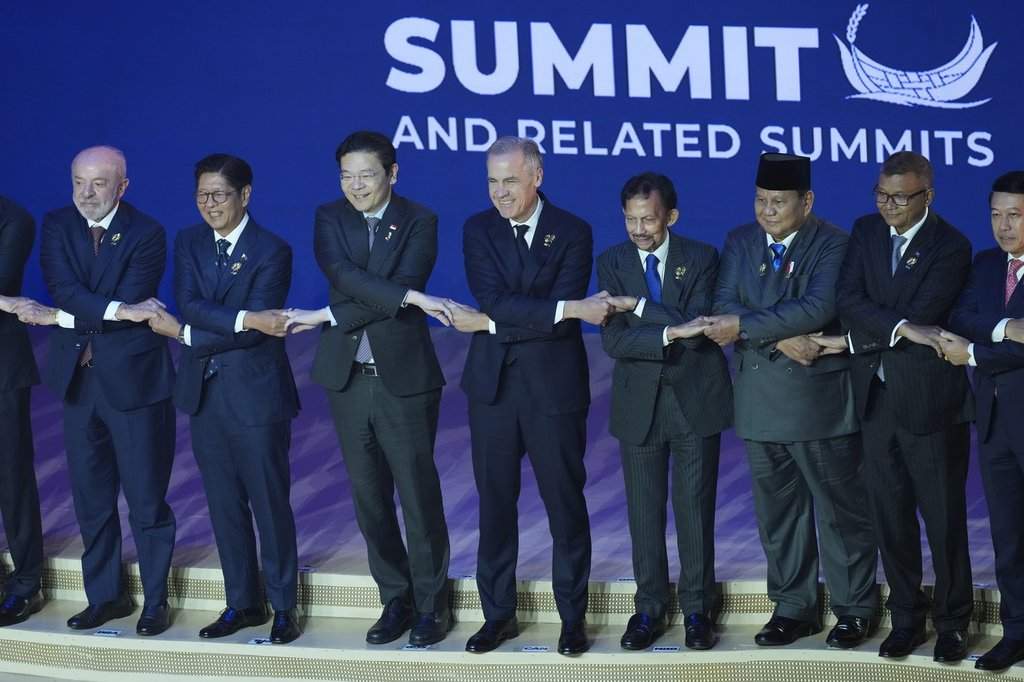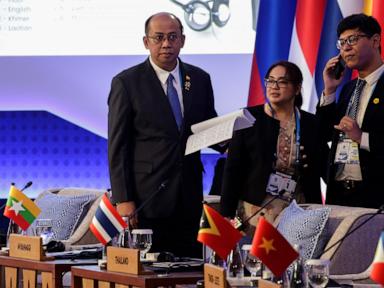
Southeast Asian leaders have once again condemned the escalating violence in Myanmar and extended their diplomatic ban on the country’s military rulers, barring them from high-level regional summits. While the Association of Southeast Asian Nations (ASEAN) presents this move as a firm stand against the junta's brutality, the reality is far more complicated. The ban is less a weapon of enforcement and more an admission of diplomatic defeat. Years after the military seized power, the bloc remains trapped by its own foundational rules, unable to stop the bloodshed on its doorstep while trying desperately to protect its international credibility.
Diplomatic statements rarely stop artillery shells. For anyone watching the crisis unfold in mainland Southeast Asia, the gap between what regional diplomats say behind closed doors and what actually happens on the ground has widened into a chasm.
The Anatomy of a Diplomatic Stalemate
To understand why ASEAN keeps repeating the same ritual of condemnation and exclusion, you have to look at the structural DNA of the organization. Founded during the Cold War, the ten-member bloc operates on a principle of strict non-interference and decision-making by consensus. Every member state holds an effective veto.
When Myanmar’s military, known as the Tatmadaw, overthrew the democratically elected government in February 2021, ASEAN scrambled to respond. The result was the Five-Point Consensus, a peace plan agreed upon in Jakarta just months after the coup. It called for an immediate cessation of violence, constructive dialogue among all parties, mediation by a special ASEAN envoy, humanitarian assistance, and a visit by the envoy to meet with all stakeholders.
Senior General Min Aung Hlaing signed off on that plan. Then he immediately ignored it.
Instead of de-escalating, the junta launched scorched-earth campaigns against civilian populations and armed resistance groups. Confronted with blatant defiance, ASEAN took the unprecedented step of barring Min Aung Hlaing and his top brass from its annual summits, inviting only "non-political representatives" from Myanmar—a seat the junta has consistently refused to fill.
Extending that ban is the bare minimum ASEAN can do without shattering its own fragile unity. To lift the ban would signal to Washington, Brussels, and Tokyo that Southeast Asia has normalized a regime accused of war crimes. Yet, the bloc lacks the legal mechanisms or the political will to go any further. ASEAN does not impose economic sanctions. It does not expel members. It relies entirely on peer pressure, a tool that works only when the target cares about its reputation among neighbors.
Why the Junta Ignores Its Neighbors
Min Aung Hlaing does not care about diplomatic snubbing in Jakarta or Vientiane. His calculus is entirely existential.
For the Tatmadaw, retaining absolute power is a matter of survival, not just political preference. The military leadership knows that relinquishing control or entering genuine power-sharing negotiations with the National Unity Government (NUG)—the shadow administration formed by ousted lawmakers—would likely end with the generals facing international tribunals or domestic prosecution.
Furthermore, the junta has suffered staggering territorial losses. Since late 2023, coordinated offensives by ethnic armed organizations and local People’s Defense Forces have stripped the military of vital border crossings, military bases, and entire townships, particularly along the frontiers with China, India, and Thailand.
When a regime is fighting for its life on multiple fronts, a seat at a regional diplomatic conference becomes an irrelevant luxury. The generals have responded to battlefield defeats not with diplomatic flexibility, but with intensified airstrikes on schools, hospitals, and displacement camps, alongside forced conscription laws that have driven tens of thousands of young people to flee the country.
ASEAN’s exclusion policy assumes the junta wants back into the club. In truth, the junta has already decided that survival inside a fortified bunker is preferable to compromise in a conference room.
The Fault Lines Splitting Southeast Asia
Behind the unified front presented in official communiqués, ASEAN is deeply divided over how to handle the Myanmar crisis. Geography dictates policy, and the bloc’s members do not share the same neighborhood problems.
Maritime nations like Indonesia, Malaysia, and Singapore have pushed hardest for accountability. Separated from Myanmar by water, they face fewer immediate security spillovers from the civil war. For them, the priority is protecting ASEAN’s global standing and preventing the bloc from looking weak on human rights and regional stability. Malaysia, in particular, has hosted hundreds of thousands of Rohingya refugees and has grown vocally frustrated with the junta's intransigence.
Mainland neighbors see things differently. Thailand shares a porous, 2,400-kilometer border with Myanmar. For Bangkok, the war is not an abstract diplomatic problem; it is an immediate national security headache involving stray artillery shells, cross-border refugee surges, disrupted trade, and transnational crime syndicates operating in lawless border zones. Consequently, Thai officials have frequently engaged in quiet, bilateral back-channel diplomacy with the junta, sometimes undercutting the broader ASEAN consensus to secure localized stability.
Cambodia, Laos, and Vietnam also harbor deep reservations about setting a precedent where ASEAN interferes too aggressively in a member state's internal affairs. Authoritarian and single-party governments across the region are acutely aware that weapons forged to discipline Myanmar today could theoretically be turned on them tomorrow.
This internal friction guarantees that ASEAN policy will always default to the lowest common denominator. Extending the summit ban is safe because it requires no military commitment, no economic sacrifice, and no direct intervention.
The China Factor Nobody Mentions in Press Releases
While ASEAN debates diplomatic protocol, Beijing shapes reality on the ground. Any honest assessment of the Myanmar crisis must acknowledge that China holds far more leverage over the conflict than all ten Southeast Asian nations combined.
Beijing’s relationship with the junta is transactional and deeply pragmatic. China has billions of dollars tied up in infrastructure projects across Myanmar, including oil and gas pipelines running from the Indian Ocean into Yunnan province—a vital strategic corridor that bypasses the vulnerable Strait of Malacca.
When cyber-scam syndicates operating in junta-allied border regions began trafficking and defrauding Chinese citizens on a massive scale, Beijing grew impatient with Min Aung Hlaing’s inability to police his own territory. China quietly gave the green light—or at least did not stand in the way—when an alliance of ethnic armies launched a devastating offensive along the northern border, wiping out the scam hubs and humiliating the Tatmadaw.
Yet Beijing also fears total state collapse in Myanmar, which would create chaos on its southwestern border and potentially invite Western influence. So China plays both sides: maintaining ties with ethnic armed groups in the north while simultaneously supplying the junta with diplomatic cover and keeping economic lifelines open.
ASEAN’s leaders know they cannot solve the Myanmar crisis without Beijing’s cooperation, yet ASEAN’s entire institutional purpose is to maintain "centrality"—the idea that Southeast Asians should manage their own regional affairs without major power interference. Relying on China to fix Myanmar exposes the limits of ASEAN centrality. Ignoring China guarantees that ASEAN’s peace plans remain dead on arrival.
The Human Toll of Diplomatic Gridlock
The real tragedy of this prolonged stalemate is measured in displaced lives and shattered infrastructure. While diplomats quibble over the wording of joint statements, Myanmar is experiencing one of the world’s worst, yet most underreported, humanitarian catastrophes.
According to United Nations estimates, more than three million people have been internally displaced by the fighting. The economy has collapsed, pushing roughly half the population below the poverty line. Healthcare systems have disintegrated, infectious diseases are resurging, and food insecurity threatens millions.
The junta routinely blocks international humanitarian aid from reaching resistance-held areas, weaponizing starvation and medical deprivation against its own citizens. ASEAN established a coordinating center to deliver aid, yet much of that assistance has been funneled through junta-controlled channels, raising alarms among human rights groups that regional aid is inadvertently subsidizing the regime’s war machine while failing to reach the people who need it most.
What Meaningful Pressure Would Actually Require
If Southeast Asian leaders wanted to move beyond symbolic bans and force a genuine shift in Myanmar, the playbook exists, even if the political appetite does not.
First, ASEAN would need to formally engage with the National Unity Government and the ethnic resistance organizations that now control vast swathes of the country. Treating the junta as the sole legitimate authority—even while banning its top generals from summits—ignores the reality on the ground. In many border regions, the junta no longer governs; resistance coalitions do. Delivering humanitarian aid directly through cross-border networks run by local civil society groups, rather than through the junta’s capital in Naypyidaw, would immediately save lives and strip the military of its gatekeeper power.
Second, regional financial hubs would need to choke off the junta’s access to foreign currency and aviation fuel. The Tatmadaw’s primary advantage over resistance forces is air superiority, which relies entirely on imported jet fuel and foreign banking networks to process payments. Singapore has already taken significant steps to scrutinize financial flows linked to Myanmar’s arms procurement, proving that targeted disruption is possible when individual states decide to act.
Finally, ASEAN would have to abandon the illusion that the Five-Point Consensus is still a viable roadmap. A framework designed in early 2021 for a political dispute cannot resolve a full-scale civil war in 2026.
Until Southeast Asian capitals are willing to absorb the diplomatic and economic friction required to enforce those measures, the summit ban will remain exactly what it is today: a polite, carefully worded lock on a door the generals have no intention of walking through.