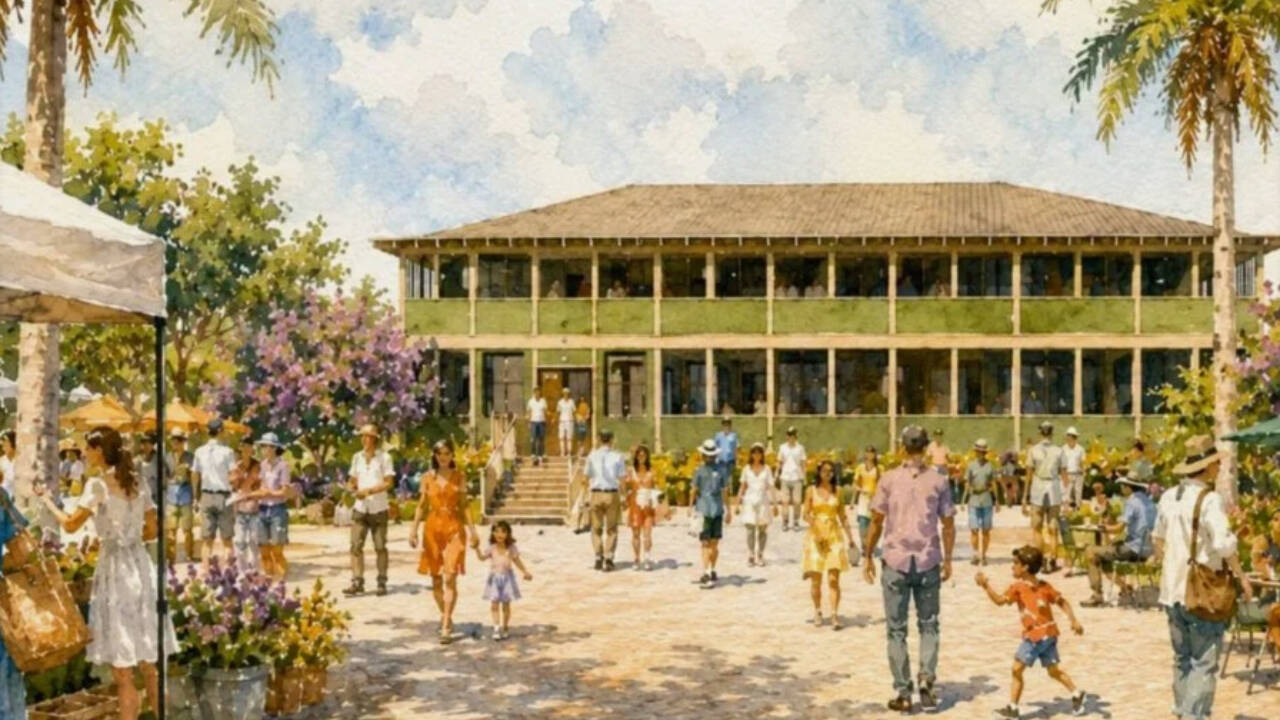
On a sliver of land where the Gulf of Mexico constantly threatens to reclaim every human footprint, concrete and timber tell competing stories. Grand Isle, Louisiana, stands as a narrow barrier against the open sea, pounded by hurricanes, choked by rising tides, and stripped over decades of the idiosyncratic vernacular architecture that once defined coastal Louisiana. Among the wreckage of storms past and the rapid march of modern, elevated storm-resistant construction, one monumental survivor has refused to vanish entirely. The Oleander Hotel, built in 1929 before a paved highway ever connected the island to the mainland, represents the last structure of its kind standing on Grand Isle.
Now, a local nonprofit known as Restore Grand Isle has acquired the building and raised roughly $400,000 to resurrect the decaying landmark as a cultural center, museum, and community hub. Yet beneath the celebratory headlines of preservation lies a harder, more complex reality. Saving a wooden building nearly a century old on a sinking, storm-vulnerable barrier island requires far more than romantic nostalgia. It demands millions of dollars, engineering feats capable of outsmarting the next major storm surge, and an answer to a fundamental question: Can historical preservation survive on a coastline that is literally washing away?
To understand why the Oleander Hotel matters, one must look backward to an era when getting to Grand Isle required a ferry rather than a drive across the bridge. Commissioned by local resident John Ludwig, the hotel opened its doors in April 1929. Local lore, long woven into the fabric of the island, credits a bargain between Ludwig and Louisiana Governor Huey P. Long. As the story goes, Long told Ludwig that if he built a hotel, the state would build a road. True to form or coincidence, Louisiana Highway 1 reached the island by 1931, tethering the isolated fishing community to the mainland and ushering in an era of coastal tourism where the Oleander served as the primary social anchor.
Built in the Louisiana Coastal Vernacular style, the two-story structure was meticulously engineered for a subtropical climate before air conditioning existed. It featured guest rooms upstairs, a restaurant and public gathering spaces below, and wide galleries designed to capture every possible breeze rolling off the Gulf. For more than sixty years, fishermen, families, and politicians crossed its thresholds. Former Governor Huey Long himself was photographed there, holding a fishing pole alongside local dignitaries. Purchased by the Augustin family in 1973, the hotel eventually closed its doors in the 1990s as economic shifts, fishing regulations, and increasingly violent storms altered the viability of old-school coastal hospitality.
As decades passed, neighboring hotels and dance pavilions succumbed to fire, rot, and hurricanes. The Oleander remained, slipping slowly into a state of architectural ghosthood. By the time the building was added to the National Register of Historic Places, its windows were weathered, parts of its historic galleries were gone, and its walls held little more than memories and nesting pigeons.
The transition from abandoned relic to active community anchor is being led by Restore Grand Isle, an organization that understands preservation on a barrier island is an uphill war of attrition. Initial stabilization work has already finished, protecting the timber frame from further immediate decay. The broader vision, however, carries a multi-million-dollar price tag. Planners intend to convert the first floor into a museum chronicling Grand Isle’s rich maritime heritage, commercial fishing roots, and fragile ecology, alongside a large flexible space for public events and a community café. The second floor is slated to function as an artist retreat, offering workspaces for writers, painters, and researchers who can document the changing face of the Louisiana coast.
Yet the financial hurdle is only half the battle. The logistical nightmare of restoring a 1920s wooden hotel in a high-risk flood zone cannot be overstated. Modern building codes, insurance realities, and the certainty of future tropical weather systems mean the restoration team cannot simply nail old siding back into place and call the job finished. Every structural upgrade must account for wind ratings, storm surge elevations, and the corrosive nature of salt air. Historic preservationists must constantly balance the purity of original materials against the brutal demands of functional survival. If the building is too heavily altered with modern steel and concrete reinforcements, it loses the historic integrity that got it listed on the National Register in the first place. If it is kept too authentic, the next strong hurricane could sweep ninety-seven years of history into the Gulf.
This tension highlights a deeper anxiety across coastal Louisiana. As land loss accelerates and repetitive flooding displaces generational families, cultural preservation is often treated as a luxury item, secondary to the immediate physical defense of the shoreline. Critics of historic preservation funding in high-risk zones sometimes argue that pouring capital into structures exposed to rising seas is throwing good money after bad.
Proponents of the Oleander project offer a different perspective. They argue that physical survival without cultural memory is an empty victory. If every old building is bulldozed and replaced by elevated vinyl-sided boxes, the community loses its soul, transforming from a distinct, vibrant fishing village into an anonymous stretch of vacation rentals. The Oleander is not merely a collection of old timber and beadboard ceilings; it is a tangible archive of human endurance. It proves that generations before us built lives, commerce, and community in the exact same crosshairs of nature.
The initial $400,000 raised by residents, local businesses, and regional supporters demonstrates that the community refuses to let that history quietly rot away. Small donations of fifty dollars mixed with larger contributions show a grassroots investment that municipal grants alone could never buy. Still, scaling up to meet the estimated two-million-dollar total cost for full rehabilitation will require deep-pocketed philanthropy and state-level backing.
The stakes extend far beyond Grand Isle. Along every mile of the Gulf Coast, climate pressures are forcing difficult choices about what to save, what to abandon, and how to honor a disappearing past. The resurrection of the Oleander Hotel serves as a high-stakes test case. If a small, storm-battered island community can marshal the resources to save its last historic hotel from oblivion, it establishes a blueprint for how coastal regions can anchor their identity against an uncertain future.
Work crews continue to clear debris from the old restaurant floor, and architectural historians finalize the master plan that will dictate the building's structural future. The old timbers remain defiant, smelling of salt, old paint, and pine, waiting to see if the modern world can match the stubborn resilience of the people who built them.