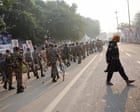
Indian security forces have erected multi-layered barricades, deployed thousands of paramilitary personnel, and imposed strict traffic restrictions across New Delhi ahead of a major opposition protest. According to standard Delhi Police operational protocols and historical crowd-control deployments in the capital, these measures are designed to prevent demonstrators from breaching high-security administrative zones, including Parliament House and central government ministries. While law enforcement officials routinely frame these lockdowns as necessary to maintain public order and protect vital infrastructure, opposition leaders and civil rights observers argue that the scale of the fortification effectively nullifies the constitutional right to peaceful assembly.
The anatomy of a Delhi lockdown follows a predictable, practiced choreography. Long before the first protester arrives at designated staging grounds like Jantar Mantar or Ramlila Maidan, the city's arteries are systematically constricted. Concrete Jersey barriers, interlocked steel fencing, and spike strips appear overnight at major border crossings—Singhu, Tikri, and Ghazipur—effectively turning the National Capital Region into a series of isolated containment zones.
The Architecture of Containment
To understand how Indian security forces manage mass mobilization in Delhi, one must look at the jurisdictional design of the capital itself. Unlike other Indian states where law and order fall under the elected state government, the Delhi Police report directly to the Union Ministry of Home Affairs. This structural reality gives the central government immediate, unmediated control over the capital's security apparatus during periods of political friction.
When intelligence briefings indicate a large-scale opposition rally, the operational response relies on layered perimeter defense. Rather than relying on a single line of riot police, commanders establish concentric rings of deterrence. The outermost ring operates at the state borders with Haryana and Uttar Pradesh, where local police coordinate with Delhi authorities to inspect incoming vehicles, verify the identities of passengers, and turn back buses carrying political workers.
Inside the city, the Central Armed Police Forces (CAPF)—primarily the Central Reserve Police Force (CRPF) and the Rapid Action Force (RAF)—reinforce local precincts. These units bring specialized crowd-control equipment, including water cannons, tear gas launchers, and Long Range Acoustic Devices. Heavy cranes are routinely positioned near key intersections to drop shipping containers or concrete blocks across multi-lane highways at a moment's notice.
Section 163 of the Bharatiya Nagarik Suraksha Sanhita (BNSS), which replaced the colonial-era Section 144 of the Code of Criminal Procedure, serves as the primary legal instrument for these operations. By invoking this provision, district magistrates prohibit the assembly of five or more people, ban the carrying of banners or loudspeakers, and authorize preventive detentions. Once this order is active, any gathering outside strictly policed zones becomes unlawful by definition, allowing forces to detain organizers before a march even begins.
Historical Precedent and Shifting Tactics
The current security posture did not emerge in a vacuum. It is the direct result of lessons drawn by security planners from major demonstrations over the past fifteen years, each of which reshaped how the state approaches urban crowd control.
During the 2011 anti-corruption movement led by Anna Hazare, authorities initially struggled to contain crowds that swelled across central Delhi, eventually forcing the government to concede Ramlila Maidan as a continuous protest site. A decade later, the 2020–2021 farmers' protest fundamentally altered policing doctrine. When tens of thousands of farmers breached initial barricades on November 26, 2020, and established permanent encampments at Delhi's borders for over a year, security agencies concluded that reactive policing was no longer viable.
The breach of the Red Fort complex on January 26, 2021, marked a permanent turning point. Since that incident, Delhi Police and central intelligence agencies have adopted a doctrine of pre-emptive immobilization. The objective is no longer merely to escort or monitor a march, but to prevent critical mass from forming in the first place.
This shift has introduced technological surveillance into standard protest policing. Drones equipped with high-resolution cameras monitor crowd density from above, feeding live telemetry to centralized command rooms. Facial recognition software, integrated with existing criminal and voter databases, is increasingly deployed at transit hubs and protest perimeters to identify known organizers and flag individuals with prior detention records.
The Legal and Constitutional Friction
Every major security lockdown in Delhi reignites a fundamental constitutional debate in India. Article 19(1)(b) of the Indian Constitution guarantees all citizens the right to assemble peaceably and without arms. However, Article 19(3) empowers the state to impose "reasonable restrictions" in the interests of the sovereignty and integrity of India or public order.
Supreme Court jurisprudence has repeatedly attempted to balance these competing imperatives, yet the application on the ground remains deeply contested. In the landmark 2018 Mazdoor Kisan Shakti Sangathan v. Union of India ruling, the Supreme Court held that while the right to protest is a fundamental right, it is not absolute and cannot paralyze the daily lives of non-participating citizens. The court directed authorities to balance the right to assembly with the right of commuters to free movement, leading to the strict designation of Jantar Mantar as a controlled protest venue with capped attendance.
Opposition parties contend that administrative authorities routinely weaponize the concept of "public order" to suppress political dissent. When police deny permission for a rally citing traffic congestion or security threats, and subsequently deploy thousands of troops to block roads, critics point out an inherent contradiction. The state's preventive measures often cause far greater disruption to commerce, ambulances, and daily commuters than the proposed march itself.
Legal scholars also highlight the growing use of preventive detention under local police acts. Party leaders, student activists, and union organizers are frequently placed under informal house arrest or detained at local police stations in the early hours of the morning before a scheduled protest. Because these detentions are typically brief—lasting until the evening after the rally window has closed—they rarely face substantive judicial review, creating an administrative mechanism that bypasses constitutional protections without formal arrests.
The Economic and Civic Toll on the Capital
Beyond the political theater, the fortification of New Delhi carries immediate, measurable costs for the National Capital Region's economy and its more than thirty million residents. Delhi functions as the logistical and commercial hub of northern India, with hundreds of thousands of workers crossing state borders daily from Gurugram, Noida, Faridabad, and Ghaziabad.
When border checkpoints are narrowed to single lanes for vehicle inspections, supply chains stall immediately. Commercial trucks carrying perishable agricultural goods, industrial components, and retail inventory face delays stretching into several hours. Trade associations consistently report sharp drops in footfall across major commercial districts like Connaught Place, Karol Bagh, and Chandni Chowk whenever security alerts are issued.
The Delhi Metro Rail Corporation (DMRC) frequently becomes an instrument of crowd management. At the direction of Delhi Police, entry and exit gates at critical stations—such as Central Secretariat, Patel Chowk, Udyog Bhawan, and Rajiv Chowk—are shuttered without advance public notice. While effective at preventing protesters from converging on central Delhi via underground transit, these closures strand thousands of office workers, students, and hospital visitors.
Emergency services face acute navigational challenges. Despite official assurances that green corridors are maintained for ambulances, the physical placement of concrete barriers and unmanned barricades on arterial roads forces emergency vehicles into lengthy detours through congested residential colonies.
Information Control and Narrative Management
Modern protest containment in Delhi extends well beyond physical barricades into the digital sphere. Alongside troop deployments, authorities routinely monitor social media platforms to track mobilization calls, identify rally coordinators, and counter what security agencies classify as misinformation or incitement.
Under provisions of the Information Technology Act, central agencies possess the authority to issue blocking orders for specific social media accounts, hashtags, or live streams deemed a threat to public order during sensitive security operations. In extreme scenarios, particularly at the border districts of neighboring Haryana or Uttar Pradesh, mobile internet services are temporarily suspended to disrupt real-time coordination among marching groups.
Simultaneously, an intense battle over public perception unfolds across television networks and digital media. Law enforcement briefings emphasize intelligence warnings of potential violence, property damage, or infiltration by unruly elements, framing the heavy security presence as a protective shield for ordinary citizens. Opposition spokespersons broadcast live from behind police barricades, using the visual contrast of unarmed political workers facing riot gear and razor wire to project an image of democratic backsliding.
The Operational Reality on the Ground
For the thousands of constables and paramilitary jawans standing behind steel barricades in Delhi's extreme weather, these deployments represent grueling, high-stress duty. Shifts routinely stretch past twelve hours without adequate sanitation or rest facilities.
Commanders face a narrow margin for error. If forces react too aggressively with lathi charges or tear gas, resulting visuals can trigger nationwide outrage and galvanize larger crowds the following day. Conversely, if a perimeter collapses and protesters reach restricted government buildings, senior officers face immediate departmental inquiries and career repercussions.
This institutional pressure incentivizes maximum force projection at the outset. By making the physical barrier appear insurmountable before a single slogan is shouted, security planners aim to deter participation psychologically. A citizen considering joining an opposition rally must weigh not only the political cause, but the high probability of physical confrontation, transit shutdowns, and hours spent in preventive police custody.
As political polarization intensifies ahead of major legislative sessions and electoral cycles, the militarized lockdown of central Delhi has transitioned from an extraordinary emergency measure into standard administrative procedure. Every concrete block lowered onto the asphalt of the capital reflects a deeper, unresolved tension in the world's largest democracy between the state's demand for absolute control and the citizen's right to occupy public space.


