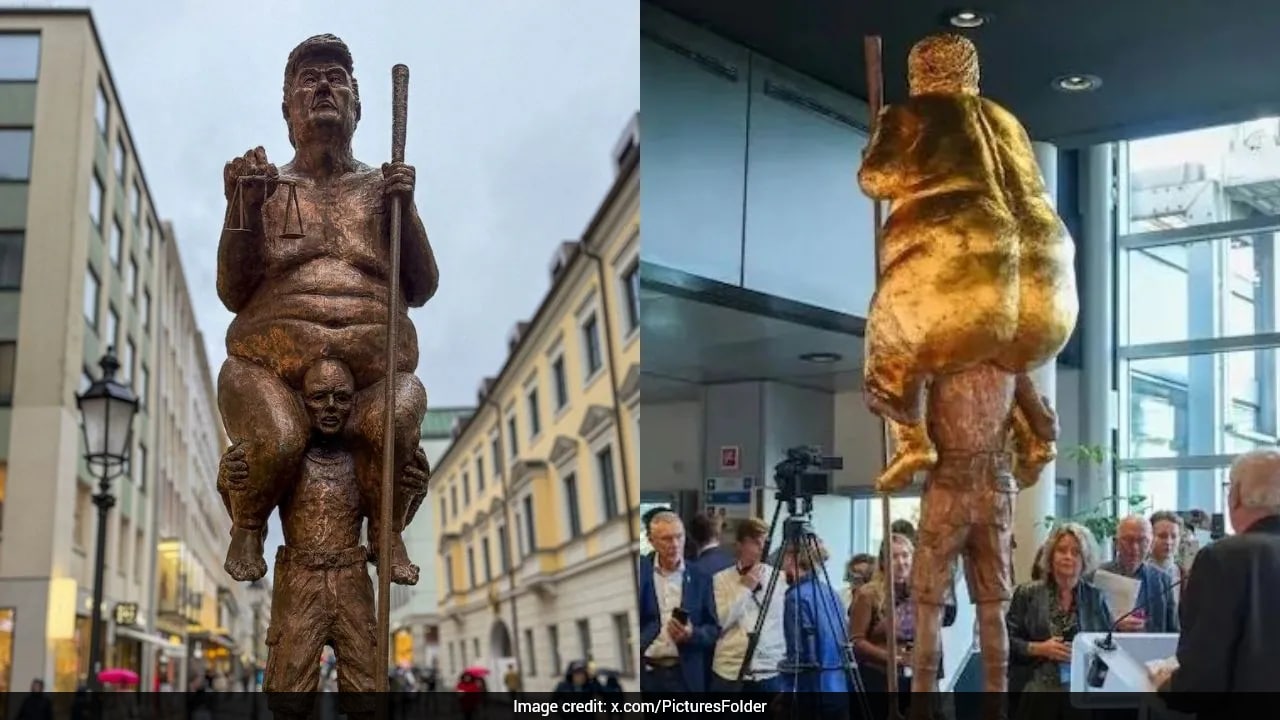
The bronze weight of political theater rarely feels quite as heavy as it does inside the grand corridors of the European Parliament in Strasbourg. Danish sculptor Jens Galschiøt understands this better than most. When his eight-foot-tall creation, The Orange Plague, was hoisted into the heart of the European legislative body, it immediately bypassed the usual bureaucratic channels of diplomatic restraint. Coated in gleaming 23-karat gold leaf, the statue depicts a naked, corpulent Donald Trump perched squarely on the shoulders of a frail, smaller bronze figure.
At the base of the plinth, an inscription reads: “I am sitting on the back of a man. He is sinking under my burden. I will do anything to help him. Except stepping down from his back.”
This is not merely another chapter in the long, exhausting history of anti-Trump caricature. It represents a calculated escalation in how European political institutions choose to interface with American power. For years, the official stance of Brussels was a carefully choreographed exercise in diplomatic deference. Officials would smile through clenched teeth, issue mild communiqués about transatlantic partnerships, and hope that internal American volatility would quietly correct itself.
The arrival of The Orange Plague shatters that polite fiction. By permitting a satirical, profoundly unflattering effigy inside its official halls, the European Parliament has sanctioned a very specific brand of institutional mockery. The timing is hardly accidental. With shifting global alignments, fierce disagreements over climate commitments, and chronic friction regarding trade and defense spending, European lawmakers are growing weary of playing the compliant junior partner in the transatlantic alliance.
Galschiøt has a long history of utilizing provocative public art to needle authority. Decades ago, his Pillar of Shame installations became global touchstones for human rights abuses. Yet turning his sights toward the American presidency introduces a sharper, more dangerous edge to the concept of protest art. It tests the boundaries of what institutional hospitality permits. As Danish Member of European Parliament Per Clausen bluntly noted during the unveiling, anyone thin-skinned enough to be offended by a piece of satire has no business operating on the world stage.
Yet, looking past the immediate shock value of a naked, gold-plated figure reveals a deeper structural anxiety within European politics. The statue's core metaphor—a heavy, self-absorbed leader crushing the labor of a nameless subordinate—speaks directly to the quiet resentment harbored by many European policymakers. They look at American foreign policy shifts, erratic environmental rollbacks, and unilateral economic pressures, and they see themselves as the smaller man in the bronze tableau. They feel the weight of decisions made in Washington that they have no power to influence yet are forced to bear.
Critics of the exhibition argue that hosting such polarizing art inside a legislative chamber risks diplomatic retaliation and degrades the seriousness of parliamentary debate. They contend that grandstanding through sculpture solves none of the structural vulnerabilities facing the European Union. Energy independence remains fragile, defense budgets are a perennial source of internal friction, and the continent's economic engine is sputtering under the weight of excessive regulation. Mocking an American president with gold leaf does not substitute for a cohesive geopolitical strategy.
Those defenses miss the pragmatic utility of the gesture. European leaders are dealing with an American political class that operates outside traditional diplomatic norms. Conventional diplomatic channels have proven increasingly ineffective at registering European discontent. When standard communiqués fail to break through the noise, provocative public art steps into the vacuum. It forces a conversation that institutional actors might otherwise prefer to ignore.
The exhibition's journey does not end in Strasbourg. Plans are already underway to transport the sculpture to upcoming international forums, including the UN climate conferences, where miniature 3D-printed replicas will be distributed to delegates. This distribution model transforms a static museum piece into a viral, decentralized political weapon. Galschiøt is handing out the tools of subversion directly to the administrative class, ensuring that the imagery travels far beyond the physical boundaries of any single exhibition hall.
The real test of this political theater is not whether it provokes outrage in Washington or temporary amusement in Europe. The test is whether it marks a permanent shift toward strategic autonomy, or if it is merely an expensive, shiny distraction masking Europe's inability to chart an independent course of action


