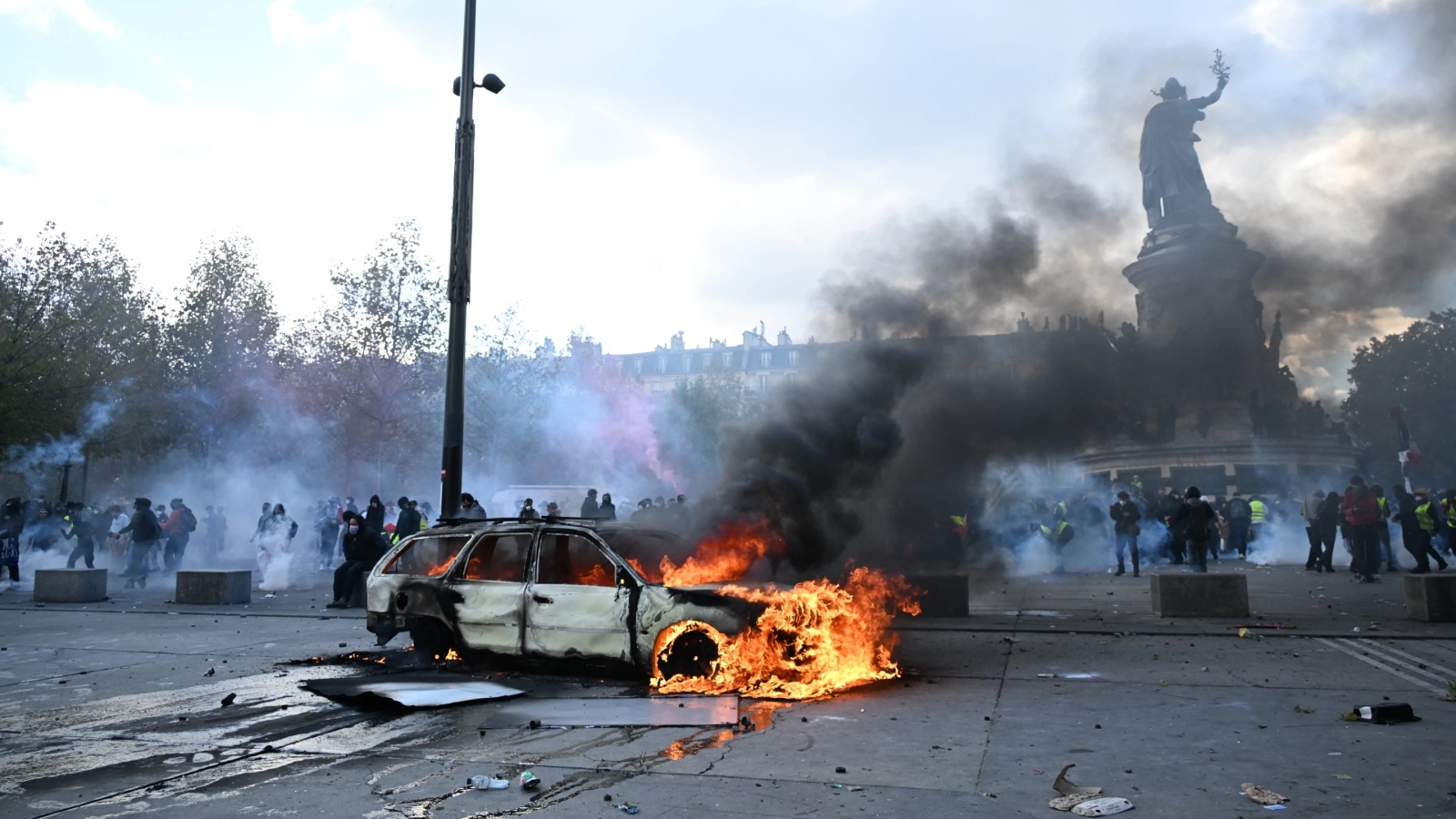
Burning barricades outside high schools, tear gas drifting across residential avenues, and hundreds of thousands of people marching from Paris to Marseille have turned French protests into a nationwide reckoning. High school students walking out over broken classrooms and missing teachers have fused with broader worker and anti-government demonstrations, creating clashes and fires across the country. Yet the real story behind the smoke is not simply teenagers throwing projectiles or riot police firing canisters. It is a structural collision between a strained public education model, stagnant household purchasing power, and an electoral calendar already bending toward extreme polarization.
Anyone who has covered French streets for twenty years knows the choreography of autumn unrest. A spark hits a high school gate, union banners appear at the junction, a subset of hooded agitators turns garbage bins into flaming roadblocks, and ministers appear on evening television demanding order. Treating that sequence as a routine seasonal spasm misses how dangerous this convergence has become. When teenagers missing science instructors for a full academic year march alongside older workers squeezed by rents and spending cuts, anger stops being a single-issue complaint. It becomes a referendum on whether public institutions still work.
Why High School Walkouts Ignited Nationwide
High schools do not usually serve as the fuse for months of national turmoil unless everyday life inside them has already broken down. Across France's roughly 3,700 lycées, student grievances have centered on concrete daily failures rather than abstract theory. Teenagers have pointed to chronic teacher absences, missing textbooks, overheated classrooms, and grueling schedules packed with awkward gaps that keep students on campus until six in the evening.
In central Paris outside Turgot High School, a fifteen-year-old student told reporters he went an entire year without a science teacher or textbooks, adding that students in the outer suburbs face even worse conditions. That observation cuts straight to the heart of the crisis. Inequalities between affluent city centers and underfunded suburban districts have widened quietly for years, turning the promise of public meritocracy into a source of resentment.
When a fifteen-year-old spends a year without a science teacher, a school blockade stops looking like truancy and starts looking like an emergency audit.
Admissions pressure adds another layer of friction. Critics of France's university placement system, Parcoursup, have long argued that complex track options and opaque selection rules deepen social stratification while stretching school days thin. When Prime Minister Sébastien Lecornu proposed modifying Parcoursup by 2027 and replacing it by 2028 during October talks with student representatives, some delegates welcomed the movement while refusing to call off mobilization. Concessions arrived after weeks of school closures, burned entrances, and hundreds of injured students, staff, and security officers. Trust rarely survives that lag.
How Street Clashes Fused With Broader Discontent
Student walkouts alone rarely fill wide boulevards across dozens of cities for two months straight. The French protests gained scale because high schoolers stepped into an older, wider current of economic frustration shared by workers, families, and returning yellow vest activists. High rent prices, tight budgets, unemployment pressures, and public spending cuts have given disparate groups a shared target in the government.
Numbers from late September through October show how quickly localized school blockades expanded into mass street mobilizations. On a single day in early October, hundreds of schools shut down or saw classes disrupted while marches drew tens of thousands of participants. Later in the month, nationwide demonstrations brought out hundreds of thousands of people—with the Interior Ministry counting at least 410,000 marchers and the CGT union claiming up to 800,000—alongside autoroute blockades, transit disruptions, and more than a thousand arrests.
| Dimension | Student Movement Core | Broader Street & Political Layer |
|---|---|---|
| Primary Grievances | Teacher shortages, missing textbooks, long hours, Parcoursup pressure | Cost of living, high rents, spending cuts, opposition to government policy |
| Typical Tactics | School blockades, walkouts, campus marches, banner drops | Mass urban marches, road blockades, clashes, arson by violent fringes |
| Government Response | Prefectoral bans outside closed schools, promised Parcoursup overhaul | Riot policing, arrests of minors and adults, parental liability push |
| Political Stakes | Reshaping youth turnout and education budgets | Polarizing voters toward extremes ahead of presidential elections |
Street violence has complicated every conversation about legitimacy. Most marchers across towns like Lyon, Nantes, Marseille, Lille, and Paris demonstrated peacefully. Yet smaller groups of hooded youths and rioters lit fires at school doors and in garbage bins, hurled fireworks and projectiles, and clashed violently with security forces. Police deployed tear gas, riot guns, and water cannons, drawing sharp accusations of excessive force and injuries to teenagers while officials pointed to hundreds of injured officers and arson damage to dozens of schools.
Both sides see a distorted mirror in the clashes. Security officials argue that dispersing violent crowds and protecting school buildings is a basic duty of the state, especially when minors make up a large share of those detained. Many students and parents counter that heavy-handed policing around high schools inflames tensions, harms peaceful participants, and diverts attention from empty classrooms. Neither argument is purely fictional, and pretending the boundary between peaceful protest and arson is neat only fuels mutual distrust.
The Overlooked Fault Lines Behind the Headlines
Surface coverage tends to reduce unrest to a tug-of-war between protesters and police. Four deeper fault lines explain why these French protests have proven so stubborn and why quick fixes keep falling short.
- The Suburban Inequality Gap: Conditions inside schools are not uniform across France, and teenagers in disadvantaged suburbs often confront sharper staffing shortages and older facilities than peers in wealthier districts.
- Exhaustion Inside the Staffroom: Teachers and school workers have endured both unsafe premises during clashes and months of disrupted instruction, leaving some educators torn between solidarity with students and frustration over lost learning time.
- Parental Liability and Legal Escalation: Justice Minister Gérald Darmanin urged prosecutors to hold parents financially liable for repair costs from damage caused by their children, while prefects banned gatherings outside closed high schools. Threatening families with bills can alienate moderate households without deterring hardened rioters.
- Electoral Opportunism Before the Vote: With presidential elections approaching next spring, political extremes have moved fast to claim or channel the anger. President Emmanuel Macron has drawn a sharp line between students and what he termed ultra-left rioters seeking to bring down the Republic, while polling after October's escalation showed Marine Le Pen ahead above 30 percent and Jean-Luc Mélenchon rising into second place around 17 percent.
Watch how political rhetoric interacts with street tactics. When politicians trade accusations over whether firebrand figures egged on youths or whether police crackdowns carried racist undertones, young demonstrators can easily feel used as pawns in a larger power struggle. A polling finding after mid-October's escalation showed 81 percent of respondents blaming the government for the violence—a striking indictment that suggests public frustration extends far beyond the core of committed activists.
What Order and Reform Actually Require
Restoring calm in schools and streets requires separating crowd control from long-term institutional repair. Relying almost entirely on bans, arrests, and stern warnings may clear a courtyard for a day, yet it leaves the missing teacher and the cramped classroom waiting on Monday morning. Conversely, treating arson and attacks on officers or school staff as harmless high spirits undermines the rule of law and puts students and staff in real physical danger.
Education officials face a practical test over the coming term. Filling vacant teaching posts, upgrading basic facilities in neglected districts, and smoothing out brutal timetables take real money and administrative discipline—far harder than announcing a multi-year overhaul of admissions software. Even strong reforms will face headwinds because public budgets are tight and trust has eroded across weeks of confrontation.
The French protests have exposed a generation that no longer trusts slow promises from distant ministries. Fixing the classrooms before the next street clash starts is the only way to turn down the heat.


