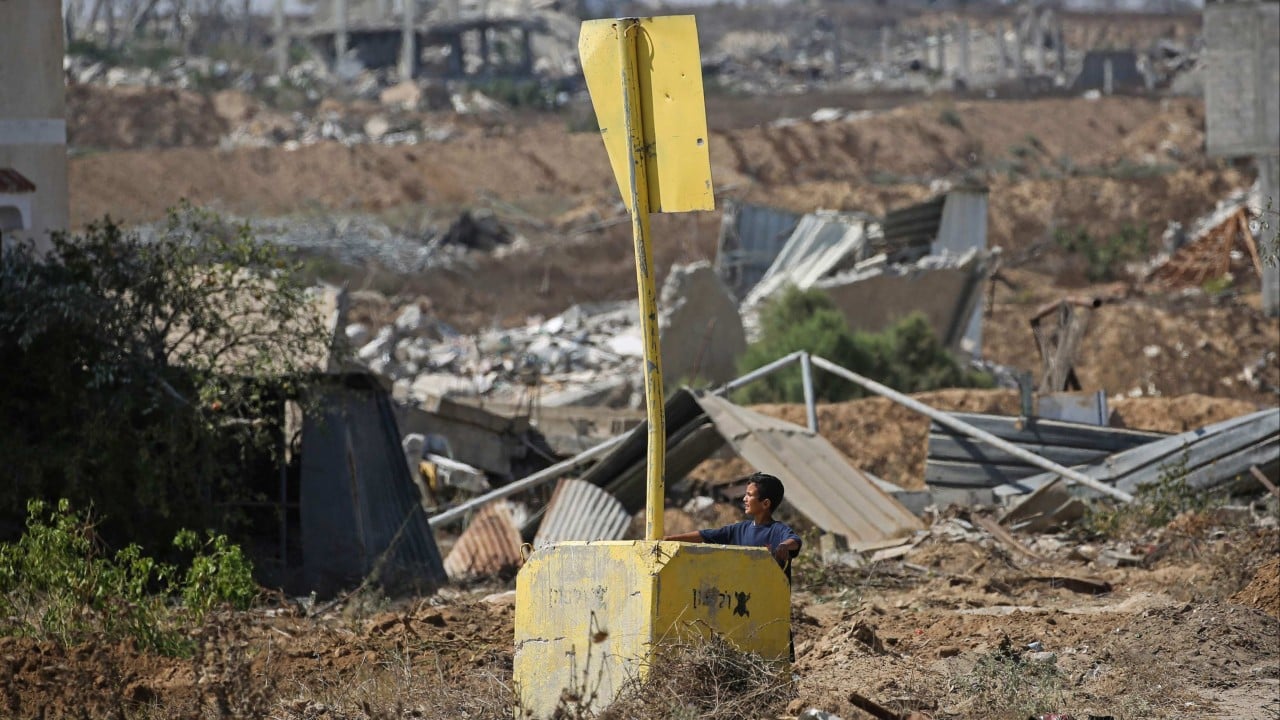
The fragile architectural blueprint tying an eventual Israeli military withdrawal from the Gaza Strip to the comprehensive decommissioning of Hamas's arsenal is facing its ultimate stress test. Donald Trump's newly created international mechanism, the Board of Peace, announced a phased agreement that conditions the retreat of Israeli forces on the complete surrender of weaponry by militant factions. The primary query driving international observers is whether a sequencing mechanism built on strict reciprocity can survive the deep-seated mutual distrust that has sabotaged every prior regional accord.
To understand why this agreement represents a departure from past diplomatic failures, one must examine the mechanics of the sequencing framework. Previous ceasefire frameworks foundered because they demanded simultaneous concessions or relied on generalized commitments of good faith. The current roadmap changes this dynamic by linking every discrete stage of military withdrawal to verifiable actions certified by an international verification commission.
Under the terms brokered through regional mediation involving Egypt, Qatar, and Turkey, the disarmament process is mapped out in rigid time-bound increments.
The Mechanics of Sequencing
The operational reality on the ground requires a precise sequence of events. First, civilian administrative control and security operations are slated to transition to a newly formed Palestinian governing body, the National Committee for the Administration of Gaza. Second, militant factions must surrender their armaments to be stored under supervision, while personal weapons held by independent local groups are targeted through a buy-back program. Only as these verification milestones are met does the Israel Defense Forces execute its phased pullback from territories held under previous ceasefire zones.
A critical vulnerability in this architecture lies in the verification infrastructure itself. The International Verification Commission, backed by a multinational stabilization force, must continuously validate compliance before the next phase unlocks.
- Verification checkpoints monitor weapons stockpiles.
- Independent administrative bodies assume management of civil infrastructure.
- Phased territorial handovers proceed only after formal certification.
An operational deadlock emerged almost immediately after the announcement, highlighting the friction inherent in the plan. Right-wing members of the Israeli security cabinet pushed for a rejection of the text, arguing that any premature discussion of withdrawal jeopardizes national security. In response, high-ranking representatives from the Board of Peace engaged in urgent diplomatic intervention, issuing explicit clarifications to reassure Jerusalem that military positions would remain intact until decommissioning reached completion.
The Regional Stakeholders and Divergent Goals
External actors carry immense influence over whether these protocols hold. Regional capitals that acted as mediators view the blueprint as a pragmatic path to ending years of devastation. At the same time, traditional Western allies harbor lingering reservations regarding the unprecedented authority concentrated within a U.S.-led international board operating parallel to traditional multilateral institutions.
Financing reconstruction remains another major variable. While early funding commitments have been pledged toward the rebuilding process, the estimated capital required to restore shattered infrastructure in the strip reaches staggering proportions. Without a reliable stream of economic recovery, the administrative committee risks inheriting a populace facing severe deprivation, which historically undermines political stability.
The tension between security demands and civil rehabilitation creates a narrow corridor for success. If the verification committee certifies a breach, the entire sequence freezes, threatening a return to active conflict. Conversely, if local factions perceive the withdrawal timeline as indefinitely stalled, cooperation with disarmament could collapse from within.
The trajectory of this agreement will be decided not by diplomatic declarations, but by the rigorous enforcement of verification protocols on the ground. Every weapon handed over and every square kilometer evacuated serves as a data point in a fragile experiment in international conflict management.

.png?itok=1mb05mKJ)

