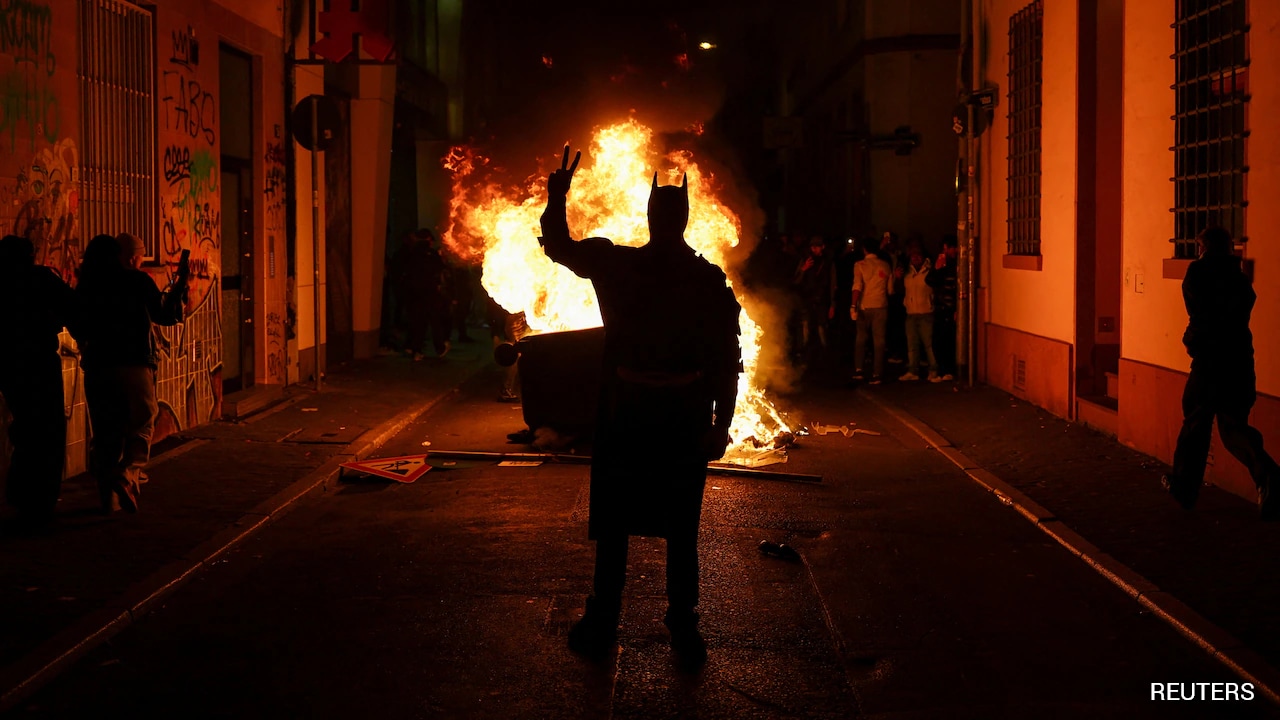
The smashed storefronts in Berlin, Hamburg, and Frankfurt are not merely random acts of juvenile vandalism, nor are they a sudden ideological awakening among Germany’s youngest adults. When protests involving Germany’s Generation Z escalate into Molotov cocktails, shattered glass, and looted retail districts, they expose a deeper structural fracture in Europe’s largest economy. A generation raised on promises of institutional stability, green transition leadership, and guaranteed upward mobility is colliding with stagnant wages, an acute housing shortage, and a political establishment perceived as unresponsive to rapid economic erosion.
Coverage of street violence almost always fixates on the spectacle. Cameras zoom in on burning barricades, black-clad agitators, and overwhelmed riot police. That framing sells clicks, yet it obscures the mechanics of how a peaceful demonstration mutates into urban looting—and why young Germans are increasingly susceptible to radicalization on the streets.
The Anatomy of Street Escalation
To understand how protests in German cities cross the threshold from loud dissent to arson and looting, you have to separate the crowd into distinct operational layers. Law enforcement analysts and urban sociologists who study European civil unrest have long observed that mass demonstrations rarely turn violent spontaneously. Instead, they undergo a predictable sequence of hijacking and contagion.
At the core of most youth-led demonstrations in Germany—whether centered on climate policy, anti-fascism, rent freezes, or geopolitical solidarity—sits a broad, non-violent coalition of students, apprentices, and young workers. They show up with cardboard signs, megaphones, and smartphones. For hours, the atmosphere resembles a festival mixed with a civic rally.
The shift happens at the margins. Small, tightly organized affinity groups—often modeled on traditional European Autonome tactics—use the mass gathering as cover. Dressed identically in dark clothing to defeat facial recognition and crowd surveillance, these cadres bring pre-staged projectiles, pyrotechnics, and accelerants. Their objective is not persuasion; it is provocation. By forcing riot police to deploy tear gas, water cannons, or baton charges into a dense crowd, agitators manufacture a shared grievance among previously peaceful bystanders.
Once police lines advance and scatter the main demonstration into side streets, command-and-control breaks down. This is the precise window where opportunistic looting occurs. A third group—often disconnected from the original political cause entirely—exploits the vacuum in policing to smash luxury boutiques, electronics stores, and commercial chains. Telegram channels and encrypted messaging groups broadcast real-time police movements, turning localized skirmishes into mobile flash mobs that outpace traditional crowd-control deployments.
The Economic Squeeze Nobody Wants to Price In
Blaming encrypted apps or agitator tactics explains the how, not the why. If young Germans felt they had a tangible stake in the preservation of civic order, street-level nihilism would find far fewer recruits.
For decades, the German social contract rested on a clear bargain: endure high taxes and strict regulatory conformity in exchange for affordable housing, world-class public transit, predictable career ladders, and a comfortable retirement. For Germans born between 1997 and 2012, every pillar of that bargain is visibly buckling.
Start with shelter. In major university and employment hubs like Munich, Berlin, Frankfurt, and Cologne, the housing market has seized up. Decades of underbuilding, strict zoning laws, and surging construction costs have pushed rents to levels that consume half or more of an entry-level salary or student stipend. When a twenty-two-year-old apprentice spends six months competing against two hundred applicants for a cramped flat, the abstract concept of property rights loses its moral authority.
Layer inflation and industrial stagnation on top of the housing crunch. Germany’s export-driven manufacturing model—long dependent on cheap Russian pipeline gas and booming Chinese demand—has entered a painful structural adjustment. Energy costs remain elevated, corporate hiring has slowed, and real wage growth has struggled to recover the purchasing power lost during the post-pandemic inflationary spike. Young adults entering the labor market today face higher living costs than their parents did at the same age, while facing an aging demographic pyramid that guarantees they will pay higher social security contributions to support a massive cohort of retiring Baby Boomers.
The Generational Arithmetic Problem
Demographics dictate political power in Germany, and the math is unforgiving for the young. Voters over the age of sixty make up the decisive bloc in federal and state elections. Consequently, major political parties—from the center-right Christian Democrats to the center-left Social Democrats—consistently prioritize pension protections, healthcare spending, and energy subsidies for incumbent industries over long-term investments in digital infrastructure, education reform, and housing deregulation.
When young citizens look at the Bundestag, they see an institution structurally incentivized to protect the accumulated wealth of older generations while deferring the costs of climate adaptation, crumbling infrastructure, and demographic decline onto them. When ballot boxes appear incapable of altering that arithmetic, the street becomes the default arena for political expression.
The Radicalization Pipeline on Short-Form Video
Traditional media outlets often assume young protesters are driven by dense ideological manifestos. Spend time analyzing the digital ecosystems where Gen Z actually organizes, and a very different picture emerges.
Platforms like TikTok, Instagram Reels, and Telegram do not reward nuanced policy debates over municipal zoning or fiscal debt brakes. Their algorithms reward visceral emotion, moral outrage, and aestheticized conflict. A thirty-second clip of a burning police van set to aggressive bass music, overlaid with captions framing the incident as a righteous uprising against a corrupt system, travels ten times faster than a breakdown of German labor law.
This dynamic creates an outrage feedback loop. Protesters film confrontations specifically to generate viral clips, knowing that dramatic footage guarantees algorithmic amplification and international media attention. In turn, that media coverage validates the tactic for the next wave of demonstrators. Violence ceases to be a breakdown of protest; it becomes the primary communication strategy.
Furthermore, foreign and domestic disinformation networks actively pour gasoline on these digital fires. Coordinated accounts routinely amplify footage of German street clashes, stripping away local context to portray the country as a failed state sliding into anarchy. For alienated teenagers scrolling late at night, these curated feeds manufacture a sense of historical inevitability—the illusion that society is already collapsing and that tearing down a storefront is simply accelerating the inevitable.
Why German Policing Keeps Getting Caught Off Guard
Whenever Molotov cocktails fly in a German city, the immediate political reflex is a call for tougher policing, longer prison sentences, and expanded surveillance powers. Yet Germany’s federalized security architecture struggles to adapt to decentralized youth unrest.
Because policing in Germany is primarily the responsibility of the sixteen individual federal states (Bundesländer), intelligence sharing and tactical doctrine vary significantly between Berlin, North Rhine-Westphalia, and Bavaria. Riot units (Bereitschaftspolizei) are heavily trained and equipped to manage predictable, static threats—such as Neo-Nazi marches, football hooligans, or stationary sit-ins.
Modern youth riots reject static geography. Using peer-to-peer messaging and live location sharing, small groups execute hit-and-run property destruction across multiple neighborhoods simultaneously. Heavy police formations, encumbered by armored vans and rigid chains of command, arrive at a shattered intersection ten minutes after the perpetrators have dispersed onto the U-Bahn or vanished into residential courtyards.
At the same time, German law enforcement operates under strict constitutional constraints born from the country’s twentieth-century history. Rules governing preventive detention, undercover infiltration, and digital surveillance are tightly circumscribed by courts and privacy commissioners. When police respond aggressively to quell a riot, viral videos of officers striking young protesters trigger immediate political backlash and parliamentary inquiries. When they hold back to avoid escalation, shop owners watch their livelihoods get looted on live television. Caught between those two traps, commanders frequently hesitate during the critical first twenty minutes of an outbreak.
The Counter-Argument That Mainstream Coverage Misses
To claim that all of Germany’s Gen Z is on the verge of violent rebellion would be a gross distortion. The vast majority of young Germans remain law-abiding, pragmatic, and deeply invested in building stable careers. In fact, recent youth studies across Germany reveal a surprising counter-trend: alongside a radicalized fringe on the streets, a massive segment of Gen Z is shifting toward political conservatism, financial caution, and an intense focus on personal economic security.
Many young Germans are disgusted by the looting and arson, recognizing immediately who pays the price. It is rarely billionaire executives or insulated politicians. The targets of street violence are predominantly small immigrant-owned corner shops, family-run cafes, municipal transit workers, and working-class neighborhoods where insurance premiums subsequently skyrocket.
Moreover, conflating politically motivated arsonists with opportunistic looters creates dangerous policy blind spots. A student throwing a flare during a heated ideological protest requires a fundamentally different civic intervention than a disorganized group of teenagers smashing a smartphone store for profit during a blackout in policing. Treating both as manifestations of a single "youth uprising" grants petty criminality an unearned political veneer while ignoring the acute social marginalization—high school dropout rates, segregated urban housing, and lack of vocational pathways—driving inner-city looting.
The Cost of Ignoring the Warning Shots
Germany has weathered severe waves of youth unrest before. The student revolts of 1968, the squatter battles in Berlin’s Kreuzberg district during the 1980s, and the G20 riots in Hamburg in 2017 all sparked fears that the Federal Republic’s social fabric was unraveling. Each time, the state eventually restored order through a combination of targeted policing and economic absorption—offering the rebellious generation high-paying jobs, affordable homes, and a path into the middle class.
That safety valve is currently jammed. You cannot police your way out of a generational affordability crisis, nor can you lecture twenty-year-olds into respecting institutions that appear incapable of building housing or modernizing an economy.
If Berlin’s political establishment treats the burning barricades purely as a law-and-order problem, the tactical cycle will simply repeat itself with every new geopolitical shock or economic downturn. Police will buy better riot gear, prosecutors will demand stiffer penalties, and encrypted chat groups will adapt their methods to bypass both. Meanwhile, the underlying fuel—a generation convinced it has been locked out of its own country’s prosperity—will remain pooled on the pavement, waiting for the next spark.