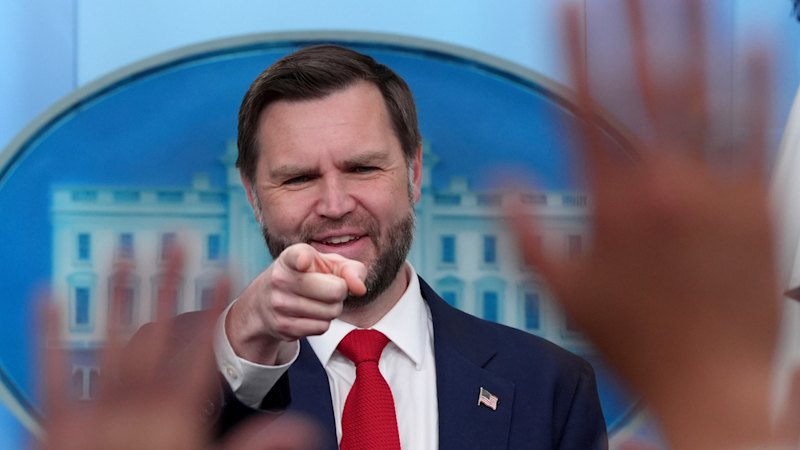
President Donald Trump has privately signaled to top donors that Vice President JD Vance is his intended choice for the 2028 presidential nomination, telling confidants inside the Oval Office that "we need to elect JD," even as he publicly maintains a calculated ambiguity to prevent early party fracture.
This private clarity collides directly with a public posture designed to keep potential challengers off-balance. Trump continues to float competing power centers, most notably Secretary of State Marco Rubio, effectively preserving a high-stakes internal audition. For political observers tracking the mechanics of the modern conservative movement, this dual-track strategy is a masterclass in political self-preservation. Trump understands the mortal peril of an early lame-duck designation. By refusing to slam the door on other ambitious actors, he retains absolute leverage over his administration and the broader party apparatus.
The Mechanics of the Heir Apparent Dilemma
Succession in a populist movement defies traditional political science. Institutional parties rely on state committees, donor networks, and institutional gatekeepers to anoint an heir. Populism relies on a singular emotional bond between a leader and a mass base. Transferring that capital is notoriously difficult.
When Trump tells donors one thing behind closed doors while teasing a Vance-Rubio joint ticket to the press, he is managing competing factions within his own coalition. Vance represents the populist, Rust Belt-aligned wing that prioritizes economic nationalism and skepticism of foreign entanglements. Rubio commands the traditional donor class and hawkish foreign policy establishment that anchored the Republican Party for decades before the 2016 paradigm shift.
For example, consider how party funding operates under this ambiguity. Traditional establishment donors who historically backed Rubio are now cautiously courting Vance, attempting to hedge their bets without alienating either camp. Vance has spent the past year aggressively shoring up these relationships, building a fundraising footprint that stretches far beyond his original populist base.
Why Trump Cannot Afford a Quick Coronation
An explicit, early endorsement of Vance would carry immediate negative consequences for the sitting administration.
First, it would instantly trigger an internal civil war. Ambitious governors and senators eyeing 2028 would be forced into open rebellion or early exits, turning legislative battles on Capitol Hill into proxy wars for the future of the party. Legislative priorities would stall as factions jockey for position.
Second, a premature coronation transforms the Vice President into an immediate target for unified opposition fire. Right-wing influencers and rival political factions are already testing Vance's armor on foreign policy and domestic spending. Keeping the race officially open forces potential rivals to spend their capital fighting each other rather than undermining the current administration's agenda.
Third, Trump thrives on competition. His management style relies on keeping subordinates slightly off balance, believing that competitive tension yields superior performance. Whether Vance is negotiating policy details or managing media cycles, the implicit threat that another figure could step into the spotlight acts as a powerful behavioral constraint.
The Vulnerabilities Beneath the Surface
Despite the private blessing from the Oval Office, Vance's path to 2028 is far from guaranteed. Populist movements are notoriously volatile. The coalition that returned Trump to power is an uneasy alliance of working-class voters, corporate populists, and national conservatives. Maintaining that coalition without Trump's unique personal magnetism presents an unprecedented structural challenge.
Vance faces a distinct hurdle regarding institutional friction. Unlike traditional politicians who spend decades climbing municipal and state ladders, his rapid ascent leaves him vulnerable to charges of being an elite transplant despite his working-class memoir origins. Furthermore, shifting geopolitical realities mean that the nationalist consensus he champions is constantly being tested by global events.
The upcoming midterms will serve as the first major stress test for this nascent succession plan. If the party suffers underperformances attributable to factional infighting, the pressure on Trump to intervene more forcefully will escalate. Conversely, a strong showing solidifies Vance's position as the indispensable executor of the MAGA mandate.
The crown will not simply be handed over. It must be seized through political survival, institutional dominance, and the delicate art of holding a restless coalition together while the founder watches from the wings.