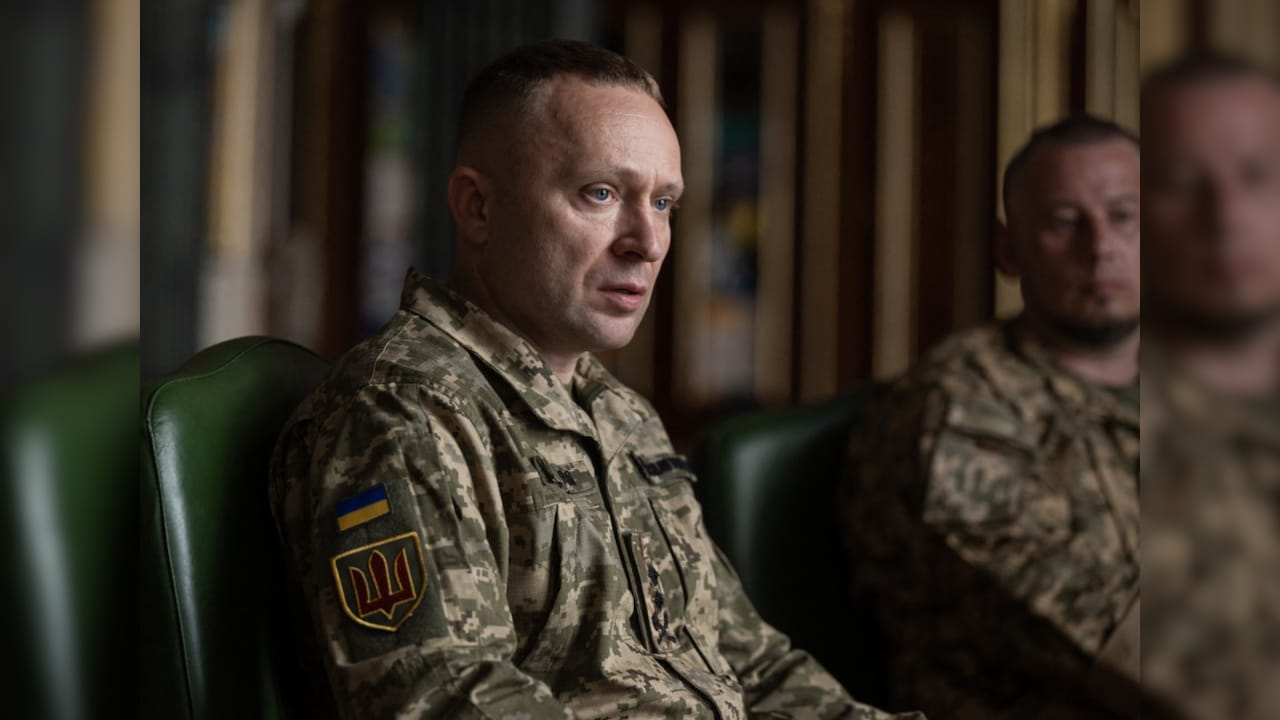
Mykhailo Drapaty is the decorated combat officer appointed as Commander-in-Chief of Ukraine's Armed Forces, taking over top command after leading the Ground Forces and turning around critical defensive failures on the eastern front. First gaining international notice in 2014 by driving an armored vehicle through a militant barricade in Mariupol, Drapaty built a reputation for rescuing trapped units, deploying drone-heavy defense networks, and confronting internal military bureaucracy. His ascension marks a structural shift away from rigid, Soviet-era doctrine toward decentralized, tech-driven warfare.
The appointment comes at a moment of extreme pressure for Kyiv. Exhausted units, ammunition scarcity, and grinding Russian offensives across Donbas require more than symbolic leadership. To understand what Drapaty represents, one must examine the specific tactical battles, command philosophy, and systemic friction that shaped his military career.
The Legend of the Flying Armored Vehicle and Early Frontline Trials
He did not rise through bureaucratic networking. Drapaty earned his command credentials in the mud and dust of the Donbas in May 2014.
Then a major commanding the 2nd Battalion of the 72nd Mechanized Brigade, Drapaty was tasked with breaking through pro-Russian barricades inside Mariupol to relieve an encircled police station. A video broadcast across global media outlets captured the moment. Leading a column of four infantry fighting vehicles, Drapaty’s vehicle accelerated and smashed through a concrete and tire barricade at full throttle, launching airborne before landing on the other side. The aggressive display forced an opening and stabilized the situation in the city during the earliest days of the war.
Later that summer, his unit faced total destruction along the Russian border near Izvaryne. Encircled and subjected to sustained rocket artillery fire originating from across the Russian border, the Ukrainian force was cut off from supply lines and higher command communications. While neighboring units destroyed their weapons and crossed into Russian territory to surrender, Drapaty refused to abandon his armor. He took operational initiative, organized a mobile column, and led 260 soldiers alongside 30 heavy armored vehicles through 40 kilometers of hostile territory under fire.
He brought almost every man back alive. That escape proved his tactical judgment under extreme pressure, proving that decentralized initiative could overcome operational encirclement.
Why the Old Command Hierarchy Failed at Kharkiv
Fast forward to May 2024. Russian forces launched a sudden cross-border assault toward Kharkiv, threatening Ukraine’s second-largest city and catching local defensive formations completely off guard.
The defensive lines proved inadequate. Early warning signs had been ignored by the local operational command, and several front-line units dissolved under heavy artillery and glide bomb bombardment. The failure exposed a deep institutional flaw within the military hierarchy: junior and mid-level commanders were regularly lying to top generals about position status. To avoid punishment or reprimands from senior officers steeped in rigid Soviet traditions, battalion commanders claimed to hold positions that had already been overrun. Higher command made strategic decisions based on imaginary battle lines.
Presidential leadership intervened immediately. Drapaty was rushed in to replace the incumbent commander of the Kharkiv Operational-Tactical Group.
He altered the operational culture within days. Drapaty convened open briefings where field officers were told they would not face disciplinary action for reporting lost territory, provided the reports were factual. By eliminating the fear of summary punishment, he restored real-time situational awareness to the command staff. He personally visited forward positions near Vovchansk and Lyptsi, reorganized broken lines, and deployed fresh reserves alongside concentrated drone strike teams.
The advance stopped. Ukrainian forces stabilized the front and eventually launched local counterattacks to reclaim territory north of Kharkiv.
Building the Drone Wall and Dismantling Top-Down Stagnation
Drapaty’s command methodology relies on speed, technology, and flexible authority rather than massed infantry charges.
During his time leading Operational Command South and the Odesa group, he pioneered tactical integration between reconnaissance UAVs, target designation, and precision strike assets. He recognized earlier than most standard infantry generals that traditional defensive strongpoints were vulnerable to modern artillery and guided air bombs unless shielded by heavy electronic warfare and continuous drone surveillance.
His tactical framework centers on distinct operational pillars:
- Decentralized Execution: Allowing platoon and company commanders to alter tactics based on real-time field conditions without waiting for written permission from distant headquarters.
- Integrated Reconnaissance-Strike Complexes: Binding low-cost commercial and specialized military drones directly to artillery batteries to cut fire-mission response times from tens of minutes down to seconds.
- Node Targeting: Concentrating firepower on enemy logistics corridors, field headquarters, and ammunition depots to render forward positions unviable rather than engaging in attrition battles.
- Transparent After-Action Reviews: Analyzing battlefield failures rigorously to extract tactical lessons rather than assigning political blame to junior officers.
When applied in the field, these tactics created what military analysts termed a drone wall. Russian armored columns attempting to advance across open fields were spotted miles away and systematically destroyed by swarms of first-person-view drones before reaching the main defense line.
Institutional Friction and the Battle Against Internal Corruption
Promotion to Commander of the Ground Forces in late 2024 brought Drapaty into direct conflict with entrenched military bureaucracy.
Managing the largest branch of the military exposed structural problems in training centers and mobilization centers. Mobilized recruits were frequently being sent to the front lines with basic skills that did not match modern combat requirements. Furthermore, newly created brigades were being dismantled before reaching the front: specialized personnel were reassigned to general infantry duty, and unit equipment was stripped to patch holes elsewhere.
Drapaty launched an immediate audit of army infrastructure.
He publicly condemned managerial stagnation and an internal culture dominated by bureaucratic self-preservation. He initiated reforms aimed at overhauling training pipelines, embedding experienced combat veterans as instructors, and standardizing drone training across all infantry divisions.
His reforms faced resistance. Senior officers accustomed to old Soviet-era chains of command pushed back against decentralized decision-making and public transparency. When defensive difficulties and unit shortages hit sectors in Donbas near Pokrovsk, Drapaty accepted personal responsibility for organizational oversights, resigning his command position in mid-2025 in a move that highlighted his refusal to participate in political posturing.
That brief exit did not last. His reputation among front-line soldiers as a general who values human lives and insists on operational accuracy made his return to supreme command inevitable.
The Comparison Between Generation Soviet and Generation Combat
To evaluate Drapaty’s promotion, one must compare his operational approach with traditional senior leadership.
| Command Attribute | Soviet-Era Legacy Command | Drapaty Combat Generation |
|---|---|---|
| Primary Metric | Strict adherence to written orders | Objective battlefield results and troop survival |
| Information Flow | Top-down, filtered through paperwork | Direct, real-time drone feeds and honest reporting |
| Tactical Preference | Massed artillery and trench defense | Drone swarms, mobility, and node disruption |
| Frontline Presence | Remote headquarters and bunker command | Direct field visits and forward observation posts |
| Response to Setbacks | Reassignment of blame and cover-ups | Open after-action analysis and leadership fixes |
This structural contrast explains why his appointment generated enthusiasm among company and battalion leaders across the front. He represents an officer class that earned its ranks on the battlefield over twelve years of continuous war rather than through peacetime political maneuvering.
The Unforgiving Reality Facing Kyiv Strategic Command
Drapaty assumes supreme command without any honeymoon period.
The operational picture remains stern. Russian forces continue to use massed infantry glide-bomb tactics to press forward in the east, accepting massive casualties to secure incremental ground. Ukraine faces persistent artillery shell deficits, manpower shortages, and an exhausted force that has been fighting continuously without adequate rotation.
Commanding an entire military force requires more than field bravery. Drapaty must manage global military logistics, navigate complex civil-military relations with political leadership, and coordinate joint sea, land, and air operations while rebuilding battered brigades under fire.
The central question is whether a combat general known for personal tactical intervention can successfully overhaul a multi-hundred-thousand-person military bureaucracy while fighting a war of survival against a numerically superior adversary.
If Drapaty succeeds, it will be because he forces the military apparatus to confront truth over comfort. Modern peer-to-peer war leaves no margin for administrative self-deception, and the survival of the state depends entirely on whether tactical honesty can be transformed into strategic victory.


