The Persian Gulf Strait Authority has quietly expanded its Non-Compliant Vessels register, adding eleven more commercial ships to a blacklist that now restricts fifty-six tankers from navigating the Strait of Hormuz. This escalation by Tehran goes far beyond traditional wartime posturing. It represents the active codification of a parallel maritime governance regime in one of the world's most critical energy chokepoints. Tankers caught violating Iranian protocols face severe, immediate threats, including heavy fines, detention, or outright confiscation.
For global energy markets, the creation and expansion of this blacklist upends standard operational logic. Cargo owners and charterers can no longer simply look to Western naval coalitions for safe passage. They must contend with an adversarial authority that is successfully dictating compliance terms on the water. Don't miss our recent coverage on this related article.
The Mechanics of the Proxy Compliance State
When the Iranian Supreme National Security Council formally established the Persian Gulf Strait Authority, naval analysts initially dismissed it as a paper tiger. Sanctioned by Washington almost immediately upon its inception, the body was treated in Western capitals as a nominal administrative front. That dismissal proved premature.
The authority functions by demanding absolute adherence to local transit configurations, route corridors, and reporting protocols. Ships that deviate, or those flagged by state-backed surveillance and even crowdsourced civilian reporting, find themselves cataloged online. To read more about the history here, NBC News offers an excellent breakdown.
The blacklist targets specific vulnerabilities in regional logistics. A significant portion of the restricted tonnage is linked directly to regional neighbors, including vessels owned by major national carriers from the United Arab Emirates and Saudi Arabia. By targeting these specific fleets, Tehran is directly disrupting the shuttle runs that regional producers rely on to move crude to external loading points.
Ship-to-ship transfers add another layer of systemic risk. The authority explicitly stated that any commercial vessel cooperating with a blacklisted carrier via transshipment or lightering will automatically inherit the same punitive status.
The Ripple Effects Across Global Refineries
Major Asian importers and international trading houses are scrambling to rewrite their risk matrices. Following the initial rollout of the register, several prominent Indian refiners and global energy traders instituted immediate bans on utilizing any hull appearing on the Iranian schedule.
This creates an acute logistical bottleneck. Consider a hypothetical scenario involving a Very Large Crude Carrier chartered to lift crude from a Persian Gulf terminal. If that specific hull was previously flagged for an infraction during an outbound transit weeks prior, charterers risk having subsequent cargoes entangled in legal limbo or subjected to physical seizure if they re-enter the southern corridor.
Insurance underwriters are responding by ratcheting up war-risk premiums to astronomical levels. Many protection and indemnity clubs are refusing to cover voyages that interact even tangentially with the contested compliance network. The result is a fractured shipping market where movement through the strait is dictated less by global trade demand and more by compliance fear.
The Strategic Reality of Enforcement
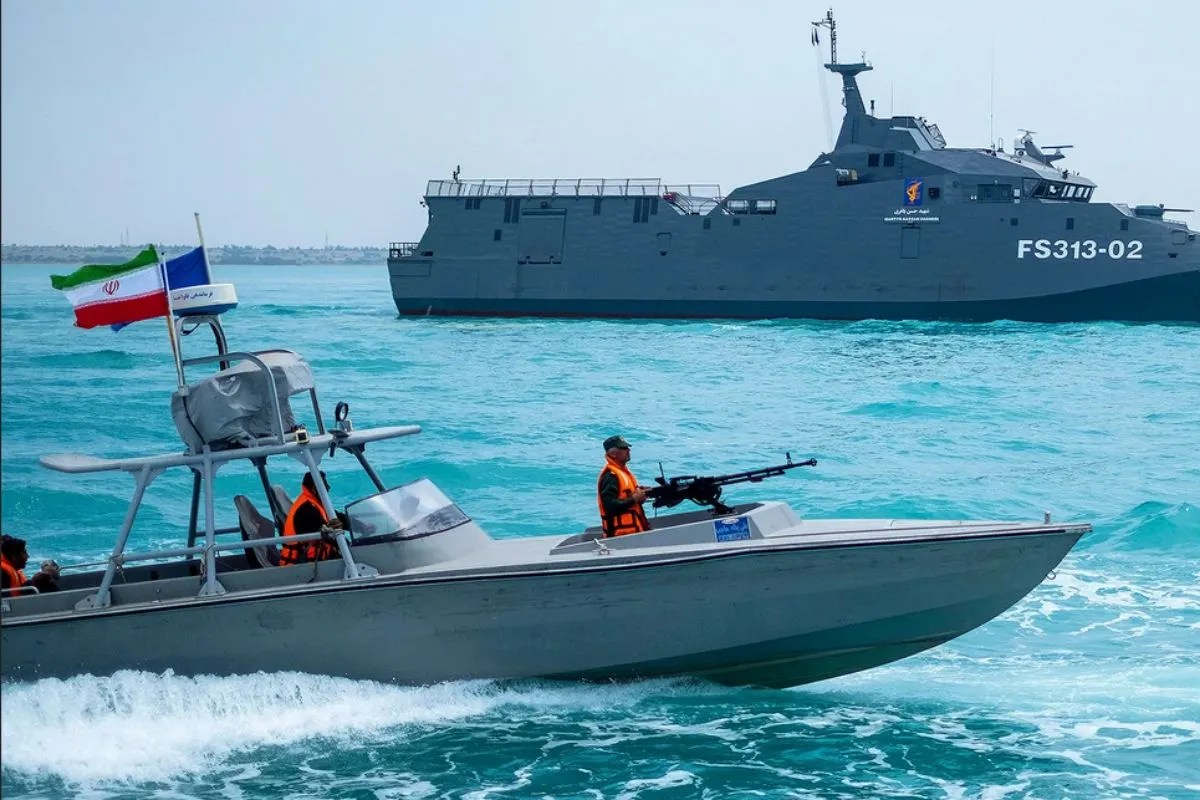
Tehran's enforcement mechanism relies on a mix of physical deterrence and administrative coercion. Actual kinetic strikes on non-compliant carriers over recent months have demonstrated that the threats carried by the authority are backed by operational capabilities. Tankers have suffered severe engine-room damage and structural hits from projectiles while transiting the southern routes close to Omani waters.
Western naval forces maintain a heavy presence in the broader region, yet they cannot escort every commercial hull through every mile of the narrow passage. Insurers and shipowners are finding that military protection offers little defense against retroactive administrative blacklisting or secondary sanctions exposure.
The broader economic strangulation campaign waged against Iran has triggered this aggressive maritime counter-strategy. Rather than folding under pressure, state entities have institutionalized a system that forces maritime operators to choose between complying with local authorities or abandoning Persian Gulf liftings altogether.
Supply chains through the waterway remain severely depressed compared to historical averages. As long as the blacklist continues to expand and draw secondary targets into its net, the cost of moving energy from the Gulf will remain tethered to the shifting politics of enforcement in Tehran.