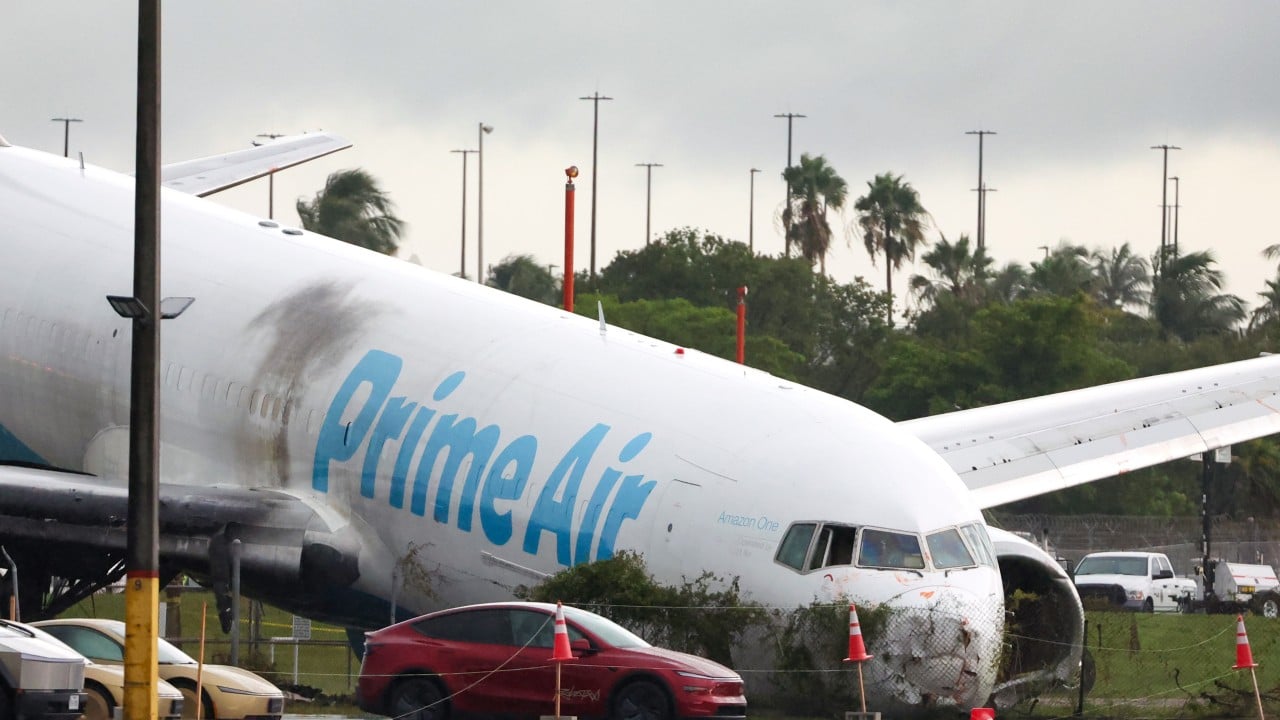
The National Transportation Safety Board recovered the flight data and cockpit voice recorders from the Amazon Prime Air cargo plane that overran a Miami International Airport runway, killing five people on the ground. Investigators shipped those orange steel cylinders to Washington, expecting them to unlock the mystery of how a Boeing 767-33A slid thirteen hundred feet past the pavement and plowed into two vehicles. Those boxes will tell us what the throttles were doing, how fast the wheels were turning, and what the pilots said in their final seconds.
They will not explain why a major international hub lacks standard safety architecture at the edge of its tarmac.
Operating under contract for Amazon Air by regional carrier 21 Air LLC, the thirty-two-year-old aircraft touched down on its third flight of the day. It arrived from San Juan, Puerto Rico, following an itinerary that looped from Cincinnati to Miami and back south. Somewhere during rollout on runway 30, stopping power vanished. The jet carved through a perimeter fence, obliterated a cleaning service van carrying airport contractors, struck a civilian vehicle on Northwest 67th Avenue, and finally crumpled near a station of parked autonomous test vehicles.
The flight crew survived. Five people in the path of the uncontrolled hull did not.
Attention immediately turned to the physical mechanics of the landing. Aviation disaster reporting follows a predictable rhythm. Officials find the wreckage. Crews extract the flight recorders. Analysts parse parameter trends for mechanical failure or pilot error. Yet focusing exclusively on what happened inside the cockpit ignores the systemic vulnerabilities governing modern air cargo operations and airport infrastructure.
The Infrastructure Deficit
Every commercial runway features a safety area designed to absorb aircraft that fail to stop in time. Federal guidelines recommend a thousand-foot overrun space beyond the threshold. Not every airport possesses the geography to accommodate this cushion. When physical land runs out, airports are supposed to install Engineered Materials Arresting Systems, known as EMAS beds.
These beds consist of cellular concrete blocks designed to crush under the weight of an airliner, decelerating the craft predictably without tearing landing gear apart. Miami International Airport has faced scrutiny over gaps in these safety installations across various runway ends. When an aircraft weighs upwards of three hundred thousand pounds fully loaded, standard grass and mud offer negligible resistance once tires hydroplane or lose traction.
The absence of an arrestor bed on a high-capacity cargo runway transforms a localized mechanical excursion into a catastrophic off-airport collision.
Logistics networks have scaled exponentially over the past decade. Ground infrastructure has struggled to keep pace. Cargo hubs operate around the clock, processing aging airframes that fly far more frequent cycles than comparable passenger fleets. Older widebody freighters like the Boeing 767 form the backbone of e-commerce distribution. They squeeze into tight scheduling windows, often landing in adverse weather or during peak congestion periods.
The Hidden Cost of Rapid Logistics
The flight was operated by a wet-lease carrier rather than a major legacy airline flying under its own brand. E-commerce giants rely on a patchwork of smaller regional airlines to manage their sky-bound supply chains. This outsourcing creates a complex web of operational oversight.
Airlines operating cargo flights for online retailers face immense pressure to maintain tight delivery windows. While safety regulations remain uniform on paper, the economic incentives driving regional freight contractors differ vastly from passenger networks. Maintenance scheduling, crew rotation limits, and turnaround times operate on razor-thin margins.
When an incident occurs, tracing liability requires untangling multiple layers of corporate responsibility. The plane wore Amazon Prime livery. The operating certificate belonged to 21 Air. The maintenance was contracted out. The ground handling and cleaning crews belonged to third-party vendors.
This corporate fragmentation obscures accountability long before investigators write their final reports.
What the Data Will Miss
The recovered flight data recorder will map every micro-adjustment of the flight control surfaces. The voice recorder will capture the tone of the captain and first officer as the runway lights rushed toward them. Neither device will capture the exhaustion of a flight crew running the third leg of a grueling regional schedule. Neither device will measure the structural risks of placing high-density roadways immediately adjacent to active airport perimeters without adequate physical barriers.
Five families are mourning relatives who simply went to work on the airport grounds or drove past a chain-link fence on a Sunday afternoon. Their deaths point to a failure of physical safety barriers that engineering standards could have prevented.
The black boxes will yield answers about the final moments of Flight 7598. The harder truths lie buried in the operational blind spots of modern logistics infrastructure.
Authorities recover black box from plane that veered off runway in Miami
This video report covers the immediate NTSB response and the recovery of the flight data and cockpit voice recorders following the runway overrun incident in Miami.
http://googleusercontent.com/youtube_content/1