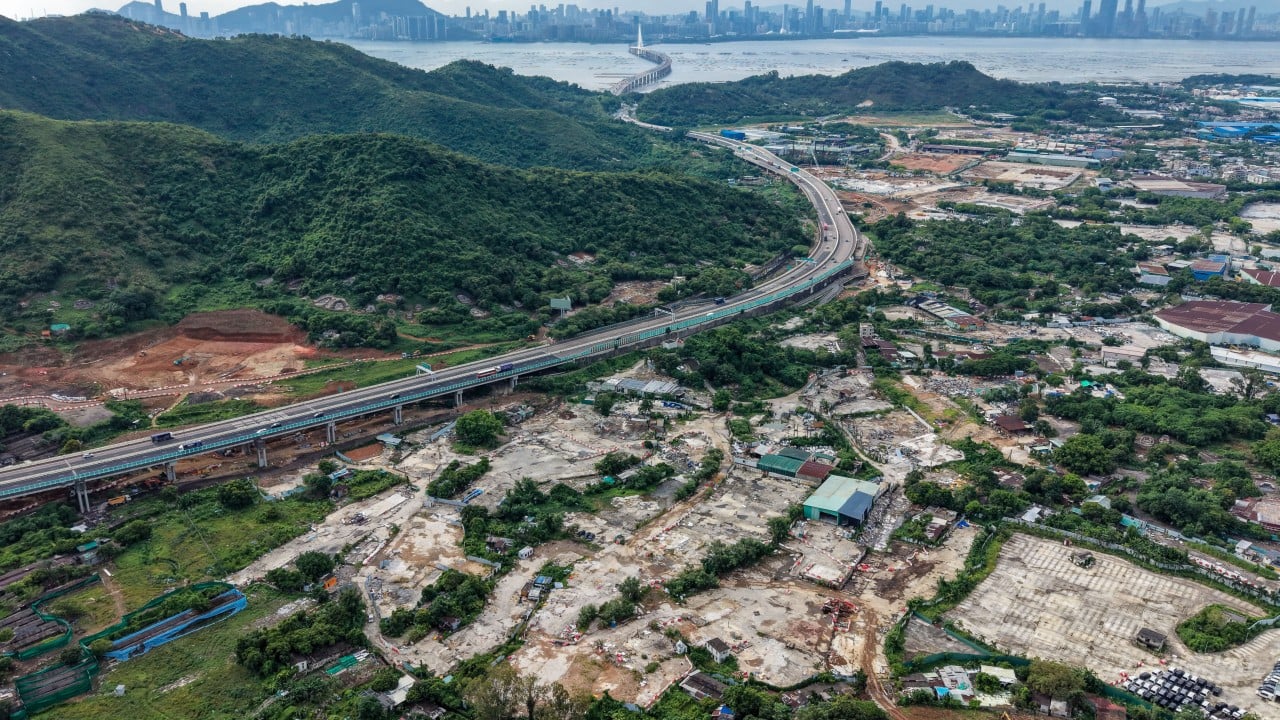
Hong Kong's multi-billion-dollar Northern Metropolis initiative is undergoing a radical structural shift as a six-company consortium featuring mainland Chinese giants and local developers secures the monumental Hung Shui Kiu project for 1.03 billion Hong Kong dollars, effectively rewriting the risk-distribution model for the territory's most ambitious frontier expansion. Rather than relying on traditional Hong Kong property syndicates to shoulder the entirety of capital exposure amid high interest rates and cautious consumer demand, the newly minted joint venture pools corporate balance sheets from both sides of the border to tame a projected 16.8 billion Hong Kong dollar price tag.
The financial architecture of this megaproject relies on a synchronized distribution of weight. State-backed mainland developers like China Overseas Land & Investment, China Resources Land, and China Merchants Land have aligned with domestic heavyweights including Sino Land, China Travel International Investment, and logistics operator JD.com to form HSK New Development Limited. Each major corporate partner holds a uniform 17 percent stake, with the remaining fraction managed by CTS Investment. This distribution breaks completely from past municipal construction efforts. It ensures that no single balance sheet absorbs the brunt of long-term development friction or stagnant initial property yields.
Market conditions surrounding the territory's frontier expansion demand this level of structural defense. Recent residential sales inside early sub-districts have demonstrated a cooling public appetite, with local buyers hesitating over aggressive square-foot pricing in areas lacking comprehensive rapid transit infrastructure. Traditional Hong Kong developers turned visibly defensive during recent land tenders, pulling back from heavy speculative bidding. By introducing operational giants like JD.com into the core equity mix—tasked directly with anchoring an integrated smart logistics hub designed to generate thousands of local jobs—the government has transitioned from a standard land-auction framework to an industry-first, planning-priority implementation model.
The mechanics of the tender process exposed this strategic pivot. Utilizing a two-envelope system where non-price competencies accounted for seventy percent of the total evaluation score, authorities prioritized industrial integration capability over immediate cash returns. This change acknowledges a hard reality. Building residential blocks across miles of former fish ponds and brownfield sites without anchoring immediate economic utility courts financial failure. Integrating supply chain operators and technology platforms directly into the real estate vehicle guarantees an internal demand generator that raw residential sales alone cannot secure.
Cross-border capital controls and changing macroeconomic crosscurrents further complicate the trajectory of the Northern Metropolis. Regulatory tightenings originating from Beijing regarding offshore financial movements and wealth deployment have introduced caution among potential high-net-worth property investors. Analysts tracking Greater China real estate note that while physical integration with neighboring Shenzhen remains an attractive long-term thesis, the bridging phase requires immense liquidity reserves and prolonged holding power. Spreading these capital requirements across diversified corporate entities prevents localized credit contractions from stalling regional development.
State supervision matching this public-private partnership is unprecedented. The Development Bureau has established a specialized oversight office dedicated to smoothing regulatory bottlenecks for the consortium. This administrative backing attempts to bypass the bureaucratic delays that historically plague large-scale municipal engineering programs. Yet, the friction points remain visible. Constructing an entirely new economic engine spanning roughly one-third of the territory demands absolute coordination between transport networks, cross-border data flows, and commercial zoning laws.
Consortium risk-sharing changes the calculus for future land parcels coming down the municipal pipeline. Upcoming tenders in Fanling North and the San Tin Technopole will likely reference this multi-party equity model to attract risk-averse capital. As property yields face ongoing pressure from broader monetary policy shifts, the era of single-developer mega-bets on raw land in Hong Kong has reached its functional limit. Future expansion relies entirely on whether these cross-border corporate coalitions can convert blueprint projections into operational reality before carrying costs erode profit margins.