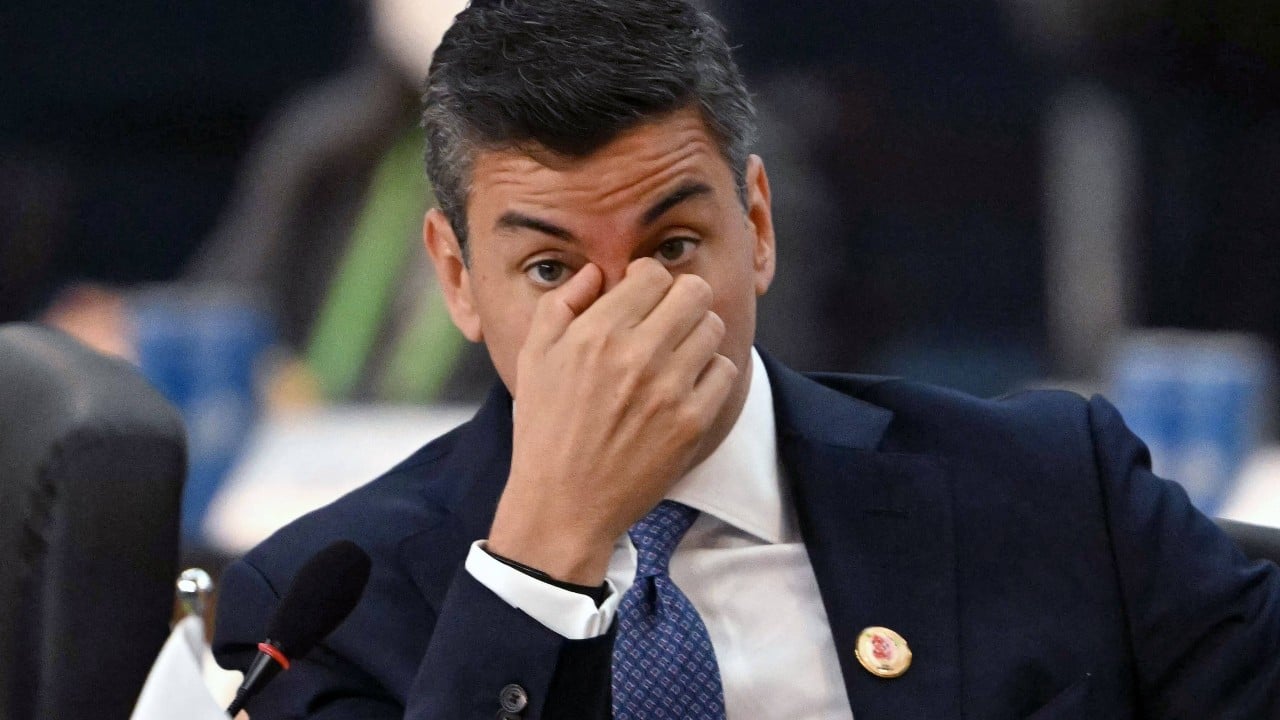
Paraguay’s President Santiago Peña has resigned following the catastrophic failure of a major domestic financial institution, an event that triggered a nationwide liquidity panic and exposed deep vulnerabilities in South America’s fastest-growing economy. While official statements point to mounting public demonstrations and parliamentary gridlock as the immediate causes of his departure, the real story lies in the collision between aggressive deregulation, concentrated political power, and a banking sector that outgrew its oversight mechanisms. Peña’s exit marks the abrupt end of an administration built on technocratic credibility, leaving Vice President Pedro Alliana to inherit an economy teetering on the edge of a systemic credit freeze.
The collapse did not happen overnight. For decades, Paraguay operated as an outlier in the Southern Cone, maintaining low taxes, stable inflation, and a reputation as a quiet harbor for regional capital. Yet beneath the surface of macroeconomic stability sat a financial architecture heavily reliant on informal credit networks, agricultural commodity cycles, and a small circle of politically connected institutions. When liquidity dried up at the center of this network, the contagion spread faster than the Central Bank of Paraguay could deploy its reserves.
How a Technocrat Lost Control of the Narrative
Santiago Peña entered office in August 2023 with a resume tailored to reassure international bondholders. A former economist at the International Monetary Fund and a past finance minister, he promised to modernize state institutions, attract foreign direct investment, and elevate Paraguay to investment-grade status. For the first year of his presidency, that strategy appeared to work, culminating in credit rating upgrades that drew billions in speculative and infrastructure capital into Asunción.
Credibility is a fragile currency. Once markets suspect that a government’s fiscal discipline masks private sector rot, the correction is merciless.
The turning point arrived when internal audits at one of the country’s largest commercial lenders revealed massive balance sheet discrepancies tied to unsecured corporate loans and off-book real estate ventures. Rather than isolating the institution through an immediate, transparent receivership, regulators initially attempted a quiet liquidity injection. That decision proved fatal. Word leaked to institutional depositors within hours, sparking a classic bank run that drained billions of guaraníes from digital accounts before physical branches even opened their doors the next morning.
The Architecture of Regulatory Blindness
To understand why the Central Bank failed to spot the insolvency earlier, you have to look at how supervision works in concentrated markets. In smaller economies, the line between regulators, bank executives, and ruling party officials is razor-thin. Examiners routinely rotate between private compliance desks and public oversight boards, creating an environment where warning signs are treated as temporary liquidity hiccups rather than structural fraud.
Consider a hypothetical example of how this dynamic plays out in practice. Imagine a mid-sized regional bank heavily exposed to soy exporters during a severe drought. Instead of forcing the bank to recognize non-performing loans and raise fresh equity—which would dilute politically influential shareholders—regulators grant a series of temporary accounting waivers. The bank uses that breathing room to issue high-yield certificates of deposit to retail savers, effectively using new deposits to cover old losses. As long as commodity prices recover, the scheme holds. The moment global interest rates stay elevated or export revenues dip, the entire structure implodes.
That exact vulnerability defined the final months of the Peña administration. When opposition lawmakers demanded the release of Central Bank inspection logs, the executive branch initially cited banking secrecy laws. To voters watching their life savings freeze behind ATM error screens, legalistic defenses looked indistinguishable from a cover-up.
The Colorado Party Paradox
No analysis of Paraguayan politics makes sense without accounting for the Asociación Nacional Republicana, universally known as the Colorado Party. Having governed the country almost continuously for nearly eight decades, the party is less a traditional ideological movement and more an all-encompassing state apparatus. Peña’s political survival depended entirely on balancing two competing demands: satisfying international investors who demanded institutional transparency, and appeasing the party’s traditional power brokers who expected state protection for their commercial interests.
For months, Peña walked that tightrope. His close political alignment with former president Horacio Cartes—a dominant figure within the Colorado Party who has faced severe international sanctions—already complicated Asunción’s diplomatic standing with Washington. When the banking crisis erupted, that underlying political tension snapped.
When Street Protests Meet Elite Defection
Latin American presidents rarely fall solely because of street demonstrations; they fall when the economic elite decides the president has become a liability to their own survival. As protests paralyzed major arteries in Asunción, Ciudad del Este, and Encarnación, the business chambers that had once championed Peña’s pro-market agenda quietly withdrew their backing.
Exporters could not clear letters of credit. Construction firms missed payrolls because their corporate accounts were locked inside the failing bank. Agricultural cooperatives, the lifeblood of the Paraguayan interior, warned that the upcoming planting season would be lost without immediate state intervention. Facing an imminent impeachment vote in Congress—where even factions of his own Colorado Party refused to guarantee their loyalty—Peña chose resignation over a protracted constitutional crisis that would have further cratered the guaraní.
The Myth of the Paraguayan Miracle
International financial media spent years celebrating Paraguay as South America’s hidden gem. The numbers looked undeniable on paper: consistent GDP growth hovering around four percent, cheap hydroelectric power from the Itaipú and Yacyretá dams, and a flat ten percent tax regime that lured Brazilian manufacturers across the border.
Numbers tell you where an economy has been, not what is rotting underneath it.
The Paraguayan economic model relied heavily on the assumption that macroeconomic stability could substitute for institutional reform. While the Central Bank kept inflation low, the judicial system remained notoriously weak, property rights enforcement lagged behind regional peers, and anti-money laundering controls struggled to keep pace with cross-border trade flows. Foreign investors priced in the low taxes and ignored the governance deficit, assuming that a technocratic president could keep the system on track through sheer competence.
Three Structural Flaws Exposed by the Crash
The collapse stripped away that illusion, laying bare three systemic weaknesses that any successor government will struggle to contain:
- Extreme Deposit Concentration: A handful of state entities, including the national social security institute (IPS), hold massive deposits in private commercial banks. When public funds are parked in institutions with questionable governance, a private banking failure instantly becomes a public pension crisis.
- Shadow Credit Exposure: Much of Paraguay’s agricultural and commercial activity is financed outside traditional regulated channels through grain traders, input suppliers, and unregulated financieras. When a formal bank fails, these informal lenders freeze credit immediately, choking off the real economy faster than central bank rate cuts can revive it.
- Dollarization Trap: Roughly half of all deposits and loans in Paraguay are denominated in U.S. dollars. While the Central Bank holds substantial foreign reserves, it cannot print dollars to bail out a failing bank. Every dollar injected into the domestic banking system directly erodes the country’s external buffer.
What Happens to Depositor Money Now
For ordinary Paraguayans, macroeconomic debates mean nothing compared to a single question: will they get their money back? Under Paraguay’s deposit guarantee law, the Fondo de Garantía de Depósitos (FGD) insures individual accounts up to a statutory cap tied to minimum wages. For small retail savers, that mechanism provides a vital safety net, assuming the fund is not overwhelmed by simultaneous failures across multiple mid-tier lenders.
The real devastation hits small and medium enterprises. Commercial operating accounts routinely exceed the insured threshold. When a local logistics company or medical clinic loses access to working capital overnight, the deposit insurance cap covers only a fraction of its Friday payroll. Liquidation proceedings in Paraguayan courts historically drag on for years, meaning uninsured corporate depositors face steep haircuts and prolonged illiquidity.
Meanwhile, surviving banks face a double-edged sword. While they benefit from a "flight to quality" as terrified savers move cash into larger, foreign-owned institutions, they also face higher funding costs and stricter capital requirements. Credit will become scarce and expensive just as the broader economy slips toward recession.
The Regional Contagion Question
Whenever a bank collapses in a Mercosur nation, traders immediately look across the borders to Brazil, Argentina, and Uruguay. Direct financial contagion from Paraguay to its giant neighbors remains limited due to the relatively small size of Asunción’s capital markets. Brazilian banks operating in Paraguay do so largely through ring-fenced local subsidiaries rather than direct balance sheet exposure.
The reputational damage, however, crosses borders effortlessly. Paraguay had positioned itself as the stable, low-regulation alternative to Argentina’s chronic currency controls and Brazil’s complex tax code. Regional family offices and mid-sized agribusinesses moved capital into Asunción precisely because they believed it was immune to sudden political and financial shocks.
That thesis is dead. Capital that fled Buenos Aires and São Paulo for the safety of Asunción is already looking toward Montevideo and Miami. Restoring that trust will require far more than a change of leadership at the Palacio de los López; it demands a complete overhaul of banking supervision, judicial independence, and the dismantling of the crony networks that turned a localized banking failure into a national political collapse.
Pedro Alliana now steps into the presidency with a fractured ruling party, an angry electorate, and a financial sector begging for a sovereign backstop it cannot easily afford. The IMF will likely be called in to stabilize expectations, bringing with it strict conditions on public spending and bank resolution transparency—the exact political poison that the Colorado Party has spent decades avoiding.