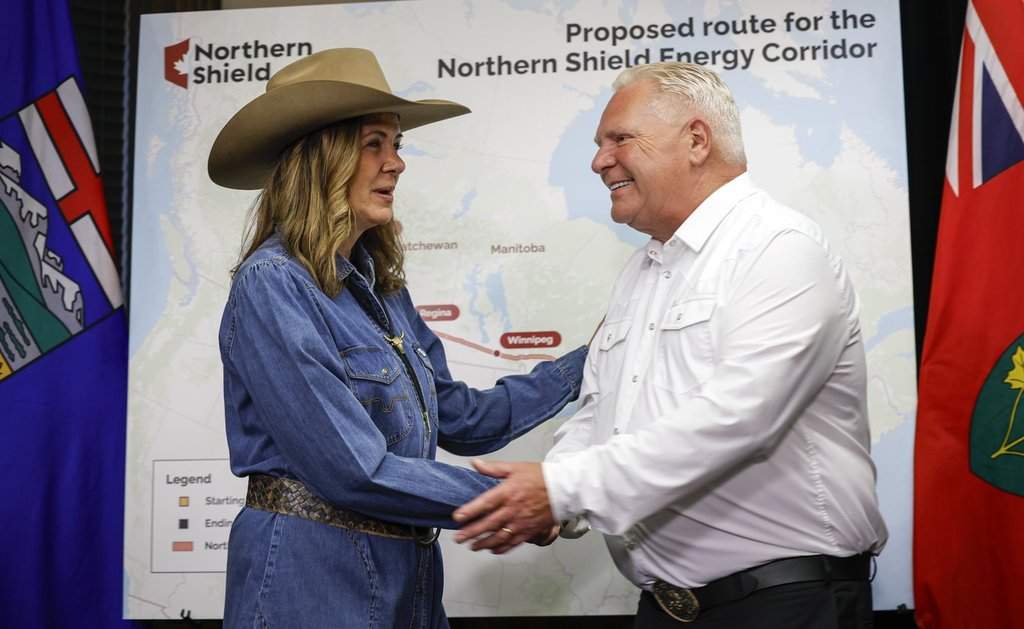
When Alberta Premier Danielle Smith and Ontario Premier Doug Ford stood shoulder-to-shoulder on a Calgary stage, the optics projected an unprecedented interprovincial alignment. They gathered to pitch the Northern Shield pipeline, an ambitious infrastructure corridor designed to move western resources eastward. Behind the podiums, however, lay a web of competing economic pressures, deep-seated regional grievances, and an unfolding political crisis that threatens the very fabric of Canadian federation. This encounter was not merely a routine policy forum. It was a high-stakes collision between western resource nationalism and eastern industrial survival.
To understand why this Calgary summit matters, look past the polite applause from industry executives. Canada faces a structural dilemma regarding how it moves oil and natural gas across vast geographic expanses while navigating a hostile trade environment south of the border. For years, provincial boundaries functioned as regulatory minefields. Energy policy became a proxy war for climate targets, constitutional jurisdiction, and regional identity. Smith has spent her tenure dismantling federal environmental rules that she argues strangle provincial economic growth. Ford, representing Canada's manufacturing engine in Ontario, desperately needs predictable, affordable energy inputs to keep his province's industrial base competitive against American rivals.
The Anatomy of the Northern Shield Proposal
Building a multi-billion-dollar energy corridor across provincial borders requires more than fiery rhetoric and optimistic conference speeches. The logistical reality is daunting. Financing such massive infrastructure in an era of capital flight from carbon-intensive industries demands innovative investment models. Private capital remains wary of long-term regulatory shifts. Ottawa holds significant constitutional sway over interprovincial trade routes, even if recent federal leadership changes have introduced a more flexible tone. Furthermore, meaningful consultation with Indigenous communities along the proposed route cannot be treated as a checkbox exercise. Past pipeline projects collapsed precisely because developers underestimated or ignored Indigenous title rights and environmental stewardship concerns. Without genuine partnership and equity ownership stakes for First Nations, any grand corridor plan remains dead on arrival.
The engineering challenge matches the financial hurdles. Moving heavy crude and refined products thousands of kilometers through Canadian Shield granite and boreal forest demands technical precision and staggering upfront capital. Refineries in Ontario and Quebec historically relied on imported foreign oil during price shocks, despite sitting adjacent to the world's third-largest petroleum reserves in Alberta. Bridging that geographic and psychological gap requires pipelines that can withstand extreme temperature fluctuations while meeting stringent modern safety protocols. Proponents of the Northern Shield project argue that Canadian-made steel and Canadian labour should construct the conduit. Yet critics point out that past interprovincial mega-projects bogged down in intergovernmental squabbling before laying a single pipe.
The Continental Trade Pressure Cooker
Yet the alliance reveals deep fissures upon close inspection. While both leaders agree on the necessity of internal pipeline connectivity, they diverge sharply on how to handle external economic coercion. Washington remains a volatile actor in North American trade. Tariff threats hang over Canadian exports like a guillotine. Smith has publicly dismissed the idea of restricting energy shipments southward as a retaliatory tactic, maintaining that Canada must remain a reliable supplier regardless of diplomatic friction. Ford has taken a more aggressive stance, arguing that energy resources should remain a viable instrument in bilateral trade negotiations. This tactical disagreement exposes a fundamental vulnerability within Canada's resource economy. One province wants absolute commercial continuity. The other sees strategic coercion as a necessary tool to defend national sovereignty.
This friction highlights a deeper historical truth about Canadian federalism. Economic interdependence between provinces has always been transactional rather than organic. When oil prices collapsed a decade ago, eastern transfer payments cushioned Alberta's descent, yet that financial solidarity did not buy emotional goodwill. Today, as Alberta experiences a demographic boom fueled by interprovincial migration from high-cost centres like Toronto, the political rhetoric in Edmonton remains combative. Smith's administration views Ottawa as an adversary that spent years trying to phase out the fossil fuel industry. Ford, meanwhile, walks a tightrope. He must appease Ontario voters worried about climate change while securing cheap energy for manufacturing plants that form his political base.
Internal Dissent and Regional Alienation
The backdrop to this uneasy partnership is an internal political uprising in Alberta. An upcoming provincial referendum on federal overreach and constitutional authority casts a long shadow over any grand nation-building project. Anger toward Ottawa has smoldered for over a decade. Frustration over blocked pipelines, carbon pricing, and federal centralization drove hundreds of thousands of citizens to sign petitions questioning their place in Confederation. Ford used his platform in Calgary to deliver a blunt, unscripted plea for unity. He told the audience that division leads to collective ruin, urging Albertans to reject separation talk. Whether eastern appeals can soothe western alienation remains entirely unproven. Resentment runs deep in the foothills.
Separatist movements in Western Canada are not new, but they have evolved from fringe political theater into mainstream ballot questions. The upcoming referendum forces voters to confront the friction between provincial autonomy and national integration. Critics of the provincial government argue that stoking constitutional grievances serves as a convenient distraction from local healthcare and housing pressures. Nevertheless, the underlying sentiment of economic abandonment is genuine. Generations of Albertans built an export-driven economy only to watch federal regulatory frameworks block access to tidewater markets. When Ford urged unity from the Calgary stage, his words carried the weight of an outsider pleading for preservation, clashing with local frustration that views eastern indifference as the primary catalyst for western separatism.
The Economic Calculus for Manufacturing
The economic math driving Ontario's interest in western energy deserves closer scrutiny. Ontario manufacturers operate in a hyper-competitive global market. Energy costs dictate profit margins for automotive plants, steel mills, and chemical facilities across the Golden Horseshoe. When natural gas prices spike or electricity grids strain under peak demand, industrial output falters. Securing a direct, long-term pipeline connection to Alberta's vast reserves offers Ontario a measure of insulation from international supply shocks. Ford understands this vulnerability intimately. His political survival depends on protecting blue-collar jobs in industrial towns that feel abandoned by shifting global trade patterns. Aligning with Alberta is a pragmatic play for regional survival, dressed up in the language of national solidarity.
Conversely, Alberta views eastern markets through the lens of diversification. For decades, the province's economic fate remained tethered almost exclusively to the American Midwest via a single export pipe. That concentration risk exposed producers to severe pricing discounts whenever pipeline capacity bottlenecks occurred. Smith wants international buyers, particularly in Asia, but internal Canadian markets provide a vital baseline demand that cushions against global price crashes. The Northern Shield concept attempts to solve two distinct provincial problems simultaneously. Ontario gains energy security. Alberta gains domestic optionality.
Achieving this vision requires confronting the ghosts of past regulatory failures. Major Canadian infrastructure projects have earned a global reputation for dying slow deaths in courtrooms and regulatory boardrooms. Billions of dollars vanish into legal fees and environmental assessments before a single shovel breaks ground. Both premiers spent considerable time criticizing past federal obstructionism, celebrating recent shifts in federal posture as a sign of progress. Yet, political goodwill in provincial capitals does not automatically translate into regulatory approval. Environmental groups, municipal governments, and landowners retain formidable legal tools to stall or halt linear infrastructure projects. Pretending these obstacles will vanish simply because two popular premiers agree on a stage is dangerously naive.
Labour Deficits and Skill Shortages
Labour shortages represent another severe bottleneck threatening the ambition of a cross-country energy corridor. Canada faces a critical deficit of skilled tradespeople. Building pipelines, processing facilities, and compressor stations requires tens of thousands of welders, heavy equipment operators, electricians, and engineers. Immigration policies and domestic training programs currently fail to meet the sheer scale of labour demand projected for major capital projects over the next decade. Sourcing this workforce without inflating construction costs to unsustainable levels is a puzzle neither premier has successfully solved. Throwing money at the problem without a comprehensive workforce strategy guarantees project delays and budget overruns.
Furthermore, jurisdictional disputes over labour mobility between provinces continue to plague Canadian infrastructure development. A certified welder from Ontario often faces administrative hurdles when attempting to work on an industrial site in Alberta. Interprovincial trade barriers cost the national economy billions of dollars annually, yet political inertia prevents meaningful reform. If premiers are serious about building transcontinental energy corridors, dismantling internal trade and labour barriers must take precedence over ribbon-cutting ceremonies in downtown Calgary. Without free movement of skilled professionals across provincial lines, the Northern Shield concept risks becoming another expensive paper exercise.
Constitutional Brinkmanship and Investor Confidence
The debate over resource ownership and constitutional jurisdiction adds another layer of complexity. Alberta's impending referendum asks citizens whether provincial legislation should override federal laws in specific domains. This constitutional brinkmanship creates deep anxiety among investors who crave stability and predictability. Capital flows away from legal uncertainty. If a corporation cannot determine whether federal or provincial regulators hold ultimate authority over a pipeline route, financing dries up instantly. Ford's presence in Calgary served as an implicit warning to separatist factions that economic balkanization destroys the very prosperity they seek to protect. Yet, preaching unity to an alienated electorate rarely succeeds without tangible structural concessions from the federal government.
International climate commitments loom large over these domestic ambitions. Canada remains a signatory to global emission reduction targets. Financing institutions, particularly major international banks, face immense pressure to divest from fossil fuel extraction and transportation infrastructure. Proposing a massive new oil pipeline in the current decade invites severe ESG scrutiny. Proponents argue that Canadian energy is produced under higher environmental and human rights standards than oil from autocratic regimes, making it a preferred ethical choice during global supply crises. Whether international capital markets will accept that argument remains an open question. ESG mandates do not easily accommodate the physical realities of global energy consumption.
The geopolitical chessboard is shifting rapidly. With energy security dominating international relations across Europe and Asia, Canada possesses resources the world desperately needs. Failing to capitalize on this moment due to internal political squabbling or regulatory paralysis would represent a generational policy failure. The Calgary summit highlighted the potential for a new domestic consensus, but potential is a long way from execution. Premiers can share stages and draft grand communiqués, but shovels in the ground require alignment across multiple levels of government, Indigenous nations, and private investors.
As the dust settles on the Enserva conference, the real test begins away from the television cameras. Will the federal government step up as an active facilitator or remain an impediment? Can provincial leaders maintain their fragile alliance when regional self-interest inevitably clashes with national compromises? The answers will determine whether Canada can transform its vast natural wealth into lasting economic security, or if the country will remain trapped in a perpetual cycle of internal division and missed opportunity. The window to act is closing fast.