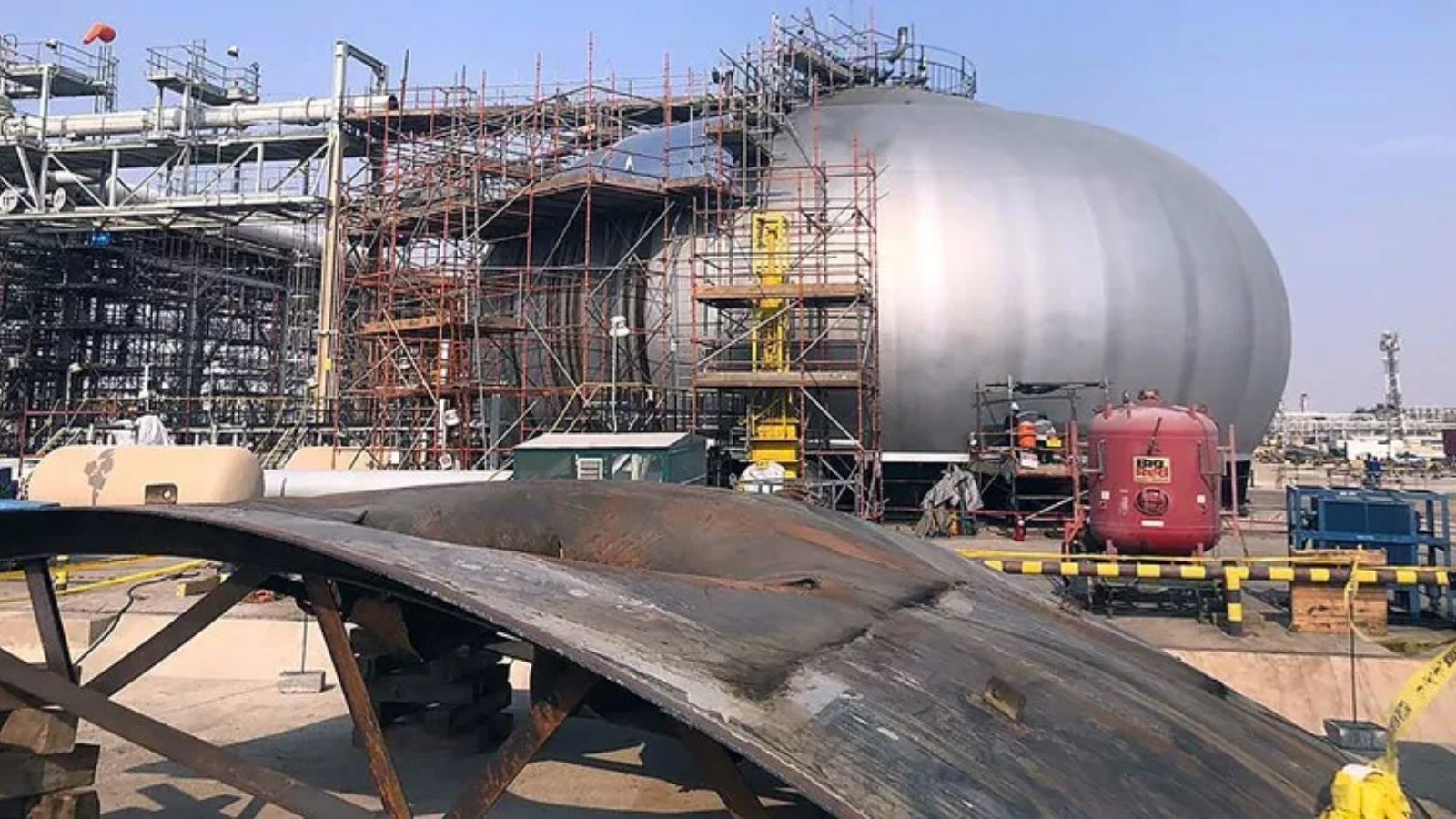
Saudi air defense batteries intercepted a barrage of ballistic missiles over Riyadh and the Eastern Province, yet falling debris and stray munitions still managed to spark a fire at a critical Saudi Aramco petroleum distribution facility. While official state media framed the military response as a textbook defensive success, the physical damage on the ground exposes a stubborn operational reality. You cannot shield a sprawling, hyper-centralized energy grid from low-cost aerial saturation without absorbing collateral hits.
The immediate market reaction followed a familiar script. Brent crude futures spiked on the initial wire reports of smoke rising from the Aramco site before settling back down once engineers confirmed that export terminals remained operational and global supply chains would not seize up overnight. Traders have grown numb to this cycle. Yet treating this strike as just another routine flare-up misses the structural shift occurring in Gulf air defense economics and energy infrastructure vulnerability.
The Physics of an Imperfect Shield
Air defense is a game of unforgiving math. When an attacker launches a ballistic missile or a swarm of long-range loitering munitions toward Riyadh or Abqaiq, the defending batteries—primarily American-made Patriot PAC-3 systems and Terminal High Altitude Area Defense (THAAD) units—have mere minutes to calculate trajectories and fire interceptors.
An interception is not an erasure.
When a kinetic hit-to-kill interceptor strikes an incoming warhead miles above the desert floor, gravity still claims the wreckage. Tons of twisted aluminum, unspent rocket propellant, and fractured high-explosive casing rain down across a debris footprint that can stretch for miles. In densely populated urban centers like Riyadh, or inside the tightly packed labyrinth of pipes, storage tanks, and fractionators at an Aramco facility, falling shrapnel is functionally indistinguishable from a direct hit.
Consider how an oil distribution plant actually operates. These facilities are not hardened concrete bunkers. They are vast, open-air networks of pressurized steel vessels holding volatile hydrocarbons. A single piece of superheated metal puncturing the floating roof of a crude storage tank will ignite a fire that takes hours to extinguish and weeks to repair. Even if the Patriot battery hits its target dead-center in the upper atmosphere, the energy infrastructure directly beneath the flight path still pays the price.
The Asymmetric Cost Trap
Defense analysts have warned about the cost-exchange ratio for years, and the math only gets worse for Riyadh. A typical long-range attack drone or older-generation ballistic missile costs anywhere from twenty thousand to a few hundred thousand dollars to assemble using commercially available electronics and basic machine shop tooling.
By contrast, a single Patriot PAC-3 MSE interceptor costs roughly four million dollars. Standard military doctrine dictates firing two interceptors at every incoming ballistic target to ensure a high probability of kill. That means Saudi forces routinely spend eight million dollars in less than ten seconds to neutralize a projectile that cost less than a luxury sedan.
Attackers do not need to penetrate the shield every time to win this war of attrition. They only need to force the defenders to keep firing. Every interception depletes finite interceptor stockpiles that take defense contractors months to manufacture, while the attackers can replenish their arsenals in hidden workshops using off-the-shelf components.
Why Aramco Remains the Ultimate Target
To understand why Aramco installations keep appearing in incident reports, look at a map of Saudi Arabia's energy architecture. Decades of engineering brilliance created the most efficient oil production and processing system on earth, but that efficiency relies heavily on centralized chokepoints.
Facilities like Abqaiq, Ras Tanura, and the major distribution hubs outside Riyadh and Jeddah handle millions of barrels of crude and refined products every single day. Because these sites process such massive volumes, they cannot be easily duplicated or dispersed across the peninsula.
The Illusion of Spare Capacity
Whenever an Aramco unit suffers damage, officials immediately reassure global markets by pointing to the kingdom's legendary spare production capacity and massive underground storage reserves. In the short term, those reassurances hold water. Aramco maintains millions of barrels of crude in strategic storage—both inside the kingdom and in leased tanks near major consuming markets like Rotterdam, Okinawa, and Sidi Kerir—specifically to bridge supply gaps during crises.
Longer-term repairs tell a different story. Modern refining and stabilization units rely on bespoke industrial equipment. Custom-forged pressure vessels, specialized compressors, and high-grade alloy piping are not sitting on a warehouse shelf waiting for an emergency. If a fire damages a core processing train rather than just an external storage tank, bringing that capacity back online requires months of specialized fabrication and engineering work.
Meanwhile, the psychological toll on the global energy market compounds with every incident. Even when physical barrels continue to flow without interruption, shipping insurers raise war-risk premiums for tankers entering the Persian Gulf. Energy traders bake a permanent geopolitical risk premium into crude prices, subtly inflating fuel and freight costs across the global economy long after the smoke clears from the Aramco compound.
Hardening the Grid Without Going Bankrupt
Riyadh is not sitting still while its infrastructure absorbs punishment. Over the past several years, the Saudi Ministry of Defense and Aramco security teams have quietly overhauled how they protect critical energy nodes, moving away from pure reliance on high-altitude missile batteries.
Layered defense is now the operational mandate. You cannot use a four-million-dollar missile to swat down a low-flying drone skimming fifty feet above the sand dunes. To plug that gap, security planners have begun integrating short-range air defense systems, electronic warfare jammers, and directed-energy prototypes around key petroleum hubs.
Passive Defenses and Physical Hardening
Walk the perimeter of a modernized Aramco facility today, and the changes are visible in concrete and steel rather than radar screens. Engineers have spent billions retrofitting existing plants with passive defense measures designed to contain damage when active interceptions fail or debris falls inside the fence line.
- Blast walls and earthen berms: Massive reinforced concrete barriers now isolate individual storage tanks and critical control rooms, preventing a fire in one unit from cascading into neighboring infrastructure.
- Mesh netting and overhead canopies: Borrowing tactics from armored warfare, engineers have installed steel cable grids over sensitive transformers and piping manifolds to detonate incoming drones prematurely before they strike pressurized vessels.
- Redundant bypass routing: Pipeline operators have built new tie-ins that allow crude and refined fuels to bypass damaged distribution hubs entirely, keeping domestic refineries and export jetties fed even while a primary terminal is offline for repairs.
These physical upgrades lack the dramatic television appeal of a nighttime missile interception over the capital, yet they represent the most practical response to an evolving threat. Concrete walls do not run out of ammunition.
The Strategic Dilemma Facing Riyadh
The broader geopolitical calculus complicates every military decision Saudi leaders make. Every time a missile battery lights up the night sky over Riyadh, the kingdom faces an immediate choice between military escalation and economic self-preservation.
Retaliating aggressively against launch sites risks triggering a wider regional conflagration that could pull in neighboring states, disrupt shipping lanes through the Strait of Hormuz, and threaten the massive foreign direct investment needed to fund Vision 2030. Giga-projects along the Red Sea coast and futuristic urban developments in the desert require decades of uninterrupted stability to attract international capital and tourism. Tourists do not book luxury resorts in a country where air raid sirens are a weekly occurrence.
Conversely, absorbing strikes while relying solely on defensive interceptions signals vulnerability. Regional adversaries watch closely to see how much punishment Saudi infrastructure can take before Riyadh alters its foreign policy or offers diplomatic concessions.
What Energy Markets Actually Watch
Experienced oil analysts no longer panic over headlines describing smoke at a distribution center. They look past the initial explosion and track three specific indicators to determine whether an attack will actually move global crude prices for more than forty-eight hours.
First, they check the status of stabilization towers—the massive columns that remove toxic hydrogen sulfide gas from raw crude oil before it can be safely loaded onto tankers. Storage tanks can burn for days without halting exports, but taking stabilization towers offline stops shipments dead in their tracks.
Second, they monitor marine vessel tracking data at export terminals like Ras Tanura and Ju'aymah. If Very Large Crude Carriers continue docking, loading, and departing on schedule, the physical supply chain remains intact regardless of what happened inland.
Third, they watch the flow of refined fuels to domestic Saudi power plants and airports. A strike that forces Aramco to divert export-grade crude or diesel to keep domestic air conditioners running during the brutal summer months tightens global balances just as effectively as blowing up an export terminal.
A Permanent State of Alert
The interception over Riyadh and the resulting damage to the Aramco facility illustrate a permanent feature of modern energy security. The era when vast oceans, friendly superpowers, or expensive air defense umbrellas could guarantee absolute immunity for critical infrastructure is over.
Proliferation of precision guidance systems, long-range propulsion, and satellite navigation has democratized strike capabilities that once belonged exclusively to major nation-states. Today, any determined adversary with modest funding can threaten billion-dollar industrial complexes from hundreds of miles away.
Saudi engineers will extinguish the fire, weld new steel plates onto the damaged unit, and restore full operational capacity within weeks. Patriot batteries will reload their canisters and continue scanning the southern horizon. Yet the underlying vulnerability remains woven into the geography of global energy—a sprawling, exposed network of steel pipes and volatile fuel sitting directly beneath contested skies.


