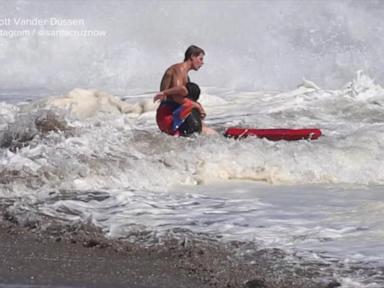
The Pacific Ocean does not negotiate. When violent eight-to-ten-foot swells generated by distant tropical systems slammed into Santa Cruz’s Seabright State Beach, the water turned into a chaotic washing machine of foam, undertow, and brute physics. In the middle of that aquatic chaos, a ten-year-old vacationer from Texas lost his footing in ankle-deep water. Within seconds, the sea dragged him into the impact zone.
What followed was a harrowing, viral battle for survival that transfixed millions online, earned a White House invitation from the President, and thrust a sixteen-year-old rookie lifeguard named Ryder Williams into the center of a national conversation about raw courage.
Yet behind the dramatic footage captured by a local beachgoer lies a much deeper reality about the hidden dangers of our coastline, the unyielding mechanics of heavy surf, and the quiet dedication of young professionals who stand watch while the rest of us play.
The Anatomy of a Sudden Coastal Crisis
Most catastrophic ocean incidents share a common prologue: deception. Witnesses on the shore that Saturday afternoon noted that the ocean cadence felt standard, almost routine, before conditions mutated without warning.
This is the terror of rogue shorebreaks and sudden swell spikes. Energy traveling thousands of miles across open water encounters shallow bathymetry near the shore, compressing raw power into vertical walls of water.
When the ten-year-old boy was swept out, he wasn't swimming far past the breakers; he was simply caught by a rogue pulse while standing near the water's line.
Ankle-deep water is deceptive. It possesses enough kinetic mass when moving outward to sweep the legs out from under an adult, let alone a child.
Enter Ryder Williams. Working his very first season as a California State Parks lifeguard, Williams spotted the child drifting into the rip-current zone and instantly sprang into action.
He didn't pause to weigh the danger. He dropped his gear, grabbed his rescue buoy, and charged headfirst into a wall of churning white water that had already deterred multiple bystanders from attempting a rescue.
The Brutal Reality of the Impact Zone
The viral video shows what happened next, but it obscures the physical toll. Williams reached the drowning child just as continuous sets began detonating over their heads.
In heavy surf, a rescuer's primary enemy is exhaustion. Every time a ten-foot wave crashes overhead, it forces both bodies downward, compressing air from lungs and generating immense disorientation.
Williams later explained that due to the violent volatility of the water, he was unable to secure the victim to his rescue tube initially.
Instead, he relied on a pure test of endurance, wrapping his arms around the boy and taking breaths in the microscopic windows between incoming waves, repeatedly ducking beneath the surface to prevent them both from being ripped apart.
Well-meaning bystanders attempted to form a human chain to assist, a classic textbook mistake in heavy surf that frequently turns one victim into multiple casualties. The sheer force of the water knocked the volunteers back toward the sand.
Recognizing the escalating secondary hazard, Williams shouted instructions for them to retreat, maintaining his grip on the child while waiting for backup.
Moments later, fellow lifeguard Aaron Bohnen punched through the surf line to support him. Working in tandem, the two guards fought their way back through the soup, landing safely on the sand where medical evaluation could begin.
The Aftermath and the Public Spectacle
As the video circulated across social media platforms, public reaction was swift and overwhelming. High-profile figures amplified the clip, praising the teenager's poise and calling for civilian honors.
President Donald Trump publicly announced an invitation for Williams, his family, and the rescued boy to visit the White House.
For most teenagers, sudden global fame would be dizzying. Yet Williams remained entirely grounded. Not active on social media, the young lifeguard returned to his station shortly after the incident and quietly finished out his shift—proceeding to participate in several additional rescues later that same day as the heavy swell persisted.
His father, a retired firefighter, noted that his son felt bewildered by the immense attention, insisting he had simply executed the protocol drilled into him through years of rigorous training and ocean immersion.
The rescued boy's father, Sumit Rai, spoke with quiet awe about the narrow margin between tragedy and survival, noting that a delay of mere seconds would have rewritten the outcome entirely.
What the Headlines Miss
The media cycle loves a simple hero narrative. A brave teen, a dramatic video, a happy ending, and a trip to Washington.
Yet local marine safety officials emphasize that this incident exposes a recurring public blind spot regarding respect for the ocean.
California State Parks reported dozens of rescues along the Santa Cruz coastline over that single weekend. Tourists and casual beachgoers frequently misjudge how quickly benign shorelines transform into high-energy hazard zones.
Lifeguards are not stationed on beaches merely to look out for routine splashes; they act as the last line of defense against an indifferent natural environment.
When individuals bypass safety warnings or underestimate rip currents, they gamble with lives and overextend emergency infrastructure.
Williams’ successful intervention averted a funeral, but it also underscored the quiet professionalism of municipal lifeguards who routinely risk their personal safety away from the cameras.
The teenager did not view his actions through the lens of history or extraordinary achievement; to him, it was simply Tuesday's work executed under extraordinary pressure.
As the digital roar fades and the viral video cycles out of the algorithm feeds, the raw power of the Pacific remains unchanged, pounding against the California coast, waiting for the next moment when vigilance meets the tide.