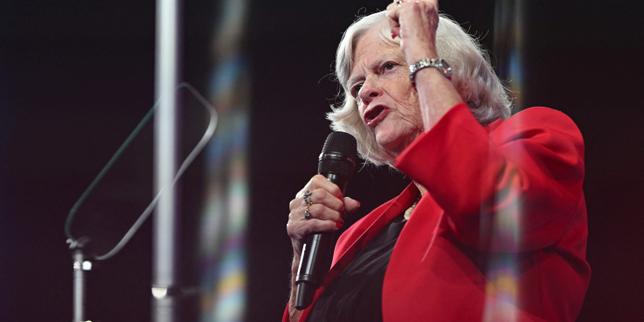
The tragic killing of former minister and Reform UK spokesperson Ann Widdecombe at her home on Dartmoor has transformed from a local murder inquiry into a national security emergency.
For the first forty-eight hours, Devon and Cornwall Police repeatedly assured the public that there was no evidence of a political motive and that the horrifying attack was not being treated as a terrorist incident. That assessment shattered on Monday. Following what authorities described as "new information and evidence," Counter Terrorism Policing South East seized control of the investigation. The 28-year-old suspect, originally arrested in South Yorkshire, has been re-arrested under the Terrorism Act.
This dramatic escalation exposes a grim truth about modern British public life. The safety net designed to protect our political figures is fundamentally broken. We are no longer dealing with isolated tragedies, but a systemic vulnerability that puts every public figure, past and present, directly in the crosshairs.
The Sudden Turn on Dartmoor
Ann Widdecombe was found dead on Thursday, July 9, 2026, after sustaining severe injuries inside her home in Haytor Vale. The timeline constructed by detectives points to a swift, targeted strike.
On Wednesday morning, the 78-year-old political veteran was doing what she did best: aggressively defending her party and its leader, Nigel Farage, during a live interview on TalkTV. By 12:19 PM, she was exchanging text messages with a television producer from Channel 5 to coordinate a follow-up appearance. Less than thirty minutes later, she had vanished from the grid.
Subsequent messages and frantic phone calls went unanswered.
Investigators now believe the attack occurred at approximately 12:30 PM on Wednesday. The suspect, a 28-year-old white British male, allegedly drove nearly 300 miles from South Yorkshire to the edge of Dartmoor National Park to commit the act. He was tracked down and arrested in Rotherham on Saturday night.
But it is the transition of the case to counter-terrorism command that changes everything.
The suspect has now been detained on suspicion of the commission, preparation, or instigation of acts of terrorism. Home Secretary Shabana Mahmood confirmed to the House of Commons that the suspect was not known to Prevent, the state’s multi-agency voluntary program aimed at stopping vulnerable individuals from turning to extremism. This detail is crucial. It points to a growing, silent threat: self-radicalized actors operating completely beneath the radar of traditional state surveillance.
The Illusion of the Safe Retired Statesman
In Westminster, an unspoken assumption has long dictated security protocols. While active Cabinet ministers and high-profile Members of Parliament receive highly coordinated protective details, backbenchers and retired politicians are largely left to fend for themselves.
The murder of Ann Widdecombe shatters this paradigm.
Though she retired from the House of Commons in 2010, Widdecombe remained a prominent, highly polarizing public figure. She served as an MEP for the Brexit Party and, at the time of her death, was a vocal national spokesperson for Reform UK. Her fierce social conservatism and unrelenting euroscepticism kept her constantly in the media spotlight.
"Politics is a calling for those of us here, but it should not be a dangerous one," Home Secretary Shabana Mahmood stated during her address to Parliament.
Yet, the reality is that it has become incredibly dangerous. The state has consistently failed to recognize that in the modern media ecosystem, retirement from office does not equal retirement from public animosity. A polarizing figure remains target number one for radicalized individuals, regardless of whether they currently hold a seat in the division lobbies.
The Growing List of Casualties
To understand how we reached this point, we must look at the brutal historical trajectory of the past decade.
| Victim | Year | Affiliation | Nature of Attack |
|---|---|---|---|
| Jo Cox | 2016 | Labour MP | Shot and stabbed by a far-right extremist |
| Sir David Amess | 2021 | Conservative MP | Stabbed by an Islamic State-inspired extremist |
| Ann Widdecombe | 2026 | Former Conservative Minister / Reform UK | Under active terror investigation following fatal home invasion |
Each time a tragedy occurs, the response from Whitehall follows a predictable script. There are expressions of shock, tributes in the chamber, promises of a "review" into parliamentary security, and advice to avoid holding open surgeries. Then, the news cycle moves on, leaving the systemic vulnerabilities completely untouched.
The Broken Model of British Security
The current approach to protecting politicians is reactive and overly reliant on defensive physical measures. After Sir David Amess was killed, MPs were given access to upgraded security packages for their homes and constituency offices, including panic buttons, enhanced CCTV, and heavy-duty locks.
But these measures are useless when an attacker is willing to travel hundreds of miles to breach a private residence in a remote rural village.
For public figures living in isolated areas like Dartmoor, physical isolation acts as an accelerant to vulnerability. Police response times in rural England are notoriously slow. By the time an alarm is raised, an intruder has already completed their objective and fled.
Furthermore, the state's intelligence apparatus is designed to monitor structured extremist networks. It is spectacularly ill-equipped to flag isolated individuals who self-radicalize in online echo chambers before executing low-tech, high-impact physical attacks. The fact that the Rotherham suspect was entirely unknown to the Prevent program demonstrates a massive blind spot in current preemptive policing.
Following the attack, Reform UK announced it would provide 24-hour private security to its senior leadership team. When political parties feel compelled to bypass state protection and hire private paramilitaries to keep their leaders alive, it represents a catastrophic failure of the state's primary duty to maintain the peace.
We cannot secure a democracy by turning every politician, active or retired, into a permanent prisoner behind reinforced glass and armed guards. Yet, continuing with the status quo is no longer an option. The government must now grapple with the logistically daunting task of extending intelligence-led threat assessments to former MPs and high-profile commentators who remain active in public debate. If they fail to adapt, the tragic list of names on the memorial plaques of Westminster will only continue to grow.