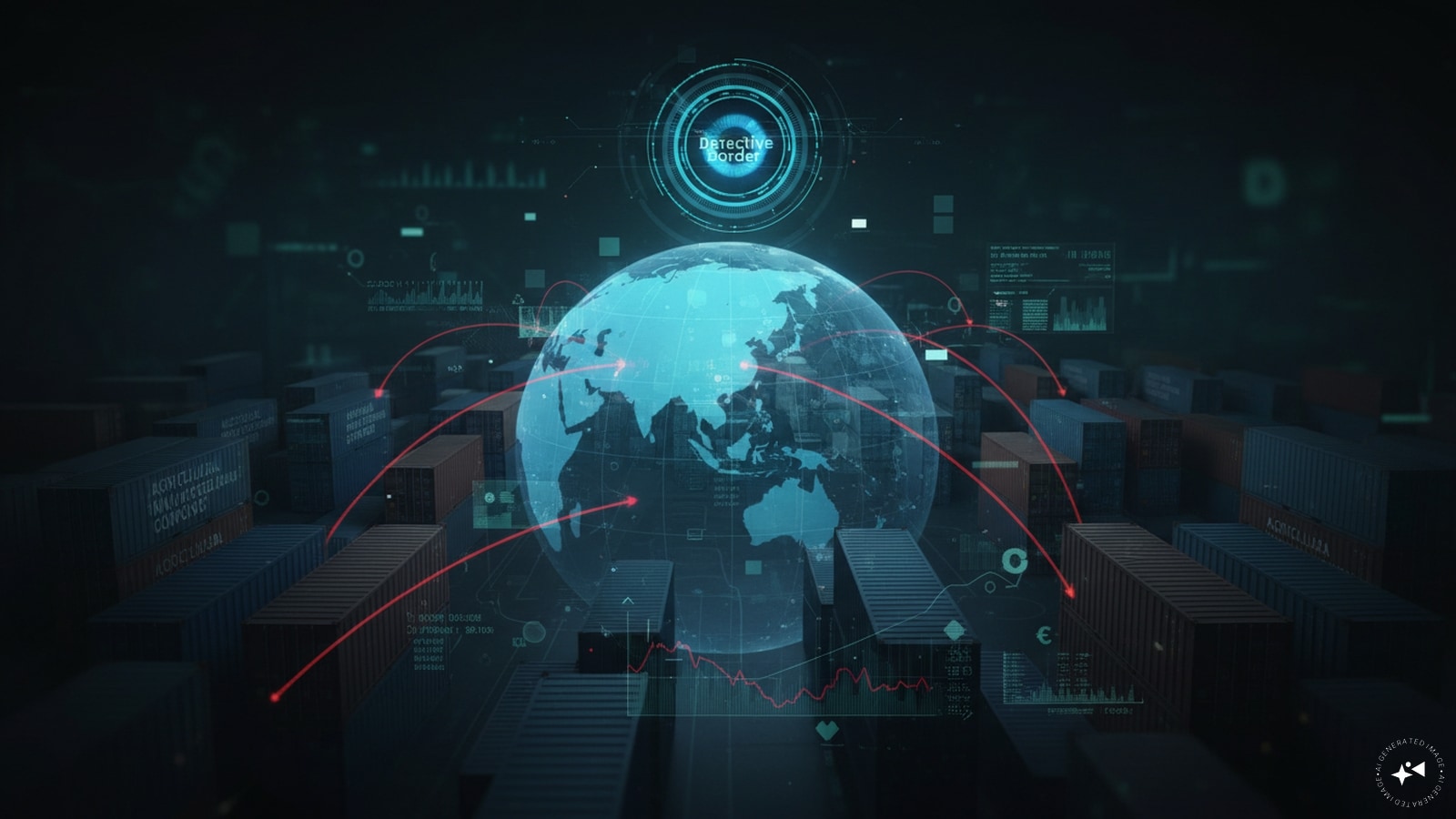
Washington named India alongside forty other global nodes as a primary conduit for illicit trade, throwing open a window into how manufacturing capital evades punitive duties. Beijing does not simply stop exporting when a wall of protectionist duties goes up. Instead, goods shift geography. They flow through intermediaries, acquire new paperwork, and wash through secondary factories designed to launder country-of-origin stamps. The strategy exploits the intricate architecture of global supply chains, where thousands of sub-components cross borders before final assembly.
Trade data tells a story of creative routing. When direct exports face steep penalties, volume simply detours through nations maintaining open commercial channels with both superpowers. This report examines the mechanics of tariff evasion, the structural vulnerabilities of customs enforcement, and why stopping the bleed requires more than another round of executive orders.
The Anatomy of Cargo Laundering
International trade relies heavily on trust and paper. A shipping container leaves a port in eastern China carrying partially assembled electronics, high-grade steel components, or specialized chemicals. Its destination is not Los Angeles or Houston. It unloads at a facility in Southeast Asia or South Asia. Here, workers apply minor transformations. They might swap packaging, re-label serial numbers, or integrate a minor locally sourced component to cross the legal threshold for substantial transformation.
Customs laws dictate that a product's origin changes if it undergoes a substantial transformation in a third country. This legal loophole serves as the primary engine for modern tariff evasion. Shrewd operators exploit grey areas in international trade agreements. They calculate the exact percentage of local value addition required to secure a new certificate of origin.
- Primary Export: Goods leave Chinese factories under broad industrial classifications.
- The Transformation Point: Intermediary hubs perform minimal assembly or documentation scrubbing.
- The Final Entry: Cargo enters American ports bearing clean paperwork and zero punitive surcharges.
The United States Trade Representative and the Department of Commerce face an uphill battle tracking these paper trails. Modern manufacturing operates at a velocity that traditional customs inspections cannot match. Millions of containers arrive daily at ports of entry like Long Beach, Savannah, and Newark. Inspectors rely on risk-assessment algorithms and random sampling rather than exhaustive audits. When a syndicate masks the trail through a chain of shell companies and multiple transshipment stops, tracing the original foundry or assembly line demands forensic accounting capabilities that overstretched agencies rarely possess.
Why Intermediary Nations Look the Other Way
India, Vietnam, Mexico, and dozens of other nations caught in the spotlight occupy a difficult economic position. They want foreign direct investment. They want manufacturing jobs. If a Chinese multinational offers to build a processing plant or finance a logistics hub that employs thousands of local workers, local regulators rarely ask uncomfortable questions about where the underlying raw materials originated.
Economic incentives routinely override geopolitical alignment. Developing economies chase growth metrics aggressively. When capital flows in from alternative corporate entities registered in the Cayman Islands or Singapore, local authorities process the paperwork without auditing the corporate genealogy. The financial rewards for acting as a transshipment node outweigh the diplomatic friction caused by Washington's warning letters.
Consider the electronics sector. Printed circuit boards manufactured in Shenzhen arrive at a facility in a secondary trade hub. They receive a protective coating, a locally printed instruction manual, and a new plastic housing unit. Under current rules of origin, customs officials in destination markets may classify the finished item as a product of the intermediary nation. The original tariffs designed to protect domestic manufacturers become entirely toothless.
The Limitations of Whack-a-Mole Enforcement
Washington's standard playbook involves expanding the list of scrutinized countries, imposing retroactive fines, and demanding stricter documentation standards. This approach resembles fixing a leaking dam with adhesive tape. As soon as customs authorities crack down on one hub, trade routes recalibrate within weeks. Operators pivot to alternative jurisdictions with weaker enforcement regimes or more lenient documentation laws.
The administrative burden falls squarely on legitimate importers. Honest businesses face skyrocketing compliance costs, delayed shipments, and invasive audits while sophisticated criminal syndicates find new ways to exploit bureaucratic inertia. Importers must prove a negative. They must demonstrate that no component within a complex assembly originated from a blacklisted entity or subsidized factory floor.
Furthermore, trade diversion creates severe domestic distortions. Industries that rely on imported raw materials find themselves caught in the crossfire. If an American manufacturer needs specialized aluminum extrusions that domestic foundries cannot produce in sufficient volume, paying an inflated tariff hurts local competitiveness. When they attempt to source legally compliant alternatives through non-Chinese channels, they often discover that those exact channels are simply laundering the prohibited material at a markup.
The Structural Fix That Nobody Wants to Discuss
Real enforcement requires changing how the world tracks value creation. Paper certificates of origin belong to the nineteenth century. They are easily forged, manipulated, or bought from corrupt municipal clerks. A modern system demands cryptographic proof of provenance from the moment raw ore leaves the ground or silicon wafers are cast.
Blockchain-based ledgers and immutable digital twins could theoretically track every component across its lifecycle. Yet, implementation remains a pipe dream. Geopolitical rivals will never agree on a unified, transparent digital trade infrastructure. China has zero incentive to grant Western customs agencies visibility into its domestic supply chains. Intermediary nations benefit too much from the status quo to voluntarily submit their ports to external oversight.
The system will continue to leak. Tariffs remain a blunt political instrument applied to a hyper-efficient, highly adaptable global economy. As long as a significant cost delta exists between protected domestic goods and restricted foreign imports, economic gravity will pull capital through the path of least resistance. The forty hubs named by Washington are symptoms of a deeper structural imbalance, and no amount of diplomatic finger-wagging will alter the fundamental incentives driving global commerce underground.