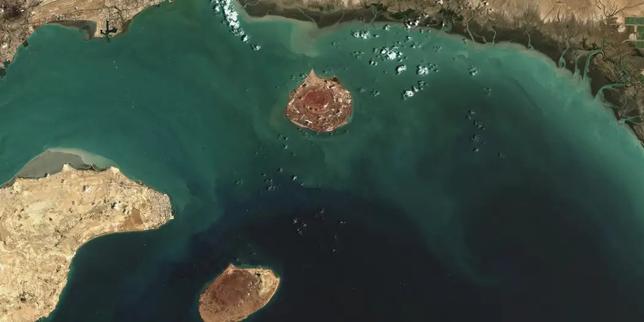
United States forces struck Iranian rocket launchers on Larak Island in the Strait of Hormuz, shattering a month-long operational lull and instantly drawing retaliatory ballistic missile strikes against American installations in Jordan. This sudden escalation exposes the profound limits of Washington’s recent pivot toward economic containment. For six months, the military campaign initiated in late February has oscillated between heavy aerial bombardments and fragile diplomatic pauses. Sunday's engagement proves that neither secondary sanctions nor temporary quiet can stabilize a maritime choke point carrying a fifth of global petroleum supplies.
The sequence of events began when United States Central Command observers detected personnel from the Islamic Revolutionary Guard Corps preparing to emplace sea mines via rocket batteries along the vital shipping lane. Operating under the pretext of protecting commercial navigation, American aircraft targeted two launchers on Larak Island. It was the first direct kinetic action inside Iranian territory since late July.
Tehran’s response was immediate and calculated to test regional air defense architecture. The Revolutionary Guard launched ballistic missiles targeting American facilities in Jordan, specifically aiming at the King Hussein and Al-Azraq air bases. Jordanian armed forces confirmed the interception of eight inbound projectiles within national airspace, avoiding catastrophic structural collapse or mass casualties but underscoring the vulnerability of regional staging posts.
The Illusion of Economic Dominance
Washington's pivot to financial warfare—championed by the Treasury Department through aggressive secondary enforcement against third-party entities trading with Tehran—was designed to bypass the friction of attritional warfare. White House strategists calculated that financial strangulation would force Iranian capitulation without expending scarce interceptor missiles or straining operational readiness.
That calculation miscalculated the institutional resilience of the Revolutionary Guard. Economic isolation has not halted military production lines; it has instead driven the regime toward asymmetric retaliation. By striking out-of-theater bases in Jordan, Tehran signaled that any American military pressure in the Persian Gulf will trigger a wider geographical response, neutralizing the comfort of distant command nodes.
The Choke Point Reality
Commercial traffic through the Strait of Hormuz remains a fraction of its pre-war volume. While the United States Navy insists that naval escorts can secure safe passage, shipping insurers view the corridor as a high-risk zone where a single floating mine can paralyze a supertanker.
Crude benchmarks reacted instantly to the Larak Island exchange, with Brent crude climbing toward ninety dollars a barrel. Energy markets understand a fundamental truth that political communiques routinely obscure. Control of the waterway is no longer a matter of diplomatic negotiation or memorandum compliance; it is contested daily through radar locks, drone sweeps, and subterranean missile caches hidden along Iran's jagged coastline.
Munitions Depletion and Strategic Strain
Behind the rhetoric of absolute military superiority, deep structural concerns persist regarding United States inventory depth. Months of sustained operations across multiple theaters have drawn down advanced precision-guided munition stockpiles. Replenishing these arsenals takes years, not weeks, creating a silent clock that limits how long Washington can sustain high-tempo kinetic campaigns without accepting unacceptable risks elsewhere in global defense planning.
The illusion that localized strikes can permanently suppress asymmetric threats is fading. Every time American forces strike a launch site on an island like Larak, Tehran adapts its dispersal tactics, moving mobile systems deeper into civilian infrastructure or utilizing hardened subterranean shelters.
The strategy of containing a resilient regional power through sporadic punitive raids has reached an operational dead end. As long as the Strait of Hormuz remains an economic jugular vein, neither sanctions nor isolated missile volleys will restore stability. The powder keg is intact, and the fuse is burning faster than ever.