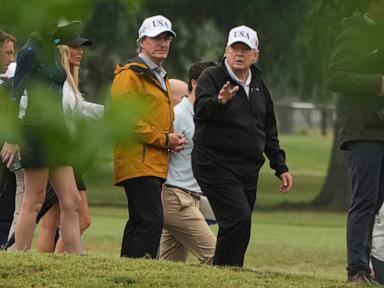
President Donald Trump's relentless focus on turf maintenance and landscaping has become a defining stylistic quirk of his second term, surfacing in dozens of public remarks ranging from economic summits to holiday receptions. Far from a random conversational detour, this fixation on grass reveals the intersection of his decades-long real estate background, his deep personal identification with golf course management, and an aggressive administrative push to physically alter the nation's capital.
Understanding this obsession requires looking past the daily news cycle and examining how physical properties shape political behavior. Building on this topic, you can also read: Inside The Amritsar Police Crackdown On Cross-Border Drug And Arms Smuggling.
The Real Estate Developer in the Oval Office
Decades spent erecting skyscrapers, managing commercial spaces, and building private clubs leave an indelible mark on how an executive views public property. For a traditional politician, a lawn is a backdrop for press conferences or a neutral expanse managed by anonymous groundskeepers. For a builder, green space is raw material. It is an asset to be engineered, paved over for utility, or resodded to project immediate control.
When the administration replaces natural earth with stone patios near the Rose Garden or installs helicopter landing pads on the South Lawn, the rationale is rooted in operational utility rather than preservation. High heels sinking into mud or heavy Marine One aircraft tearing up turf are tangible operational failures. In the developer's framework, if a physical surface impedes function or looks worn, it must be fixed, upgraded, or paved. Observers at USA Today have provided expertise on this matter.
The Golf Course Mentality
No factor influences this worldview more than the golf course. Operating high-end private clubs means managing turfgrass varieties down to the millimeter. Greens, fairways, and roughs demand constant capital investment, chemical intervention, and strategic redesign.
The president has frequently noted that financial survival in the golf industry depends entirely on turf quality. That micro-level attention translates directly into public sector projects. Consultations with corporate turf researchers, custom selections of tall fescues and Kentucky bluegrasses, and direct oversight of park renovations reflect an executive who views municipal landscaping through the lens of a proprietary club owner.
Municipal parks and federal grounds are treated not as historic ecosystems, but as underperforming properties awaiting a private-sector turnaround.
Rewriting the Capital's Aesthetic
This hands-on approach extends to a broader campaign to remake Washington's physical monuments and public spaces. White House grounds face unprecedented wear, from large-scale corporate and entertainment events to structural upgrades. Rather than concealing these changes, the administration highlights them as evidence of decisive action.
When infrastructure demands clash with heritage preservation, utility wins. The insistence that grass "has a life" and therefore requires active management, replacement, or even removal serves as a philosophical justification for constant physical disruption. The capital is treated as a construction site that never sleeps, driven by the belief that visible alteration equals progress.
The physical footprint of the presidency is shifting away from solemn preservation toward aggressive, commercial-grade modernization. Every square foot of turf tells a story of control, utility, and an unwavering belief in architectural revision.
Trump Goes Viral Over 'Grass Has a Life' Remark | Strange White House Moment Explained
This video captures the viral public reaction to the administration's unusual blending of infrastructure talk and turf philosophy during a White House event.