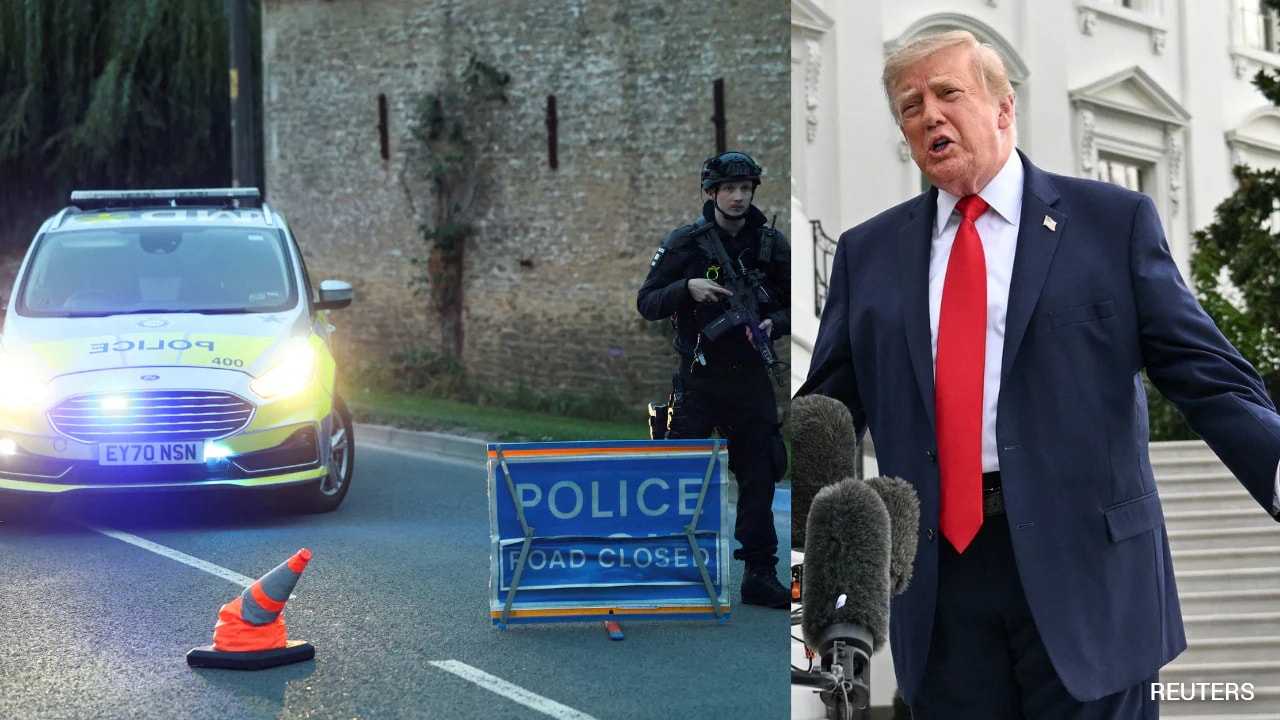
When President Donald Trump told reporters that terror suspects targeting a UK air base were planning "big damage to our fort," he stripped away decades of diplomatic euphemisms to expose a raw operational reality. American military power in Europe relies heavily on host-nation installations—bases technically owned by allies like the United Kingdom, guarded largely by local perimeter forces, yet packed with billions of dollars in US strategic assets and thousands of American personnel. The foiled plot against a British air facility housing US forces reveals an uncomfortable truth about modern asymmetric warfare. Adversaries no longer need to cross an ocean to strike the American homeland when they can target forward-operating bases sitting in the middle of quiet English counties.
The incident centers on intelligence-led counterterrorism operations in Britain that disrupted a suspected plot aimed at an air base utilized by United States military units. While security services on both sides of the Atlantic routinely keep granular operational details classified during active investigations, the strategic implications are already clear. By referring to the installation as "our fort," Trump highlighted the blurred lines of sovereignty, jurisdiction, and force protection that govern US bases abroad.
The Architecture of Shared Vulnerability
To understand why a UK air base makes an attractive target, you have to look at how these installations actually function. Bases like RAF Lakenheath, RAF Mildenhall, and RAF Fairford are not isolated desert fortresses surrounded by miles of empty wasteland. They are woven directly into the rural fabric of East Anglia and Gloucestershire. Public roads run right past their perimeter fences. Local villages sit just beyond the runways. Plane spotters routinely park their cars along adjacent fields with high-powered telephoto lenses to photograph F-35 Lightning II fighter jets or B-52 Stratofortress bombers taking off.
This proximity creates a massive security headache.
For decades, the security model for US bases in Britain rested on a quiet division of labor. The Ministry of Defence Police and RAF Regiment handled external perimeter security and local law enforcement jurisdiction, while US Air Force Security Forces managed internal asset protection and access control. That system worked well enough during the late Cold War and even through the height of the Global War on Terror, when threats to mainland UK military bases were largely confined to lone-actor incidents—such as the 2016 attempted abduction of a serviceman near RAF Marham—or sporadic protest incursions.
Modern threat actors operate differently. Today, military planners face a convergence of hostile state-sponsored sabotage, decentralized extremist cells, and commercially available reconnaissance tools. A perimeter fence designed to stop a trespasser does nothing to stop a commercially modified drone carrying an explosive payload, nor does it prevent hostile operatives from mapping shift changes from a public layby half a mile away.
Why Forward Bases Are Prime Targets
Terrorist networks and hostile intelligence services calculate return on investment just like any corporate strategist. Attacking a high-profile target inside the continental United States requires complex logistics, border crossings, and navigating overlapping layers of federal surveillance. Striking a US-occupied base in Western Europe achieves nearly identical psychological and political shock value at a fraction of the operational cost.
Consider the strategic math from an adversary's perspective:
- High-Value Asset Density: A single squadron of fifth-generation fighter jets or strategic aerial refueling tankers represents billions of dollars in hardware that cannot be quickly replaced. Damaging even two or three aircraft on the tarmac creates an immediate operational gap for NATO.
- Political Friction: An attack on British soil targeting American personnel instantly tests the bilateral relationship. It forces difficult questions in Parliament about whether hosting US strategic assets makes British towns collateral targets.
- Media Amplification: Dramatic imagery of smoke rising from an allied air base dominates global news cycles for weeks, projecting an image of Western vulnerability without requiring a conventional military confrontation.
Trump's characterization of the plot—warning that the suspects intended to inflict "big damage"—cuts straight to the physical vulnerability of parked aircraft and fuel infrastructure. Modern military aviation is extraordinarily lethal in the air and remarkably fragile on the ground. Unlike Cold War-era hardened aircraft shelters built to withstand tactical nuclear blasts, many contemporary hangars and maintenance facilities at European bases are lightweight structures designed for peacetime efficiency and climate control, not kinetic defense.
The Counterterrorism Dragnet in Britain
The fact that this plot was intercepted before execution speaks to the quiet effectiveness of British domestic intelligence, primarily MI5 and Counter Terrorism Policing, working alongside US military intelligence units. Britain maintains one of the most aggressive preemptive counterterrorism legal frameworks in the Western world. Under the UK's Terrorism Act, authorities can arrest and hold suspects for up to 14 days without charge to disrupt nascent plots before weapons are acquired or final reconnaissance is completed.
Yet interception is not the same thing as immunity.
Intelligence veterans often describe counterterrorism as a game of asymmetric odds: security services have to be right every single time, while an attacker only needs to slip through once. When investigations uncover plots targeting military installations, the post-mortem almost always reveals a period where suspects conducted physical surveillance near the base. In the UK, where public footpaths frequently abut military land, distinguishing between an aviation enthusiast with a camera and an operative conducting target-package reconnaissance requires intense human intelligence and digital tracking.
Furthermore, the threat environment in Europe has shifted dramatically over the past few years. Security officials across NATO have repeatedly warned about a rise in hybrid threats—ranging from arson attacks on logistics warehouses in Germany and Poland to GPS jamming in the Baltic region. Even when a plot appears rooted in ideological extremism, intelligence analysts increasingly look for indirect state-actor encouragement, encrypted funding channels, or shared tactical playbooks circulating on dark-web forums.
The Jurisdictional Friction of "Our Fort"
Trump's choice of words—calling a British Royal Air Force station "our fort"—may ruffle feathers among British defense traditionalists, who point out that the Union Jack flies over these bases and British commanders retain nominal station command. Technically, there are no sovereign American bases in the United Kingdom; every installation is an RAF station made available to US Visiting Forces under agreements dating back to the early 1950s.
In practice, however, Trump's phrasing reflects how Washington views these hubs. When the Pentagon invests hundreds of millions of dollars upgrading runways, constructing specialized munitions storage areas, and preparing infrastructure for nuclear-capable strike platforms, American leaders view those installations as vital extensions of US national defense.
That dual identity creates real-world friction when threat levels spike.
Under the NATO Status of Forces Agreement, the host nation bears primary responsibility for security outside the wire. If US intelligence detects a specific threat to a base in Suffolk or Oxfordshire, American commanders cannot simply deploy armed US troops to patrol the surrounding English villages or set up roadblocks on county lanes. They must rely entirely on local British police forces, whose resources are already stretched thin by domestic policing demands and budget constraints.
A hypothetical scenario illustrates the gap. Imagine a surveillance team is spotted flying a commercial quadcopter from a public park two miles from an air base perimeter. US base security can track the drone on radar and deploy electronic countermeasures within the installation's airspace, but they have zero legal authority to drive off-base, detain the operator, or seize their vehicle. They have to call local British police, wait for armed response units to arrive, and hope the suspects haven't already packed up and disappeared down the motorway.
Overlooked Factors in Base Defense
Public discussions around base security usually focus on fences, guards, and intelligence intercepts. Military engineers and force-protection specialists worry about far more mundane vulnerabilities.
Supply Chain and Contractor Access
Modern air bases run on civilian labor. Hundreds of local contractors—delivery drivers, plumbers, catering staff, waste management crews, and IT technicians—pass through base gates every day. While vetting procedures exist, background checks are snapshots in time. A contractor with clean records during initial vetting can be radicalized, blackmailed, or bribed years later. Insider threats remain one of the hardest vectors for counterintelligence to detect because the individual already possesses legitimate access and intimate knowledge of base layouts.
Electromagnetic and Drone Exposure
Air bases are noisy electromagnetic environments, which paradoxically makes detecting small, low-flying drones harder. Commercial drones can be programmed to fly pre-set GPS waypoints completely off-radio, rendering traditional radio-frequency detection gear useless until the aircraft is already inside the perimeter. Once over the flight line, even a small payload dropped onto the canopy of a parked fighter jet or a fuel bowser can cause catastrophic fire damage.
Predictable Operational Rhythms
Military bases are creatures of habit. Shift changes happen at exact hours. Logistics convoys follow identical routes. VIP transport aircraft arrive with predictable security cordons. Any patient observer sitting in a parked car near a base exit can map the installation's daily pulse within a week, identifying precisely when gate guards are distracted by peak commuter traffic or when emergency response crews are conducting routine drills.
Hardening the Perimeter Without Building a Fortress
Securing forward bases without turning allied towns into militarized zones requires uncomfortable trade-offs. The Pentagon and the UK Ministry of Defence have quietly accelerated investments in counter-unmanned aerial system (C-UAS) technology, deploying directional jammers, acoustic sensors, and kinetic interceptors around critical European airfields.
Physical hardening is also making a comeback. After decades of treating European bases as administrative hubs for Middle Eastern deployments, defense planners are relearning Cold War survival habits: dispersing aircraft across wider aprons, building blast walls around fuel farms, and upgrading perimeter sensor networks with thermal imaging and ground-surveillance radar.
Still, technology cannot solve a political and geographic reality. As long as American airpower relies on forward staging bases embedded inside dense civilian communities across Europe, those installations will remain exposed to asymmetric probing. Diplomatic niceties about host-nation sovereignty matter little when a cell of operatives is actively plotting to burn aircraft on the tarmac.
When a US president calls a British air base "our fort" and warns of plans to inflict "big damage," the message is aimed well beyond the suspects sitting in custody. It is a blunt reminder to allies and adversaries alike that forward deployment carries forward risk—and that the front line of homeland defense now starts at a chain-link fence in the English countryside.