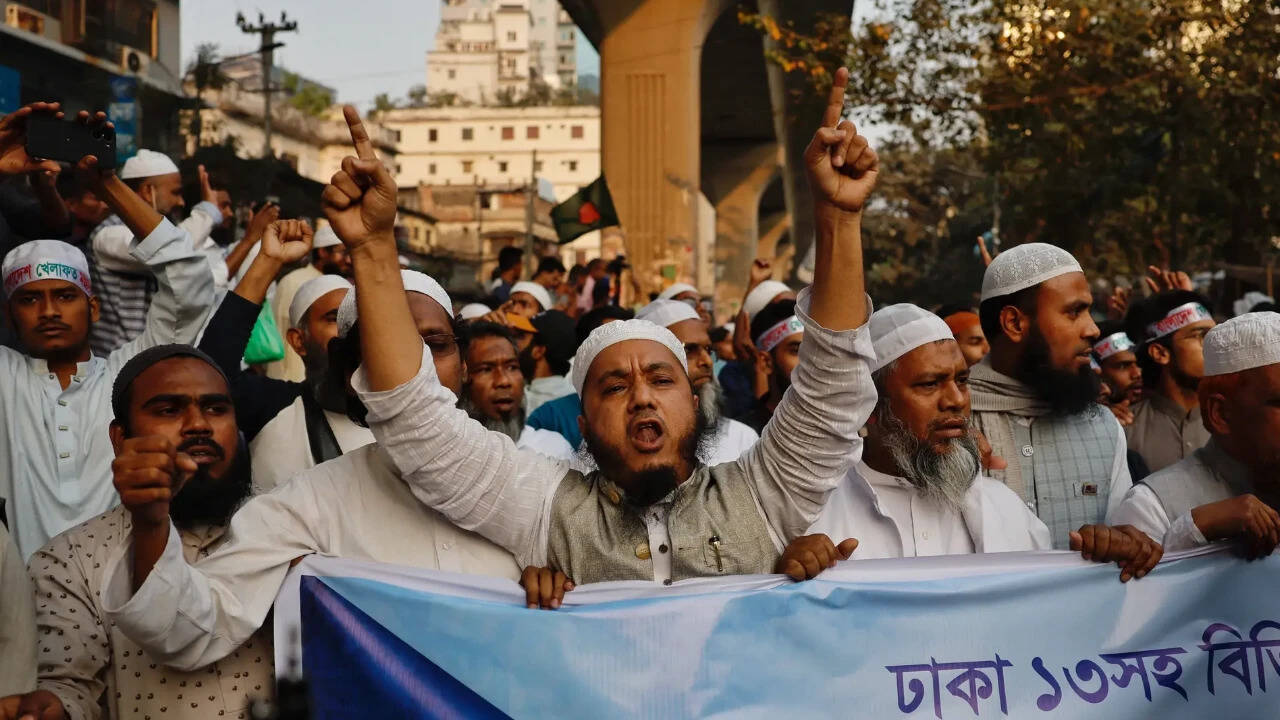
The Anatomy of Intelligence Rumors in Post-2024 Dhaka
Accusations of secret backchannels between opposition figures and foreign intelligence services operate as high-leverage political weapons in fragile post-uprising democracies. Following the August 2024 mass uprising that ended Sheikh Hasina's rule and the subsequent February 2026 parliamentary elections that brought Tarique Rahman's government to power, political alignment in Bangladesh has shifted rapidly. In late October 2026, Prime Minister Tarique Rahman's special assistant, Mohammad Rashed Khan, alleged that Bangladesh Jamaat-e-Islami Secretary General Mia Golam Parwar and two other party figures met secretly with a senior Indian intelligence official in Dhaka. Jamaat-e-Islami rejected the claim as false and demanded proof, while India's Ministry of External Affairs declined to comment.
Standard news reporting on such disputes typically treats the allegation and the denial as a symmetric he-said-she-said exchange. That framing misses the structural mechanics of why intelligence claims surface at specific moments in a political cycle. A rigorous analysis separates what is verified in the public record from what remains an unsubstantiated claim, maps the incentives of each actor, and evaluates how unverified intelligence narratives reshape coalition politics and bilateral posture. If you found value in this piece, you should read: this related article.
To understand the dynamics behind the Dhaka dispute, analysts must examine three interconnected mechanisms:
- Epistemic asymmetry: Intelligence encounters are designed to leave minimal public traces, making public accusations easy to level and difficult to disprove on demand.
- Coalition realignment pressure: Allegations of cross-camp coordination—including claims linking Jamaat-e-Islami with Awami League mobilization—attempt to raise the political cost of tactical opposition maneuvers.
- Bilateral signaling costs: A ruling aide's claim implicating a neighboring power's intelligence apparatus strains diplomatic ties even when the foreign ministry avoids confirming or denying the story.
Facts Versus Hypotheses in the Dhaka Dispute
Establishing factual clarity requires separating documented public statements from strategic interpretations. What is known is limited to public political claims, official responses, and broader political context: For another perspective on this story, check out the recent update from USA Today.
- Known fact: In late October 2026, Mohammad Rashed Khan, a political aide and special assistant to Prime Minister Tarique Rahman, publicly alleged that Jamaat-e-Islami Secretary General Mia Golam Parwar and two party colleagues held a secret meeting in Dhaka with a senior Indian intelligence official.
- Known fact: Rashed Khan linked the alleged meeting to questions over anti-India rhetoric and claimed a Jamaat plan to launch a movement alongside the Awami League represented an early step in a conspiracy against the state.
- Known fact: Jamaat-e-Islami leaders, including Parwar and Ahsanul Mahboob Zubair, denied the allegation, distinguished between meeting a diplomat and meeting an intelligence official, and challenged Rashed Khan to produce evidence.
- Known fact: India's Ministry of External Affairs spokesperson Randhir Jaiswal declined to comment when asked about the aide's claims.
- Known fact: The Awami League was barred from political activities and excluded from the February 2026 parliamentary elections following the August 2024 uprising, with former Prime Minister Sheikh Hasina residing in India.
Everything beyond these public statements is an educated hypothesis rather than a proven fact. Because no documentary evidence, photographs, or official confirmations have been placed in the public domain, analysts cannot verify whether a covert meeting occurred, what its agenda might have been if it did, or whether the accusation originated from intelligence reporting, political rumor, or deliberate messaging.
Why Covert Allegations Are Hard to Falsify
In intelligence and political warfare, allegations of secret meetings possess a built-in structural advantage for the accuser. Covert contact, by definition, avoids official channels, press schedules, and diplomatic registries. When an accuser asserts that a clandestine meeting took place, demanding "proof" puts the burden of a negative on the accused party. A denial from a political party or silence from a foreign ministry rarely settles the matter in public discourse because skeptics can interpret silence as strategic caution and denials as predictable self-defense.
The second limitation of such claims is evidentiary fragility. Even in environments with active domestic surveillance or competing political factions, rumors of backchannels frequently blend real diplomatic friction, misread encounters, or partisan wishcasting into a single narrative. Treating an unverified allegation as an established event corrupts downstream analysis. A disciplined analyst treats the public accusation itself as a verifiable political act while keeping the underlying meeting classified as unproven.
Strategic Incentives Across the Three Actors
When a secret-meeting claim enters public debate, each actor faces distinct payoffs and constraints. Mapping those incentives clarifies why the story gained traction without relying on speculation about hidden motives.
The Ruling Camp and Rashed Khan
For an aide close to the prime minister, spotlighting alleged secret outreach between Jamaat-e-Islami and an Indian intelligence official serves immediate domestic messaging goals. First, it frames political opposition not merely as policy disagreement or street protest, but as potentially aligned with external intelligence interests or previously marginalized political forces such as the Awami League. Second, it tests the credibility of a prominent rival party by forcing it onto the defensive over its nationalist and ideological consistency.
Yet escalating intelligence claims carries real risks for the ruling side. If evidence does not emerge, opponents can portray the government or its aides as relying on unsubstantiated accusations to pressure rivals. Moreover, framing domestic political friction around foreign intelligence plots can heighten broader instability—a sensitive issue given Prime Minister Tarique Rahman's own warnings regarding attempts to destabilize the country.
Jamaat-e-Islami
Jamaat-e-Islami faces a reputational trade-off in any accusation involving Indian intelligence. The party's public posture has long emphasized opposition to perceived Indian influence and skepticism toward previous Awami League governance. An allegation of secret engagement with an Indian intelligence official directly targets that brand identity.
Its counter-strategy relies on two moves: flatly rejecting the premise as fabricated and drawing a sharp conceptual line between routine diplomatic contact and intelligence backchannels while challenging the accuser to substantiate the claim. That response is aimed at two audiences simultaneously—party loyalists who expect a firm rebuttal and neutral observers who look for concrete evidence before updating their beliefs.
New Delhi
India's position in post-2024 Bangladesh politics is structurally delicate. With Sheikh Hasina in India and the Awami League excluded from the February 2026 parliamentary polls, New Delhi has had to navigate a transformed political reality in Dhaka while managing bilateral friction over extradition requests, consular issues, and political rhetoric.
Declining to comment through the Ministry of External Affairs is a standard institutional response when foreign political figures make unverified claims about intelligence activities. Confirming contact would inflame domestic politics in Bangladesh and potentially alienate interlocutors; issuing a detailed denial could draw New Delhi deeper into partisan mudslinging or invite further questioning about regional intelligence operations. Strategic silence preserves room to maneuver while keeping official diplomatic channels separate from domestic political theater.
Cause-and-Effect Chains in Coalition and Bilateral Dynamics
Vague commentary often assumes that a single rumor automatically produces a single political outcome. In practice, cause and effect operate through multi-step feedback loops across domestic coalitions and interstate relations.
Consider first the domestic coalition effect. In fluid post-election parliaments and street politics, parties frequently weigh whether to cooperate, compete, or stage joint agitation around specific grievances. When an aide alleges that Jamaat-e-Islami plans a movement alongside the Awami League following a secret intelligence meeting, the claim seeks to stigmatize tactical alignment before it can gain momentum. Even if the claim is disputed, it raises coordination costs by forcing potential partners to weigh whether association will carry a heavy nationalist penalty.
Consider next the bilateral effect. South Asian diplomatic relationships are highly sensitive to domestic political signaling. When a figure associated with the prime minister's office invokes a senior Indian intelligence official in a public critique, the friction does not stay neatly inside domestic party competition. It feeds into an already strained bilateral atmosphere marked by postponed consular talks, competing narratives over Sheikh Hasina's status, and heightened scrutiny of cross-border influence.
In high-tension bilateral environments, domestic political rhetoric frequently becomes a secondary diplomatic variable, complicating routine statecraft even when governments prefer quiet engagement.
Illustrative Scenario: How Backchannel Rumors Escalate
Imagine a hypothetical scenario in which two rival political camps in a capital city are competing for street influence ahead of a legislative push. A mid-level political actor claims on social media or at a rally that a rival leader met a foreign intelligence officer at a private residence. No photos or logs exist. Within forty-eight hours, partisan outlets amplify the claim as near-certainty, opponents demand an investigation or proof, and allies use the story to question the rival's loyalty. Even if the meeting never occurred, the political environment shifts: trust erodes further, protest mobilization becomes more polarized, and foreign diplomats spend bandwidth managing fallout rather than substantive policy.
Analytical Checklist for Evaluating Intelligence Claims
Readers, analysts, and decision-makers confronting claims of secret intelligence meetings in sensitive political environments can apply a four-step verification discipline before drawing conclusions:
- Isolate the primary claim from commentary: Separate the core assertion (who allegedly met whom, where, and in what capacity) from broader conspiracy claims or partisan characterizations attached to it.
- Audit evidentiary standards: Check whether any verifiable details—dates, locations, corroborating witnesses, or official records—are presented, or whether the claim rests solely on assertion.
- Map incentives and timing: Examine why the claim surfaces at that specific moment, how it affects coalition bargaining or protest narratives, and what each side gains or loses by engaging or ignoring it.
- Separate domestic signaling from verified bilateral shifts: Watch for concrete state actions—such as formal diplomatic protests, policy reversals, or institutional inquiries—rather than treating partisan rhetoric alone as proof of a covert realignment.
No single analytical heuristic eliminates uncertainty in covert politics. Intelligence matters are intentionally opaque, and political actors routinely exploit ambiguity to shape public perception. Rigorous analysis therefore resists both gullibility and cynical dismissal: it refuses to treat unproven allegations as fact while taking seriously how those allegations alter political incentives on the ground.
Strategic Action for Decision-Makers
For diplomats, policy analysts, and political observers tracking Dhaka, the decisive move is to anchor assessments in observable institutional behavior and coalition arithmetic rather than unverified backchannel claims. Track concrete indicators—such as formal parliamentary alignments, protest mobilization around concrete policy demands, official diplomatic engagements, and state security actions—and treat secret-meeting allegations primarily as a barometer of domestic political friction unless hard corroboration emerges.


