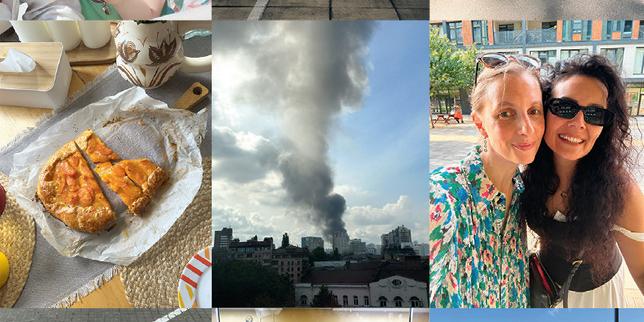
The grand narrative of any conflict is usually written in territory gained or lost, in casualty figures broadcast across tickers, and in the cold geometry of supply lines. History textbooks prefer the macroscopic view because maps are easy to print and statistics are clean. But war is experienced entirely in the microscopic. It lives in the friction of daily survival, the anxious wait for a digital notification, and the peculiar weight of words committed to paper or screen when tomorrow is entirely unpromised.
When private correspondence between individuals caught inside an active combat zone becomes public, it offers a rare counterweight to official communiqués. These letters do not speak of strategic objectives or tactical retreats. They speak of missing socks, the sound of artillery rattling a windowpane at three in the morning, and the strange, guilt-ridden normalcy of making coffee while sirens wail three streets over.
The Mechanics of Distance
Separation during wartime is not merely physical. It is a psychological fracturing. When two people are abruptly cleaved from one another by mobilization orders or shifting front lines, their shared reality splinters. One person inhabits a world of concrete bunkers, mud, and the constant, low-frequency hum of mortal danger. The other inhabits a ghost town of routines that no longer make sense, sitting in a kitchen thousands of miles away or across an enforced divide, staring at a cold burner.
Correspondence bridges this gap, but it also exposes the inadequacy of language. How do you describe the smell of cordite to someone whose biggest crisis is a delayed train? How do you tell the person waiting at home that you are numb, without breaking their heart entirely?
Writers of wartime letters often engage in a delicate dance of omission. They edit their daily realities to protect the recipient. The soldier minimizes the closeness of the shell blast. The civilian downplays the terror of an empty bed and the solitary shadow cast by an unyielding lamp. This mutual self-censorship creates a strange alternate universe—a relationship sustained entirely by carefully curated fragments of truth.
The Evolution of the Dispatch
Throughout history, the medium of communication has shaped the nature of emotional survival. During the Napoleonic Wars, letters took months to arrive, turning correspondence into a dialogue with ghosts. By the twentieth century, postal services operated with astonishing military efficiency, delivering V-mail across oceans while it was still relevant.
Today, the digital tether changes the psychological texture of endurance entirely. Instant messaging creates a dangerous illusion of proximity. When a message is delivered in real-time, silence becomes deafening much faster. A ten-minute delay between "I'm heading out" and the next reply stretches like an eternity. The friction of the physical letter—the paper, the ink, the deliberate pacing of thought—forced a slower, more contemplative processing of grief and hope. Instantaneous digital updates strip away that buffer, exposing both parties to the raw, unfiltered anxiety of the present moment.
The Domestic Frontline
We often separate the combatant from the non-combatant as if they inhabit different moral universes. Yet, the person receiving the letters is fighting a parallel war of attrition. The psychological toll of waiting is a recognized phenomenon, yet it rarely receives the analytical weight given to tactical operations.
Every ring of the phone or ping of a notification carries a dual potential: the reassurance of continued existence or the devastating confirmation of the worst. Over months and years, this constant state of high-alert erodes cognitive function, relationships, and emotional resilience. The home front is not a place of rest; it is a waiting room with no exit door.
The Weight of Archives
Decades from now, the digital caches and paper archives of this era will be studied by historians seeking to understand how ordinary human beings endured systemic disruption. They will look past the headlines and search the margins of personal accounts for the texture of daily life.
What they will find is not heroism in the cinematic sense. They will find exhaustion, stubborn domesticity, and the quiet persistence of affection in the face of annihilation. The letters exchanged across these divides are artifacts of endurance. They remind us that civilization is not defended solely by force of arms, but by the stubborn refusal to let human connection become another casualty of the state.
The silence that eventually follows the final letter is the true measure of the cost.


