The rain in Melbourne does not fall so much as it lingers, a permanent damp ghost clinging to the bluestone laneways and the heavy wool of winter coats. On a Tuesday evening at Flinders Street Station, the commuter tide is a predictable mechanical rhythm. Footsteps echo against vaulted ceilings. Ticket barriers click open and shut with the sharp cadence of a metronome. People hurry toward platforms, anxious to trade the grey chill for a kitchen light and a hot mug.
Then, a sudden shift.
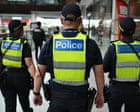
Two officers in high-visibility vests step forward. They are not chasing a disturbance or responding to a triple-zero call. They are simply standing there, arms crossed, eyes scanning the crowd. They don’t need a warrant. They don’t need reasonable suspicion. They simply need a uniform, a badge, and the freshly minted authority of a state government policy that flipped its own script overnight.
Consider what happens next. A young man carrying a guitar case and a canvas backpack slows his pace. He has done nothing wrong. He is headed home from a late shift at a bookstore. Yet, as the officer's gaze locks onto him, his stomach drops. He is about to be told to empty his pockets on a public concourse because a law written in a parliament house miles away says a train station has just been designated a temporary zone of absolute inspection.
This is the reality of the Victoria Police and Protective Services Officer backflip. Random stop and search powers have arrived, sweeping through transport hubs and designated public places with a quiet, frictionless efficiency that leaves civil liberties gasping for air in the vacuum.
For years, the political dividing line in this state was sharp. The Labor government stood firm, resisting the expansion of warrantless search powers on the grounds that personal autonomy and the presumption of innocence were non-negotiable pillars of a free society. Critics inside legal circles warned that giving authorities the unilateral right to frisk citizens without cause would erode trust, disproportionately target marginalized communities, and turn ordinary public spaces into checkpoints.
And then, the calculus shifted. A rising tide of community anxiety over public safety, fueled by high-profile incidents and relentless media cycles, created a political gravity too heavy to resist. The backflip was swift. Pragmatism swallowed principle whole. The legislation passed, and suddenly, the invisible line separating a free citizen from an inspected subject shifted right beneath our shoes.
To understand why this matters, we have to look past the press releases and the comforting assurances of politicians who swear these powers will be used responsibly. Power, once granted, rarely shrinks. It expands to fill the containers prepared for it.
Imagine standing on a crowded platform. You are tired. You are carrying your life in a nylon bag—your laptop, your journal, a spare pair of socks, perhaps a confidential medical file or a letter you haven't mailed. To an officer trained to look for threats, a hesitant glance or a sudden adjustment of a jacket strap is enough to trigger a search. You are asked to step aside. Your personal items are laid bare on a cold concrete floor under the merciless glare of fluorescent lighting.
Did you commit a crime? No. Were you acting suspiciously? Not objectively. But under these new provisions, the threshold of suspicion has been dissolved entirely. It is replaced by geography. If you are in the wrong zone at the right time, your right to privacy becomes conditional.
This is where the human cost hides. It is not always about a wrongful arrest or a dramatic confrontation. Most of the time, the impact is quieter. It is the cold knot in the stomach of a teenager of color who learns early that his presence in a public square requires constant justification. It is the subtle cooling of community warmth, the quiet retreat of trust between the citizen and the state. When the people paid to protect us are also given the power to interrogate our daily routines without provocation, the psychological texture of the city changes. We stop walking with our heads up. We start watching our flanks.
Defenders of the policy argue that desperate times require robust tools. They point to knife crime, urban unrest, and the unpredictable volatility of modern public spaces. They ask a very simple, seductive question: If you have nothing to hide, what do you have to fear?
It is the oldest argument in the history of governance. It is also a trap.
We do not value privacy because we have illicit secrets tucked away in our pockets. We value privacy because it is the oxygen of dignity. It is the boundary that allows us to move through the world as free agents rather than managed subjects. When that boundary is treated as an inconvenience to be cleared away for the sake of administrative convenience, we lose something vital, even if the trains run on time and the statistics tick downward.
History teaches us a sobering lesson about temporary emergency powers. They have a peculiar habit of becoming permanent fixtures of the architectural landscape. What begins as a targeted measure for high-risk transport hubs slowly metastasizes into shopping strips, festival grounds, and suburban transit nodes. Before we realize how far we have wandered, random searches are no longer an exception to the rule. They are the background radiation of daily life.
Melbourne is a city built on culture, laneway secrets, public coffee cups, and a distinct, relaxed irreverence toward authority. We pride ourselves on being a place where people can breathe easy, walk late, and inhabit the streets without looking over their shoulders for a state-sanctioned hand checking for hidden contraband.
That culture is resilient, but it is not indestructible. It is worn down one concession at a time, traded away in boardrooms and parliamentary chambers under the banner of safety.
The officers standing at the station gates tonight are just doing their jobs. They are men and women trying to navigate a difficult, high-stress world, carrying out orders handed down from above. The fault does not lie with them. It lies with the quiet erosion of imagination in our leaders—the tragic belief that the only way to make a society safe is to make it transparent to the state.
As the last train pulls away from the platform, the red tail-lights bleed into the dark Melbourne mist. The crowd disperses into the night, leaving behind an empty concourse and a new normal. The powers are active. The patrols have begun. And somewhere out there in the damp dark, an invisible line has been crossed, changing the relationship between the citizen and the street forever.