A map is just paper and ink until you live on the edge of the lines. For a fisherman in the Taiwan Strait, the ocean isn't a geopolitical chessboard; it is a source of silver-scaled livelihood. But lately, the water feels different. It carries a vibration. When Chinese warships drift across the median line—that unofficial boundary that has kept the peace for decades—the ripples reach far beyond the hulls of steel. They reach the dinner tables in Taipei and the mahogany desks in Washington.
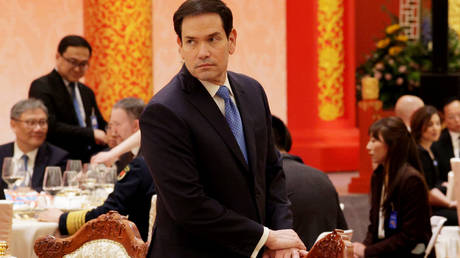
Marco Rubio, the Vice Chairman of the Senate Intelligence Committee, watches these ripples with a practiced, wary eye. When Beijing issues its latest warning, couched in the stiff, formal language of "red lines" and "sovereignty," Rubio doesn't see a routine diplomatic exchange. He sees a clock ticking.
The recent friction centers on a fundamental disagreement about who owns the air and the salt. China claims Taiwan as a breakaway province. Taiwan sees itself as a self-governing democracy. The United States, bound by the Taiwan Relations Act, sits in the uneasy middle, providing the means for the island to defend itself while officially dancing around the question of independence. It is a fragile status quo held together by strategic ambiguity and a massive amount of hardware.
The Weight of a Warning
Beijing’s warnings are rarely subtle. They often arrive as a rhythmic percussion of fighter jets entering Taiwan’s Air Defense Identification Zone (ADIZ). Imagine a neighbor pacing back and forth on the very edge of your lawn, staring through your window, never stepping over the property line but making sure you know they could. That is the daily reality for the 23 million people living on the island.
Rubio’s response to the latest Chinese rhetoric was sharp. He understands that in the theater of international relations, silence is often interpreted as permission. By reinforcing American support for Taiwan, he isn't just playing politics. He is signaling to the world that the "red lines" drawn by Beijing are not the only ones that matter.
Consider the hypothetical case of "Linh," a software engineer in Hsinchu. She works at the heart of the global semiconductor industry. The chips her company produces power the smartphone in your pocket, the medical devices in your local hospital, and the guidance systems in the very jets patrolling the coast. If the line in the water is crossed, Linh’s world doesn't just change; the global economy grinds to a halt. We aren't talking about a temporary price hike. We are talking about a fundamental breakdown of the modern world.
This is the invisible stake. The "Taiwan question" isn't merely about historical maps or ethnic identity. It is about the nervous system of the 21st century.
Rhetoric and Reality
The language coming out of the Chinese Communist Party has grown increasingly urgent. They speak of "reunification" as an inevitability, a historical debt that must be settled. To Rubio and many of his colleagues in the Senate, this isn't just talk. It is a blueprint.
The Senator argues that the best way to prevent a conflict is to make the cost of that conflict unthinkable. This is the logic of deterrence. It’s the idea that if you want peace, you must be visibly, undeniably prepared for the alternative. When China warns the U.S. to stop "meddling" in its internal affairs, they are testing the floorboards. They are checking to see which ones creak.
Rubio’s stance is that the U.S. must provide Taiwan with the "asymmetric" capabilities needed to defend itself. Think of it like a porcupine. A porcupine doesn't need to be bigger than a wolf to survive; it just needs to be too painful to swallow. Small, mobile missile systems, sea mines, and advanced surveillance are the quills.
The Cost of Miscalculation
History is littered with wars that started because someone misread a signal. In 1914, the powers of Europe stumbled into a slaughter because they thought the other side was bluffing. Today, the stakes are nuclear.
The tension isn't just about military might, though. It’s about the soul of the international order. If a larger power can simply erase the borders of a smaller neighbor because of a historical claim, then the rules we’ve lived by since 1945 are effectively dead. That is the core of Rubio’s argument. If Taiwan falls, the message to every other democracy in the shadow of an autocracy is: "You are next."
But there is a human weariness to this. For the people of Taiwan, the constant "warnings" from the mainland are like the sound of a distant chainsaw. At first, it’s terrifying. After years, it becomes background noise. You go to work. You buy groceries. You raise your children. But you never quite stop listening to the saw.
The Global Ripple
If a conflict were to erupt, the fallout would be instantaneous. The Taiwan Strait is one of the busiest shipping lanes on the planet. Half of the world’s container ships pass through those waters. A blockade or a kinetic strike would trigger a supply chain collapse that would make the disruptions of the early 2020s look like a minor inconvenience.
Your car, your laptop, your refrigerator—everything with a pulse of electricity relies on the stability of that small stretch of water.
Senator Rubio’s insistence on a firm response to Beijing’s warnings is rooted in this reality. He is criticized by some for being a hawk, for poking the bear. But his supporters see him as the one pointing out that the bear is already mid-stride.
The friction between Rubio and Beijing is a microcosm of the larger struggle of our era. It is the clash between an ascending, assertive power that wants to rewrite the rules and an established power trying to hold the line. It’s a story of ego, history, and the terrifying precision of modern weaponry.
Beyond the headlines and the high-level meetings, there remains the quiet, persistent pulse of the island itself. People there don't want to be a flashpoint. They don't want to be the "most dangerous place on earth," as some magazines have called them. They want the right to choose their own tomorrow.
The warnings will continue. The jets will keep flying. Rubio will keep issuing statements from Washington. And in the Taiwan Strait, the fishermen will keep watching the horizon, looking for the silver flash of fish, and hoping the ripples they see are only caused by the wind.
The line in the water is invisible, but it is the heaviest thing in the world.