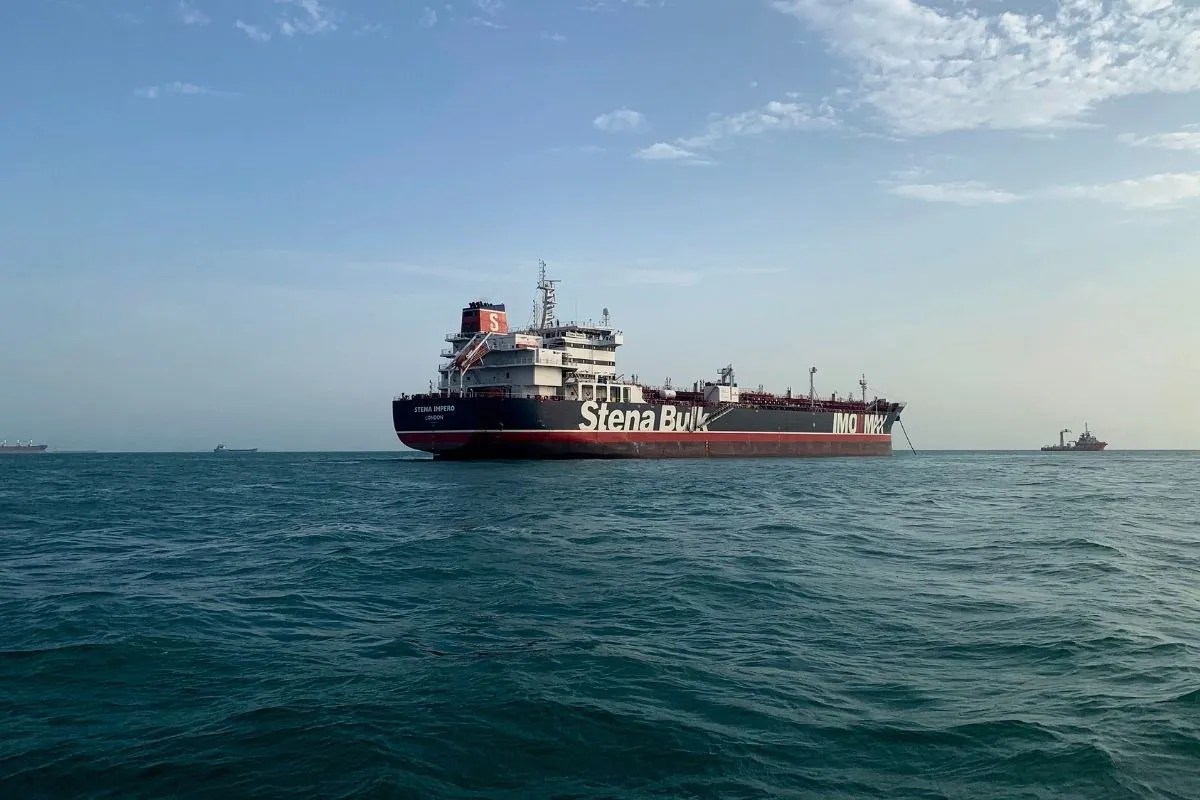
The sea has a memory. Deep beneath the turquoise shimmer of the Persian Gulf, where the heat is thick enough to chew and the silence is absolute, that memory is made of rusted steel and volatile chemicals. For decades, the world has looked at the Strait of Hormuz as a simple valve—a geographical choke point through which twenty percent of the world’s oil flows. We talk about it in terms of barrel prices, shipping lanes, and geopolitical chess moves. But for the men who command the massive tankers, those floating cities of iron, the Strait is no longer a map. It is a minefield.
A ceasefire is signed in a quiet room far away. Pens scratch against parchment. Diplomatic handshakes are captured for the evening news. On the surface, the war is over. Below the surface, however, the war is just beginning its long, silent vigil.
Reports are now surfacing that indicate Iran may have a terrifying problem: they have lost track of their own ghosts. Specifically, the naval mines they sowed during periods of high tension. These are not the sophisticated, GPS-tracked devices of modern cinema. They are often "dumb" mines—spheres of explosives designed to float, wait, and destroy. And according to intelligence assessments, Tehran might have forgotten exactly where they planted the seeds of this particular harvest.
The Ghost in the Machine
Imagine you are Captain Elias. You’ve spent thirty years at sea. You know the way the current pulls at the hull of a Very Large Crude Carrier (VLCC). You know that your ship, laden with millions of gallons of oil, cannot stop on a dime. It takes miles to arrest that much momentum.
As you enter the Strait, the air is salt-heavy and the sun is a blinding white coin. You are told there is peace. But you also know that a naval mine doesn’t care about a signed treaty. It doesn’t have a radio to receive the news of a ceasefire. It sits there, tethered to the seabed by a corroding chain, swaying in the dark currents like a heavy, metallic fruit.
The Iranian military, in its rush to fortify the Strait against perceived threats, utilized a variety of mining techniques. Some were sophisticated, but many were simple contact mines. The problem with simple tools is that they are prone to simple failures. Chains snap. Anchors drag in the shifting sands of the seafloor. What was once a documented hazard in Sector A has now drifted, invisible and unmoored, into the high-traffic shipping lanes of Sector B.
The report suggests that the record-keeping during the height of the tension was, at best, chaotic. When you are operating under the shadow of potential aerial bombardment, you don't always have the luxury of precise mapping. You drop the payload. You move on. Now, years later, the "peace" is haunted by these drifting legacies of a conflict that refuses to stay in the past.
The Economic Heartbeat
This isn't just a story about sailors and steel. It is a story about your morning commute. It is a story about the cost of the plastic in your keyboard and the heating in your home. The Strait of Hormuz is the jugular vein of the global economy.
If a single tanker—just one—hits a rogue mine tomorrow, the shockwave will travel faster than any physical blast. Within minutes, the algorithms on Wall Street will trigger. Oil futures will spike. The cost of maritime insurance will quadruple. Shipping companies will begin to reroute, adding weeks to voyages and billions to global logistics costs.
- The Scale of the Choke Point: At its narrowest, the shipping lanes in the Strait are only two miles wide.
- The Volume: Roughly 20 million barrels of oil pass through this gap every single day.
- The Risk: A sunken tanker doesn't just block the lane; it creates an environmental catastrophe that would take decades to clean, effectively shuttering the Strait for months.
When we talk about Iran "forgetting" where these mines are, we are talking about a loss of control over a global detonator. The Iranian Navy has the capability to lay mines, but their "sweeping" or clearing capability is a different matter entirely. Detecting a mine in the turbulent, murky waters of the Strait is like trying to find a specific needle in a haystack while someone is shaking the haystack and the lights are out.
The Technology of Terror
A naval mine is a patient hunter. A modern mine can be programmed to ignore small fishing boats but detonate when it detects the specific acoustic signature of a massive tanker’s engine. It can count. It can wait for the third ship in a convoy before it fires, knowing that the third ship is likely the most valuable or the most vulnerable.
However, the "dumb" mines—the ones Iran is reportedly struggling to track—are even more dangerous because they are indiscriminate. A rogue mine that has broken its mooring becomes a "drifter." It travels with the tide. It can end up in an Omani harbor or wedged against a pier in Dubai.
The Iranian government faces a humiliating paradox. To admit they have lost track of their mines is to admit to a lack of professional military discipline. To keep quiet is to risk an international incident that could reignite the very war they just agreed to stop. So, they remain in a state of nervous silence, watching the waters and hoping the currents are kind.
The Human Cost of an Invisible War
We often view these events through the lens of "The State" or "The Military." But the real weight is carried by the families of the merchant mariners. These are men and women from India, the Philippines, Russia, and the UK who sign on to these ships to provide for their children. They are not combatants. They are truck drivers on the water.
When a ship enters the Strait today, there is a palpable shift in the atmosphere on the bridge. The radar is tuned to its highest sensitivity. The lookouts are doubled. Everyone is looking for that one thing that doesn't belong—a dark shape bobbing in the trough of a wave, a glint of metal that shouldn't be there.
There is a psychological toll to sailing over a graveyard of unexploded ordnance. You are essentially playing a game of Russian Roulette where the cylinder takes days to spin. You feel every vibration of the engine in your teeth. Every time a piece of driftwood hits the hull, your heart stops. You realize that your life is dependent on the clerical accuracy of a revolutionary guardsman who might have been more concerned with finishing his shift than marking a GPS coordinate five years ago.
The reports claiming that the Strait won't "open" in the traditional sense after a ceasefire are technically correct, even if the gates are physically clear. A waterway is only truly open when it is safe. If the threat of a sudden, catastrophic explosion remains, the Strait is effectively a ghost town for the risk-averse.
The Shifting Sands
The seabed of the Persian Gulf is not a static floor. It is a desert of shifting dunes, moved by powerful underwater currents. A mine that was placed on a flat sandy plain in 2021 might be buried under six feet of silt by 2026. Or, conversely, a mine that was safely buried could be unearthed by a storm, its firing horns suddenly exposed to the passing world.
The task of clearing these waters is monumental. It requires specialized mine-countermeasure (MCM) vessels, side-scan sonar, and often, highly trained divers who must approach these rusted spheres with the delicacy of a diamond cutter. It is a slow, agonizing process. You don't clear a minefield; you manicured it, square meter by square meter.
Iran’s regional neighbors are rightfully terrified. Saudi Arabia, the UAE, and Oman all share these waters. A mine that drifts away from an Iranian coastal defense position becomes everyone's problem. It is a form of environmental and economic pollution that stays lethal for half a century.
Consider the reality of a "forgotten" mine. It is a weapon that outlives its purpose. It is a soldier that refuses to stand down. It sits in the dark, cold water, its internal components slowly corroding, its explosives becoming more unstable with every passing year. It waits for a touch. It waits for the pressure of a hull. It waits for the moment the peace becomes too comfortable.
The sun sets over the Strait of Hormuz, turning the water into a sheet of liquid gold. From the deck of a passing freighter, the world looks serene. There are no warships on the horizon. There are no jets screaming overhead. But a hundred feet below the keel, a rusted sphere of TNT sways gently in the tide, its tether straining, its memory of the war still perfectly intact. Peace is a fragile thing, but it is never more fragile than when it is floating just beneath the surface, waiting for a ship that has no idea it is being hunted.